Philippines breathing easier as Typhoon Lupit turns north
October 24, 2009 Philippines breathing easier as Typhoon Lupit turns north

Enlarge

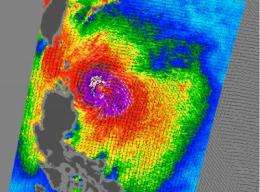
NASA's QuikScat measured Typhoon Lupit's rotating winds on October 22 at 0947 UTC (5:47 p.m. Local time Manila) by using microwaves to peer into the clouds. White barbs show direction of wind and point to areas of heavy rain. The highest wind speeds are normally shown in purple, which indicate winds over 46 mph. QuikScat noticed that Lupit's tropical storm-force winds extended as far as 135 miles from center of the storm. Credit: NASA JPL

Typhoon Lupit is giving residents of Luzon a break from facing the storm head on. The Luzon region of the Philippines still experienced rain and gusty winds, but the storm didn't and won't make landfall there.

Lupit, called "Ramil" in the , turned north on Friday, October 23, and is forecast to move northeast, while staying at sea and tracking to the east of Taiwan over the weekend. While on its northern track, cooler waters and wind shear will continue weakening the storm.

At 11 a.m. EDT or 11 p.m. local Asia/Manila Time, October 23, Lupit had near 55 knots (63 mph). It was located 345 miles north-northeast of Manila, near 19.8 North and 123.6 East. It was crawling north-northeast near 4 mph, but still generating 31-foot-high waves.

Despite the storm's turn to the north, warnings still abound in the Philippines for October 23. Public Signal 3 is in force in the following areas of Luzon: Babuyan, Calayan Islands and Batanes Group. Public Storm Warning Signal 2 is in force in the following areas of Luzon: Northern Cagayan, Ilocos Norte and Apayao. Public Storm Warning Signal 1 is in force in the following areas of Luzon: Ilocos Sur, Abra, Kalinga.

NASA's Quick Scatterometer satellite (QuikScat) observed Lupit's winds by using microwaves to peer into the clouds. QuikScat can determine the speed of the rotating winds within the storm at the surface of the ocean.
Philippines breathing easier as Typhoon Lupit turns north
Enlarge

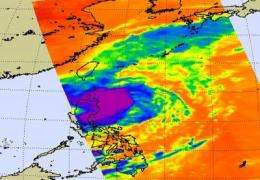
The AIRS instrument on NASA's Aqua satellite captured an infrared image of Typhoon Lupit at 12:47 p.m. local time October 23. Infrared imagery revealed that the deep convection located over the low-level center of circulation has become fragmented and disorganized. The coldest cloud tops are cold as or colder than 220K (Kelvin) or minus 63F. The blue areas are around 240K, or minus 27F. Credit: NASA JPL, Ed Olsen

NASA's QuikScat measured Typhoon Lupit's winds on October 22 at 0947 UTC (5:47 p.m. Local time Manila) by using microwaves to peer into the clouds. QuikScat can determine the speed of the rotating winds. White barbs show direction of wind and point to areas of heavy rain. The highest wind speeds are normally shown in purple, which indicate winds over 40 knots (46 mph). QuikScat noticed that Lupit's tropical storm-force winds extended as far as 135 miles from center of the storm.

Data from the Atmospheric Infrared Sounder (AIRS), an instrument that flies aboard NASA's Aqua satellite captured an infrared image of Typhoon Lupit at 12:47 p.m. local Manila time October 23. Infrared imagery revealed that the deep convection located over the low-level center of circulation has become fragmented and disorganized.

Because AIRS infrared images show the temperature of the cloud tops, scientists can tell how strong the thunderstorms are that make up the tropical cyclone. The highest clouds have the coldest temperatures. In fact, they can be as cold or colder than 220 degrees Kelvin (K) or minus 63 degrees Fahrenheit (F). Lower clouds are as cold as 27F (240K). There are still some very high, strong thunderstorms around Lupit's center of circulation. The data from AIRS is also used to create an accurate 3-D map of atmospheric temperature, water vapor and clouds, all of which are also helpful to forecasters.

Forecasters at the U.S. Navy's Joint Typhoon Warning Center also looked at water vapor imagery, and noticed that an upper level mid-latitude jet stream has been affecting the northwestern quadrant of Lupit in a way that's detrimental to the storm. The jet stream is bringing in dry air to the mid-and-upper levels of the storm, which is weakening it as it moves north.

Although Lupit is turning north, it's expected to continue crawling at a slow pace, which means a longer duration of rain over northern Luzon this weekend. Eventually it will pull far enough away so that the fringes of the let Luzon start drying out.

Source: JPL/NASA (news : web)


Rate this story - not rated yet


October 24, 2009 all stories

Comments: 0

not rated yet

  • hide
  • Related Stories


  • hide
  • Relevant PhysicsForums posts

  • Carbon Dioxide emissions question
    created Feb 08, 2010
  • Photosynthesis vs. carbonization
    created Feb 07, 2010
  • Sheep's footprints
    created Feb 05, 2010
  • How did Victorians estimate the ages of fossils?
    created Feb 03, 2010
  • How can we defeat pollution as individuals?
    created Jan 29, 2010
  • Formation of lava fields on Lanzarote
    created Jan 27, 2010
  • More from Physics Forums - Earth

Other News

Climate 'Tipping Points' May Arrive Without Warning, Says Top Forecaster

Space & Earth / Environment

created 5 hours ago | popularity 3 / 5 (4) | comments 5 | with audio podcast

(PhysOrg.com) -- A new University of California, Davis, study by a top ecological forecaster says it is harder than experts thought to predict when sudden shifts in Earth's natural systems will occur -- a worrisome finding ...


Rho Ophiuchus cloud

Professor: We have a 'moral obligation' to seed universe with life

Space & Earth / Astronomy

created 17 hours ago | popularity 3.3 / 5 (22) | comments 47 | with audio podcast report

(PhysOrg.com) -- Eventually, the day will come when life on Earth ends. Whether that’s tomorrow or five billion years from now, whether by nuclear war, climate change, or the Sun burning up its fuel, the last ...


38 percent of world's surface in danger of desertification

38 percent of world's surface in danger of desertification

Space & Earth / Environment

created 2 hours ago | popularity 2.3 / 5 (3) | comments 4

A team of Spanish researchers has measured the degradation of the planet's soil using the Life Cycle Assessment (LCA), a scientific methodology that analyses the environmental impact of human activities, and ...


A new 3-D map of the interstellar gas within 300 parsecs from the sun

A new 3D map of the interstellar gas within 300 parsecs from the Sun

Space & Earth / Astronomy

created 8 hours ago | popularity 5 / 5 (4) | comments 0 | with audio podcast

(PhysOrg.com) -- Astronomy & Astrophysics is publishing new 3D maps of the interstellar gas in the local area around our Sun. A French-American team of astronomers presents new absorption measurements toward ...


URI researcher calls for global effort to monitor marine pollutants

Space & Earth / Environment

created 6 hours ago | popularity 3 / 5 (2) | comments 1

A University of Rhode Island researcher who studies chemical pollutants in the marine environment has called on colleagues around the world to establish a global monitoring network to verify that the chemicals banned by the ...