From ecological Soviet-era ruin, a sea is reborn
(AP) -- Standing on the shore under the relentless Central Asian sun, Badarkhan Prikeyev drew on a cigarette and squinted into the distance as one fishing boat after another returned with the day's catch.
Until recently, this spot where the fish merchant was standing, in a man-made desert at the edge of nowhere, represented one of the world's worst environmental calamities.
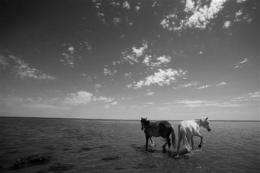
Now fresh water was lapping at his boots, proclaiming an environmental miracle - the return of the Aral Sea.
The Aral Sea was once the world's fourth-largest body of fresh water, covering an area the size of Ireland. But then the nations around it became part of the Soviet Union. With their passion for planned economics and giant, nature-reversing projects, the communists diverted the rivers that fed the inland sea and used them to irrigate vast cotton fields. The result: The Aral shrank by 90 percent to a string of isolated stretches of water.
The catastrophe "is unprecedented in modern times," says Philip Micklin, a geography professor at Western Michigan University who has studied the Aral Sea for years.
And even now, nearly two decades after the Soviet Union broke up, the damage is far from reversed. Satellite images taken earlier this year show that one section of the sea has shrunk by 80 percent in the last three years alone. Uzbekistan, which controls three-quarters of the Aral Sea, has given up trying. The rescue has happened on Kazakhstan's portion, and it is striking.
Aralsk is a port that ended up 100 kilometers (60 miles) inland. But now, a dam built by the World Bank and Kazakh government is slowly resurrecting a small part of the sea, reviving the fishing industry and bringing hope to an area that some expected would simply dry up and blow away in the fierce, salty winds.
The returning water has crept to within 25 kilometers (15.5 miles) of Aralsk, also known as Aral, and the World Bank reckons it could reach the port in about six years.
Kazakhs can hardly wait. "Good News - The Sea is Coming Back," declares a sign at the entrance to Aralsk.
In some areas, the water is already lapping at the derelict hulls of ships that were stranded deep inland, heightening the ghostly and surreal aura of the landscape.
"Finally, there is hope and a life to be made here." said Prikeyev, 49, waiting for his fishermen near the village of Akespe, 90 kilometers (55 miles) west of Aralsk. "Work is available for anyone who wants it."
This summer his boats returned laden with heaving sacks of pike and carp.
The miracle is a small one compared with the damage that will probably never be undone. Uzbekistan has chosen to keep the lucrative cotton industry going, and to prospect for gas and oil under the exposed seabed.
But where the sea is being saved, the solution has proved elegantly simple.
The $88 million project launched in 2001 resulted in a dam to channel the precious waters of the Syr Darya river into the Kazakh section, rather than let them flow south and go to waste.
The five states of former Soviet Central Asia are in broad agreement about the need to coordinate use of the region's two life-giving rivers, the Amu Darya and Syr Darya. In practice, however, little concrete collaboration has been achieved, meaning certain death for large part of the sea.
The centerpiece of the Aral salvation project is the concrete Kokaral dam. It's an unremarkable-looking structure that can be walked across in less than a minute, but its impact has been dramatic.
The rising water level has noticeably cooled the climate and lowered salinity sufficiently to sustain freshwater fish.
According to the World Bank, the catch of freshwater fish reached around 2,000 tons in 2007, up from just 52 tons in 2004.
For the first time in years, many Kazakhs living near the Aral Sea feel they have a future.
"My father grew up in a fishing village and catching fish is what he did all his life," said Prikeyev, who oversees a crew of more than 100 fishermen and others during high season in summer.
After the sea began to dry up in the 1960s, Aral villages withered as people migrated to the cities for jobs. The surrounding region became a searing dust bowl and fishing, one the few sources of steady employment, collapsed. Prikeyev tried running a chain of small shops, failed and went back to fishing, only to find the fish disappearing.
The land became a desert, baking in the day, freezing at night. Salt blown inland by the wind off the exposed seabed unleashed a scourge of respiratory diseases in Kazakhstan and Uzbekistan.
The drying-out has severely damaged plant and animal life and created huge salt and dust storms that can travel 500 kilometers (300 miles), Micklin said in an e-mail interview.
The payoff was a bonanza of cotton to supply the Soviet market as well as Cuba and the communist countries of Europe. The fishermen paid the price. By the mid-1970s, Aral catches were down by about three-quarters from the roughly 40,000 tons before the drying. Eventually fishing on an industrial level ceased altogether.
As dead freshwater fish washed ashore, desperate Soviet authorities introduced the salt-resistant flounder, a squat bottom-feeder, to save the local fishing industry.
Now it's the flounders that are dying in the returning waters, while Prikeyev is selling his catch in Russia, Ukraine and Georgia and has his eye on wealthy western European consumers.
"The western Europeans like the pike because it is so lean," Prikeyev said, as he waited for returning fishermen near the village of Akespe.
"We Kazakhs need fat ones, like that one," he laughed, pointing at a freshly caught carp shimmering on the beach.
"My dream is to improve things for the fishermen, so that they can live and work a little more easily," Prikeyev said.
Local fishing cooperatives have received $2 million in Japanese aid to house the fishermen in mobile homes with electricity and phone lines, Prikeyev said.
The fish have to be driven by jeep on a bumpy half-hour ride across a blinding white expanse to be loaded onto refrigerator vans. But Prikeyev hopes to eliminate those daily trips by building a $25,000 walk-in refrigerator in a nearby village.
On the northern side of the Kokaral dike, migratory birds and seagulls circle over the waters, screeching and scanning for prey. A few carp slide over the brim of the dam. All will die in one of the isolated pockets of the southern sea.
Between the Aral's old coastline and the current one, a new ecosystem has taken root. Salt-encrusted seabed has become scrubland full of gophers, lizards, spiders, warthogs and roaming herds of camels.
The fleet of stranded boats, hulls rusting, wheelhouses cobwebbed, is thinning out, plundered by scrap metal dealers.
And hope is returning with the waters. Alexander Danchenko, a retired shipyard worker, feels it in the weather.
"When there was no sea, it felt like we were in a frying pan here in the middle of the desert," he said. "Now it's returning, sometimes you can feel a pleasant, cool breeze coming in from the south."
At Aralsk's port, disused cranes loom over open space strewn with garbage. Murat Sydykov, 70, a musician who lives in the city, says his mournful music is inspired by the fate of the sea, but he is optimistic it will one day play a happy tune again.
"When the sea returns to Aralsk," he said, "I will write a symphony and get an orchestra to play it by the shore."
©2009 The Associated Press. All rights reserved. This material may not be published, broadcast, rewritten or redistributed.


