NASA is 'go' for crucial rocket test
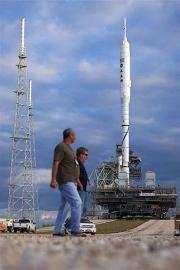
October 25, 2009 by Jean-Louis Santini NASA's Ares 1-X rocket rolled to launch pad 39-b at the Kennedy Space Center October 20, 2009 in Cape Canaveral, Florida

Enlarge

NASA's Ares 1-X rocket rolls out to launch pad 39-b at the Kennedy Space Center October 20, 2009 in Cape Canaveral, Florida. NASA is set to blast off a prototype rocket on Tuesday that carries hopes of returning humans to the Moon, and for the first time to Mars, despite deep uncertainty about the program's future.

NASA is set to blast off a prototype rocket on Tuesday that carries hopes of returning humans to the Moon, and for the first time to Mars, despite deep uncertainty about the program's future.

The space agency said everything is in order for Tuesday's two-minute, 30-second test of the Ares I-X rocket, a first look at the designed to replace NASA's aging fleet.

It is "an early opportunity to test and prove flight characteristics, hardware, facilities and ground operations associated with the Ares I," the space agency said.

Data will be collected from over 700 sensors spread across Ares I-X, providing a stream of information that will be scrutinized for months.

But more rides on the launch than data.

It is the culmination of three years work on Constellation, a human space flight program conceived by former president George W. Bush in the wake of the 2003 Columbia shuttle disaster that killed all seven crew onboard.

The program includes plans to create "Orion," the space shuttle's successor that by 2017 would carry astronauts into space in a bid to return to the moon and later make a first human trip to .

But an independent panel of experts threw cold water over Constellation's starry-eyed aspirations in a report to US President Barack Obama on Thursday, warning that needs three billion dollars a year more to meet its goals.

"The US human space flight program appears to be on an unsustainable trajectory" due to lack of funds, panel leader Norman Augustine, former president of aerospace giant , said in the 155-page report.

The 10-member-panel floated the idea of manned space flights to asteroids, and flyovers close to the and Mars, both projects that would not require complicated landing arrangements.

For Obama, who leads an increasingly cash-strapped nation, that may sound like a good option.

In the face of this uncertainty NASA scientists are trying to appear workman-like.

"The team is ready to go fly; the vehicle is ready to go fly," said Ares I-X launch director Ed Mango, estimating a 40 percent chance of favorable weather conditions for launch at 8:00 am (1200 GMT) from the Kennedy Space Center in Cape Canaveral, Florida.

Launch countdown preparations will begin on Monday and the actual countdown is scheduled to begin Tuesday at 1:00 am (0500 GMT).

NASA has one more launch window opportunity on Wednesday should stormy weather scuttle the launch plans.

Doug Cooke, associate administrator of NASA's Exploration Systems Mission Directorate, remained upbeat about the Ares prospects.

"This test is very important," he told reporters on Friday. "The data is important to us regardless of what comes next."

Only the first stage of Ares I-X -- a modified solid-fuel motor from the shuttle program -- will be tested, while the upper stage and capsule are mock ups.

The upper stage will plunge into the Atlantic Ocean after reaching a maximum altitude of 150,000 feet (45,720 meters).

The rocket measures 327 feet (99.6 meters) -- 33 feet (10 meters) taller than the Statue of Liberty in New York.

(c) 2009 AFP


print this article email this article download pdf blog this article bookmark this article     Stumble it Digg this share on Facebook retweet share on Reddit add to delicious
Rate this story - 4.4 /5 (7 votes)

Rank Filter

Move the slider to adjust rank threshold, so that you can hide some of the comments.


Display comments: newest first

  • TegiriNenashi - Oct 25, 2009
    • Rank: not rated yet
    Let me mention the obvious: with new technology, bags of meat in space are liability, not advantage.

    The shift to autonomous things happening everywhere. TV news stations buy unmanned helicopters with camera which do the same job at much lower costs. Next generation fighter aircrafts would be remote controlled. Human piloted deep sea exploration submarines become relic as well.

    In 20 years (timeframe for alleged future human Mars mission) robotics would advance even more to render human space exploration idea totally ridiculous. Who would have possibly imagine 20 years ago to be able to buy $30(!) mini helicopter and fly it in your living room?

  • IWCorpus - Oct 25, 2009
    • Rank: not rated yet
    In a response to the predictably lonesome author of the previous statement: It's thinking about human beings like 'bags of meat,' that has put our Mars exploration program 40 years behind schedule.

    Space flights routinely undergo repairable mechanical malfunctions. Human creativity has been the most advantageous cargo we've carried into space, and ever will.

    Please let authors like those of the above-statement play with their remote-controlled cars, while the rest of us move ahead with the exciting challenges of the human species.
  • probes - Oct 26, 2009
    • Rank: 3.5 / 5 (2)
    Why are NASA using a solid fuel booster? If they used a 1KW VASIMR motor they could get to the moon in about 39 seconds.
  • otto1923 - Oct 26, 2009
    • Rank: 5 / 5 (1)
    Mr meatbag;
    Humanity needs to spread itself around the system as quickly as possible which has been pointed out by Asimov?, ie eggs in one basket, et al. The universe is too dangerous and we are too rare [well-done?] to remain in one spot. Time to emigrate. We can explore as we go and take our robots with us ala humans on Phobos directing mars rovers in realtime, while prospecting themselves.

    Solid fuel boosters- I've been reading the report, they seem to be the most dependable alternative at present.
  • SteveL - Oct 26, 2009
    • Rank: 3.5 / 5 (2)
    When the space shuttle Challenger blew up, a co-worker exclaimed: "Good! If God had wanted us to be in space, He'd have put us there." Frankly, I wanted to hit him, but I didn't.

    Presently all of humanity's "eggs" are in this one basket. It's getting cramped on this rock and we are running low on resources. While we still have the ability to move into a bigger basket, I think we should. Robotics has its place in the space program, just as it does in industry. So do remotely operated vehicles. But the end goal should be to help humanity grow up and leave the cradle. Isn't it about time?

October 25, 2009 all stories

Comments: 5

4.4 /5 (7 votes)
  • Stumble this up

  • Digg this

  • share this

  • hide
  • Related Stories

  • NASA puts new Ares I-X rocket on launch pad for test flight
    created Oct 20, 2009 | popularity not rated yet | comments 0
  • First Rocket Parts Of NASA's New Launch System Arrive In Florida
    created Nov 04, 2008 | popularity not rated yet | comments 0
  • NASA Successfully Tests Parachute for Ares Rocket
    created Mar 02, 2009 | popularity not rated yet | comments 0
  • NASA selects Ares I upper state contractor
    created Aug 29, 2007 | popularity not rated yet | comments 0
  • Final Piece Of NASA's Next-Generation Rocket Heads To Launch Site
    created Mar 13, 2009 | popularity not rated yet | comments 0


  • hide
  • Relevant PhysicsForums posts

  • Doppler shifted blackbody spectrum
    created 2 hours ago
  • Earth v. Moon
    created 4 hours ago
  • help me with coordinates and orbits
    created 4 hours ago
  • basic 'our universe' question..
    created 14 hours ago
  • More from Physics Forums - General Astronomy

Other News

Astronauts gear up for 2nd spacewalk of mission (AP)

Astronauts gear up for 2nd spacewalk of mission

Space & Earth / Space Exploration

created 1hour ago | popularity 5 / 5 (1) | comments 0

(AP) -- An astronaut is gearing up for the first spacewalk of his career while awaiting the imminent birth of his daughter.


Cassini's Big Sky: The View from the Center of Our Solar System

Cassini's Big Sky: The View from the Center of Our Solar System

Space & Earth / Space Exploration

created 22 hours ago | popularity 4.7 / 5 (10) | comments 1

(PhysOrg.com) -- When NASA's Cassini spacecraft began orbiting Saturn five years ago, a dozen highly-tuned science instruments set to work surveying, sniffing, analyzing and scrutinizing the Saturnian system.


More than 18 million cubic metres of sand are set to be poured onto the new coastal band of dunes until 2011

Dutch build more dunes against rising seas

Space & Earth / Environment

created 18 hours ago | popularity 4.3 / 5 (6) | comments 0

On the beach at Monster, bulldozers painstakingly turn sand dredged from the bottom of the North Sea bed into dunes in an ambitious effort to safeguard the Netherlands from flooding.


New Method to Measure Snow, Soil Moisture With GPS May Benefit Meteorologists, Farmers

Space & Earth / Earth Sciences

created 17 hours ago | popularity not rated yet | comments 1

(PhysOrg.com) -- A research team led by the University of Colorado at Boulder has found a clever way to use traditional GPS satellite signals to measure snow depth as well as soil and vegetation moisture, a technique expected ...


Astronauts await word of baby girl on Earth (AP)

Astronauts await word of baby girl on Earth

Space & Earth / Space Exploration

created 19 hours ago | popularity 5 / 5 (1) | comments 0

(AP) -- Atlantis' astronauts anxiously awaited word on the birth of one crewman's daughter Friday, as they moved more supplies into the International Space Station and geared up for another spacewalk.