Internet 'a teenager' at 40
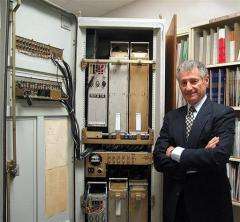
Leonard Kleinrock never imagined Facebook, Twitter, or YouTube that day 40 years ago when his team gave birth to what is now taken for granted as the Internet.
"We are constantly surprised by the applications that come along," Kleinrock told AFP as he and others at the University of California, Los Angeles (UCLA) prepared to throw the Internet a 40th birthday party on Thursday.
"It's a teenager now. It's learned some things but it has a long way to go. It's behaving erratically, but it's given enormous gratification to its parents and the community."
On October 29, 1969 Kleinrock led a team that got a computer at UCLA to "talk" to one at a research institute.
Kleinrock was driven by a certainty that computers were destined to speak to each other and that the resulting network should be as simple to use as telephones.
"I thought it would be computer to computer, not people to people," Kleinrock said in a nod to online social networking and content sharing that are hallmarks of the Internet Age.
"I never expected that my 99-year-old mother would be on the Internet like she was until she passed away."
A key to getting computers to exchange data was breaking digitized information into packets fired between on-demand with no wasting of time, according to Kleinrock.
He had outlined his vision in a 1962 graduate school dissertation published as a book.
"Nobody cared, in particular AT&T," Kleinrock said. "I went to them and they said it wouldn't work and that even if it worked they didn't want anything to do with it."
US telecom colossus AT&T ran lines connecting the computers for ARPANET, a project backed with money from a research arm of the US military.
Engineers began typing "LOG" to log into the distant computer, which crashed after getting the "O."
"So, the first message was 'Lo' as in 'Lo and behold'," Kleinrock recounted. "We couldn't have a better, more succinct first message."
Kleinrock's team logged in on the second try, sending digital data packets between computers on the ARPANET. Computers at two other US universities were added to the network by the end of that year.
"We had four-node network and tested the heck out of it," Kleinrock said. "We were able to break the network at will. It was very valuable to shake those things out early on."
Funding came from the US Advanced Research Projects Agency (ARPA) established in 1958 in response to the launch of a Sputnik space flight by what was then the Soviet Union.
US leaders were in a technology race with Cold War rival Russia.
Kleinrock's team ran a 15-foot cable between an Interface Message Processor device referred to by the acronym IMP and a "host" computer and tested sending data back and forth on September 2, 1969.
"That was the day this baby was born," Kleinrock said.
The National Science Foundation added a series of super computers to the network in the late 1980s, opening the online community to more scientists.
"The Internet was there, but it was not known to Joe Blow on the street," Kleinrock said.
The Internet caught the public's attention in the form of email systems in workplaces and ignited a "dot-com" industry boom that went bust at the turn of the century.
"The original plan was that it should be very creative, basically it should be like a sandbox," British professor Sir Tim Berners-Lee said of creating the World Wide Web in 1990.
Kleinrock pegs the launch of "the dark side of the Internet" to the 1988 release of the first malicious software "worm."
It was April of 1994 when the first spam email hit, according to the engineer.
"We started sending email back to those folks saying 'Stop it'," Kleinrock said.
"We sent so much email we crashed their computer. Inadvertently, the first spam email created the first denial-of-service response."
Kleinrock, 75, sees the Internet spreading into everything.
"The next step is to move it into the real world," Kleinrock said. "The Internet will be present everywhere. I will walk into a room and it will know I am there. It will talk back to me."
He also foresees intelligent software "agents" that do people's bidding online.
During an on-stage chat at a Web 2.0 Summit that ended Thursday in San Francisco, Berners-Lee said governments and big firms shouldn't meddle with the Web.
"I'm always worried, of course, about anything large coming in to take control," Berners-Lee said.
"Web technology itself should not tell you what's right and wrong; humanity has ways of doing that. It isn't the Wild West. The laws apply."
(c) 2009 AFP


