Mantis shrimps could show us the way to a better DVD
October 25, 2009 Mantis shrimps could show us the way to a better DVD

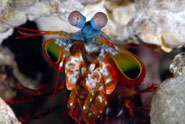
A mantis shrimp (Odontodactylus scyllarus) Photo by kind permission of Roy Caldwell, University of California, Berkeley

(PhysOrg.com) -- The remarkable eyes of a marine crustacean could inspire the next generation of DVD and CD players, according to a new study from the University of Bristol published today in Nature Photonics.

The mantis shrimps in the study are found on the in Australia and have the most complex vision systems known to science. They can see in twelve colours (humans see in only three) and can distinguish between different forms of polarized light.

Special light-sensitive cells in mantis shrimp eyes act as quarter-wave plates - which can rotate the plane of the oscillations (the polarization) of a light wave as it travels through it. This capability makes it possible for mantis shrimps to convert linearly polarized light to circularly polarized light and vice versa. Manmade quarter-wave plates perform this essential function in CD and DVD players and in circular polarizing filters for cameras.

However, these artificial devices only tend to work well for one colour of light while the natural mechanism in the mantis shrimp's eyes works almost perfectly across the whole - from near-ultra violet to infra-red.

Dr Nicholas Roberts, lead author of the paper said: "Our work reveals for the first time the unique design and mechanism of the quarter-wave plate in the mantis shrimp's eye. It really is exceptional - out-performing anything we humans have so far been able to create."

Exactly why the mantis shrimp needs such exquisite sensitivity to circularly isn't clear. However, polarization vision is used by animals for sexual signalling or secret communication that avoids the attention of other animals, especially predators. It could also assist in the finding and catching of prey by improving the clarity of images underwater. If this mechanism in the mantis shrimp provides an evolutionary advantage, it would be easily selected for as it only requires small changes to existing properties of the cell in the eye.

"What's particularly exciting is how beautifully simple it is," Dr Roberts continued. "This natural mechanism, comprised of cell membranes rolled into tubes, completely outperforms synthetic designs.

"It could help us make better optical devices in the future using liquid crystals that have been chemically engineered to mimic the properties of the cells in the mantis shrimp's eye."

This wouldn't be the first time humans have looked to the natural world for new ideas, for example the lobster's compound eye recently inspired the design of an X-ray detector for an astronomical telescope.

More information: A biological quarter-wave retarder with excellent achromaticity in the visible wavelength region by NW Roberts, T-H Chiou, NJ Marshall and TW Cronin. , http://www.nature.com/nphoton/index.html (DOI: 10.1038/nphoton.2009.189)

Source: University of Bristol (news : web)


print this article email this article download pdf blog this article bookmark this article     Stumble it Digg this share on Facebook retweet share on Reddit add to delicious
Rate this story - 4.9 /5 (18 votes)

Rank Filter

Move the slider to adjust rank threshold, so that you can hide some of the comments.


Display comments: newest first

  • Birthmark - Oct 25, 2009
    • Rank: 3.7 / 5 (3)
    natural mechanism in the mantis shrimp's eyes works almost perfectly across the whole visible spectrum - from near-ultra violet to infra-red.

    I heard about this animal on the science channel, and I was amazed at it's vision. I want to know what it would be like to see infa-red, I mean you couldn't even explain it.
  • Adrianrain - Oct 25, 2009
    • Rank: 1.7 / 5 (3)

    I heard about this animal on the science channel, and I was amazed at it's vision. I want to know what it would be like to see infa-red, I mean you couldn't even explain it.

    It is very easily explained. You need two things. 1 get a modern video camera (phone one will do) 2 get a remote control.

    Look at the end of the remote control where the infra-red light comes out from. Press some buttons and you will not see a thing. Now turn your camera on and look at it though the camera. You will see the end of the remote flashing red.

    Your camera can indeed see in infra-red. What your camera has done is taken all the really really red colours in the infra-red spectrum and lowered down to normal red so you can see them. If you could see infa-red normally you would just see a lot more red in your every day life. Hot air would have a red colour to and so would things that are so hot they look as if they start to go white.
  • rhuarch - Oct 26, 2009
    • Rank: 1 / 5 (1)
    Your camera can indeed see in infra-red. What your camera has done is taken all the really really red colours in the infra-red spectrum and lowered down to normal red so you can see them. If you could see infa-red normally you would just see a lot more red in your every day life. Hot air would have a red colour to and so would things that are so hot they look as if they start to go white.


    I don't think that's true. When you see an infrared representation like what you are describing, those colors are artificially applied so the image will make sense to someone who can't actually see that part of the spectrum. We only call it infrared because it is near the red part of the visible spectrum. If we could actually see it, it wold likely be a different color all together. After all, yellow is also near red on the visible spectrum. The only reason we don't call it ultra red is because we can actually see it.
  • TJ_alberta - Oct 26, 2009
    • Rank: 1 / 5 (1)
    it's true I just tried it. Thanks Adrianrain. Great way to check if the remote is working.
  • danman5000 - Oct 27, 2009
    • Rank: 2 / 5 (1)
    Right, we are incapable of seeing infared so while the camera is able to see infared it has to translate it into something that humans can see. Like how heat vision color codes pictures based on how hot they are - that doesn't mean that the infared spectrum is just another rainbow of colors, it's just translated into something we can make sense of. I would imagine actually being able to see infared radiation would make everything glow with an entirely new "color." It's sort of like how we can describe a hypercube, but it's impossible to visualize.

October 25, 2009 all stories

Comments: 5

4.9 /5 (18 votes)
  • Stumble this up

  • Digg this

  • share this

  • hide
  • Related Stories

  • Mantis shrimp vision reveals new way that animals can see
    created Mar 20, 2008 | popularity not rated yet | comments 0
  • Shrimps see beyond the rainbow
    created May 14, 2008 | popularity not rated yet | comments 0
  • No sunglasses required for fish supper
    created Oct 16, 2007 | popularity not rated yet | comments 0
  • Student Develops First Polarized LED
    created Mar 03, 2008 | popularity not rated yet | comments 0
  • Study: Squid are masters of disguise
    created Sep 25, 2006 | popularity not rated yet | comments 0


  • hide
  • Relevant PhysicsForums posts

  • avoidance of admitting that we dont know somethin
    created 6 hours ago
  • Speed of light : missing energy
    created 10 hours ago
  • Can light produce darkness and can noise procude quiteness 4
    created 12 hours ago
  • Magnetic Oscillation Equations
    created 18 hours ago
  • More from Physics Forums - General Physics

Other News

Restored machine to explore mysteries of Big Bang (AP)

Restored machine to explore mysteries of Big Bang

Physics / General Physics

created 10 hours ago | popularity 4.4 / 5 (12) | comments 6

(AP) -- Scientists are preparing the world's largest atom smasher to explore the depths of matter after successfully restarting the $10 billion machine following more than a year of repairs.


nuclear power plant

Doubts raised on nuclear industry viability

Physics / General Physics

created Nov 19, 2009 | popularity 3.2 / 5 (19) | comments 18

(PhysOrg.com) -- The investment in nuclear power has been growing around the world over the last few years, being viewed as a means for countries to control their energy security, avoid the price fluctuations ...


Researchers Find Innate Correlations Among Different Power Law Phenomena

Researchers Find Innate Correlations Among Different Power Law Phenomena

Physics / General Physics

created Nov 17, 2009 | popularity 4.3 / 5 (15) | comments 12

(PhysOrg.com) -- Studying the patterns that emerge in natural and social phenomena is a popular area of research, although usually individual phenomena are studied separately from each other. In a recent study, ...


Scientists demonstrate 'universal' programmable quantum processor

Scientists demonstrate 'universal' programmable quantum processor

Physics / Quantum Physics

created Nov 15, 2009 | popularity 4.6 / 5 (21) | comments 11

Physicists at the National Institute of Standards and Technology have demonstrated the first "universal" programmable quantum information processor able to run any program allowed by quantum mechanics -- th ...


Proton's party pals may alter its internal structure

Proton's party pals may alter its internal structure

Physics / General Physics

created Nov 18, 2009 | popularity 4.5 / 5 (19) | comments 9

A recent experiment at the DOE's Thomas Jefferson National Accelerator Facility has found that a proton's nearest neighbors in the nucleus of the atom may modify the proton's internal structure.