Disgraced cloning expert convicted in South Korea (Update)
October 26, 2009 By HYUNG-JIN KIM , Associated Press Writer
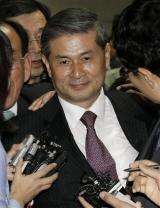
South Korean disgraced scientist Hwang Woo-suk arrives for his trial at the Seoul Central District Court in Seoul, South Korea, Monday, Oct. 26, 2009. The court prepared to deliver a verdict Monday in the trial of Hwang whose fraudulent claims of breakthroughs in stem cell research shook the international scientific community. (AP Photo/Ahn Young-joon)
(AP) -- A South Korean stem cell scientist once hailed as a hero for bringing hope to people with incurable diseases and creating the world's first cloned dog was convicted Monday on criminal charges related to faked research, but avoided jail.
The Seoul Central District Court sentenced Hwang Woo-suk to two years in prison for embezzling research funds and illegally buying human eggs. However, it suspended the penalty, allowing him to stay free if he breaks no laws for three years.
Prosecutors had asked for four years in prison, but Judge Bae Ki-yeol said the 56-year-old scientist had shown remorse and had notable achievements in dog cloning.
Hwang, who appeared confident as he walked into the courthouse, made no comment as he left. His lawyer, Yoo Chul-min, suggested in an interview with the YTN television network that he would not appeal, saying Hwang had been unable to concentrate on his research because of the "time-consuming" trial.
Prosecutors were not immediately available for comment late Monday.
The verdict was the culmination of a long fall from grace for a man once hailed as a pioneer in stem cell research.
Hwang gained worldwide fame in 2004 when he and his former colleagues at Seoul National University claimed in a paper published in the journal Science that they had created the world's first cloned human embryos - and had extracted stem cells from them.
A year later, Hwang's team also claimed in the journal that they had created human embryonic stem cells genetically matched to specific patients, a purported breakthrough that promised a way to withstand rejection by a patient's immune system.
Stem cell research is highly controversial, and Hwang had been the only South Korean scientist allowed to carry out studies on the master cells that scientists say could lead to revolutionary cures for hard-to-treat diseases such as Alzheimer's and Parkinson's.
The South Korean government showered him with lavish perks, designating him the country's first "top scientist," giving him generous research funds and assigning personal bodyguards and a diplomat to assist him with international contacts. Korean Air gave Hwang and his wife free first-class flights for a decade, calling the scientist a "national treasure."
But Hwang's reputation quickly eroded after questions about his claims led to an investigation by a university committee. It concluded that the 2005 paper was based on faked data, and also cast doubt on the previous findings. The journal, Science, retracted both papers.
The South Korean government stripped him of the right to conduct stem cell research and other privileges in 2006.
He was charged later that year with fraud for allegedly accepting some 2 billion won (about $2 million) in private donations under false pretenses. He also was accused of embezzling 800 million won (about $800,000) and buying human eggs for research in violation of South Korea's bioethics laws.
Hwang eventually admitted the data was faked but claimed he had been deceived by a fellow researcher.
The trial, which heard testimony from more than 60 witnesses, lasted more than three years. During an August hearing, Hwang pleaded for leniency, saying he was ready to "pour the last of my passion" into his research.
On Monday, Judge Bae dismissed the main fraud charge against him, saying it was difficult to believe Hwang intended to deceive donors to get funding.
Hwang, who with his Seoul National University team of scientists created the first known cloned dog, Snuppy, in 2005, has focused on cloning canines since being fired by the university and stripped of the right to conduct stem cell research.
Hwang still has a loyal following, with dozens of supporters rallying outside the court Monday and chanting "We trust Dr. Hwang."
"This is a dire matter for us," said Choi Bu-am, a polio victim who is a vice president of the Korea Culture Association for the Disabled. "We want the government to allow Hwang to resume his stem cell research."
©2009 The Associated Press. All rights reserved. This material may not be published, broadcast, rewritten or redistributed.
-
SKorea seeks jail for disgraced cloning scientist
Aug 24, 2009 |
not rated yet |
0
-
Disgraced Scientist to Resume Research
Jun 28, 2006 |
not rated yet |
0
-
Briefs: Korean scientist's research license voided
Mar 16, 2006 |
not rated yet |
0
-
Some vindication for S. Korean scientist?
Mar 13, 2006 |
not rated yet |
0
-
Hwang scandal hurt Korean scientists
Feb 21, 2007 |
not rated yet |
0
-
Engineers build first sub-10-nm carbon nanotube transistor
Feb 01, 2012 |
4.9 / 5 (32) |
30
-
Something old, something new: Evolution and the structural divergence of duplicate genes
Jan 31, 2012 |
4.6 / 5 (7) |
1
-
The hidden nanoworld of ice crystals: Revealing the dynamic behavior of quasi-liquid layers
Jan 30, 2012 |
5 / 5 (4) |
1
-
Stock market network reveals investor clustering
Jan 27, 2012 |
3.9 / 5 (23) |
8
-
Of microchemistry and molecules: Electronic microfluidic device synthesizes biocompatible probes
Jan 26, 2012 |
5 / 5 (2) |
0
-
Factors affecting beet root cell membrane
6 hours ago
-
Stem cell question.
Feb 10, 2012
-
Protease cleavage
Feb 10, 2012
-
Pertubance in a model
Feb 10, 2012
-
Cancer drugs and Alzheimer's, Oh my!
Feb 09, 2012
-
Squishing cells
Feb 09, 2012
- More from Physics Forums - Biology
More news stories
A mitosis mystery solved: How chromosomes align perfectly in a dividing cell
Although the process of mitotic cell division has been studied intensely for more than 50 years, Whitehead Institute researchers have only now solved the mystery of how cells correctly align their chromosomes during symmetric ...
1 hour ago |
5 / 5 (3) |
0
|
The proteins ensuring genome protection
Researchers from the University of Geneva (UNIGE), Switzerland, have discovered the crucial role of two proteins in developing a cell 'anti-enzyme shield'. This protection system, which operates at the level of molecular ...
1 hour ago |
5 / 5 (2) |
0
|
Researchers find extensive RNA editing in human transcriptome
In a new study published online in Nature Biotechnology, researchers from BGI, the world's largest genomics organization, reported the evidence of extensive RNA editing in a human cell line by analysis of RNA-seq data, demons ...
1 hour ago |
5 / 5 (3) |
0
|
Entire genome of extinct human decoded from fossil
(PhysOrg.com) -- In 2010, Svante Pääbo and his colleagues presented a draft version of the genome from a small fragment of a human finger bone discovered in Denisova Cave in southern Siberia. The ...
Feb 07, 2012 |
4.7 / 5 (58) |
48
|
Why are there so few fish in the Earth's oceans?
(PhysOrg.com) -- A Stony Brook University researcher has found that, contrary to popular belief, there are not plenty of fish in the sea.
Feb 08, 2012 |
4.3 / 5 (17) |
27
|
Scientists discover molecular secrets of 2,000-year-old Chinese herbal remedy
For roughly two thousand years, Chinese herbalists have treated Malaria using a root extract, commonly known as Chang Shan, from a type of hydrangea that grows in Tibet and Nepal. More recent studies suggest that halofuginone, ...
New method to examine batteries -- MRI from the inside
There is an ever-increasing need for advanced batteries for portable electronics, such as phones, cameras, and music players, but also to power electric vehicles and to facilitate the distribution and storage of energy derived ...
Lab study raises questions over nano-particle impact
Tests involving chickens have raised questions about the impact on health from engineered nano-particles, the ultra-fine grains commonly used in drugs and processed foods, scientists said on Sunday.
Google might launch Drive for cloud storage soon
(PhysOrg.com) -- Google's next big move, according to the Wall Street Journal, is a cloud storage service called Drive. Hardly first to the plate, Google is simply catching up to introducing its cloud reposi ...
Starve a virus, feed a cure? Findings show how some cells protect themselves against HIV
A protein that protects some of our immune cells from the most common and virulent form of HIV works by starving the virus of the molecular building blocks that it needs to replicate, according to research published online ...
Injured boomers beware: Know when to see doctor
(AP) -- It happened to nurse Jane Byron years after an in-line skating fall, business owner Haralee Weintraub while doing "men's" push-ups, and avid cyclist Gene Wilberg while lifting a heavy box.