Internet set for change with non-English addresses
October 26, 2009 By KELLY OLSEN , AP Business Writer
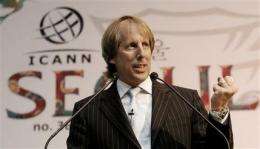
Rod Beckstrom, president and CEO of ICANN (Internet Corporation for Assigned Names and Numbers), delivers a speech during the opening ceremony of ICANN's 36th International Public Meeting in Seoul, South Korea, Monday, Oct. 26, 2009. (AP Photo/Ahn Young-joon)
(AP) -- The Internet is set to undergo one of the biggest changes in its four-decade history with the expected approval this week of international domain names - or addresses - that can be written in languages other than English, an official said Monday.
The Internet Corporation for Assigned Names and Numbers, or ICANN - the non-profit group that oversees domain names - is holding a meeting this week in Seoul. Domain names are the monikers behind every Web site, e-mail address and Twitter post, such as ".com" and other suffixes.
One of the key issues to be taken up by ICANN's board at this week's gathering is whether to allow for the first time entire Internet addresses to be in scripts that are not based on Latin letters. That could potentially open up the Web to more people around the world as addresses could be in characters as diverse as Arabic, Korean, Japanese, Greek, Hindi and Cyrillic - in which Russian is written.
"This is the biggest change technically to the Internet since it was invented 40 years ago," Peter Dengate Thrush, chairman of the ICANN board, told reporters, calling it a "fantastically complicated technical feature." He said he expects the board to grant approval on Friday, the conference's final day.
The Internet's roots are traced to experiments at a U.S. university in 1969 but it wasn't until the early 1990s that its use began expanding beyond academia and research institutions to the public.
Rod Beckstrom, ICANN's new president and CEO, said that if the change is approved, ICANN would begin accepting applications for non-English domain names and that the first entries into the system would likely come sometime in mid 2010.
Enabling the change, Thrush said, is the creation of a translation system that allows multiple scripts to be converted to the right address.
"We're confident that it works because we've been testing it now for a couple of years," he said. "And so we're really ready to start rolling it out."
Of the 1.6 billion Internet users worldwide, Beckstrom - a former chief of U.S. cybersecurity - said that more than half use languages that have scripts based on alphabets other than Latin.
"So this change is very much necessary for not only half the world's Internet users today, but more than half of probably the future users as the use of the Internet continues to spread," he said.
Beckstrom, in earlier remarks to conference participants, recalled that many people had said just three to five years ago that using non-Latin scripts for domain names would be impossible to achieve.
"But you the community and the policy groups and staff and board have worked through them, which is absolutely incredible," he said.
ICANN is headquartered in the United States in Marina del Rey, California.
©2009 The Associated Press. All rights reserved. This material may not be published, broadcast, rewritten or redistributed.


I would be OK with that decision as well, but I think forcing it on web servers in other countries goes a little far. Sure, it would be easier all around, but honestly as more and more electronics get 'plugged in' it will get more and more difficult to enforce.
I don't care *what* the universal language is (English, Spanish, Mandarin, Hindi... whatever), but fraking assign one already! Pick one and I'll learn it.
This multi-lingual crap has gone on long enough. It's detrimental to society as a whole.
There are no physical constraints to making web addresses based on whatever language... all gets translated into 1 & 0s ... and if a webpage can display all languages .. why shouldn't address bar?
As for confusion ... how many english speakers go to Chinese sites? and when you do what do you see? Chinese ... if you can read, you prob have fonts etc already.
As for the "The internet is supposed to break down barriers of language, culture and race" -- I really dont think Tim Berners-Lee had this in mind .. so what gives you that idea? .. all it does is breakdown communication borders .. nothing else.
In the end, with machine translation getting significantly better over time, it doesn't matter what language a site or domain name is.
It does not matter which language is universal... English is already there so it might as well be English. Who care where English came from.
This however might cause more confusion that good, and I am positive that this change is going to be exploited to hell and back by phishers and spammers.
Not to say it shouldn't be implemented, just that it will entail quite a number of problems as well.
As far as the universal language goes, I don't see anything wrong with there being one. I actually see a lot of things right with there being one and a campaign for one, because that would bridge a lot of gaps. Anti-globalization zealots are going to comment that this destroys culture, but i big to differ. Having one universal common language does by no means entail having no other or not speaking your native language in your native country.
I am Romanian, and incidentally, if I wouldn't have learned and loved English, I would be half the man I am today, financially, socially, mentally and any other llys.
f u can understd this line of tex ... then u no wat I mean...
few other languages are this flexible for understanding them quickly and without unecessary rules for the sake of rules alone to make them complex ... like most other languages (say like French which is full of unecessary rules and complexity).
The people that talk about English not being spoken by 80% of the planet is like saying we should not have any language... because 99.99999% of life on earth does not speak any language at all.
If non-latin alphabet using people have managed so far, why rock the boat? My guess is that the standard will be ratified and allowed, but it will take years (if ever) for all the software vendors to catch up, i.e. nobody will ever bother using it, just like what happened to IPv6.
It's a pattern we find throughout history.
Simply because in an ideal society (at least in my opinion) there should be one (or some very small number max) standard world language everyone would know, or learn in addition to their native language. English, being quite simple and widespread, is the logical choice.
As for the article, it is not about english or languages, but about other symbols than latin being allowed for domain names, so the headline is wrong.
OT, People who tend to blog about political or controversial issues across the planet tend to use English to: a) keep anyone who knows them from finding and recognizing their writings and b) to reach the widest possible audience for their thoughts. Saudis who blog in English tend to be far more liberal than Arabic blogging Saudis and when Russia invaded Georgia many Georgians started posting in English to get their side of the issue out. In addition to business, science, pop culture, tourism and most other fields, English is also the language of politics and debate.
This is already being done in Japan for their local domains (domain.co.jp, domain.jp, etc).
All those who don't know how to write kanji characters for a particular site will never see it! Except for maybe a google search. But would you click on a link that you can't read? Most likely not.
And romanized version of a domain is difficult for a non-English speaker to remember. Bet you would have problems remembering the domain: google.com if it was written in Katakana? You don't know what katakana is? Well that makes my point...
There are no Uzbek characters.
Mandarin uses Chinese characters. As do all the other languages/dialects spoken in China. A man from Shanghai usually doesn't understand the people in Hongkong - but they use the same Chinese characters with the same meaning. That's different from European languages which use the same Latin characters, but don't convey meaning with a single character.
When Georgia attacked South Ossetia, many South Ossetians started posting in Russian. You know why.
furthermore english while pervasive and widespread if you are speaking of number of people who speak a language then mandarin is the most used language in the world with over well over 1.5 billion speakers. English is less than half of this. And Spanish will out do english within 50 yrs. With Hindi as a close 4th.
Should we demand that english be the language of domainnames when it make no difference to anyone -- if you type with a russian alphabet use it the computer will translate thanks to a herd of programmers
and as for making programmers work more -- hey is a world wide RECESSION , we need the demand to go up so that IT can get paid and get a job if need be. Cut backs have been hard all over the world.
Oh, it will cause more than headaches. This is a phisher's wet dream come true. Expect to see cybercrime skyrocket. It's all too easy to use Unicode to spoof English-looking letters. And that's not even counting all the nice bugs this change will create for criminals to exploit. Internationalization tends to be added to software as an afterthough, i.e. when it's forced upon the programmer by some outside force like ICANN, and it's notoriously buggy as a result. As a programmer, I can tell you that most of us shudder at the mention of internationalization. I wasted literally months of my life at Amazon.com trying to clean up messes caused by other programmers adding internationalization as an afterthought -- including some exploitable bugs (no, I won't tell you what they were. ;-)
I18N is not the same thing as a non-Latin FQDN. I18N is difficult, yes, but you need it if your non-English customers are supposed to buy your application.
ICANN isn't your boss. ICANN doesn't force anybody; ICANN gives degrees of freedom to people who want it.
Software internationalization is defined as "adapting computer software to different languages and regional differences" -- see http://en.wikiped...ionalize
To modify Latin-only software to accept FQDNs of any language is to internationalize it. Basically, any time you dig around in the code adding calls to UTF functions (or whatever), you're internationalizing. And it's tricky, tedious, and dangerous. And, as you pointed out, it's often necessary.
No, they're not holding a gun up to my head forcing me to adhere to the standard. But if I want my software to sell, or to be interoperable, then I'd darn well better make it standards-compliant!
I do agree. But MS obviously not - for the sake of their profits.
The story of The Tower of Babel comes to mind.
Not really. Most of the 6000 languages and dialects on this planet are doomed as new generations prefer to speak a dominant language. Australia: 90 percent of the 250 languages will vanish. English is a death angel for these languages. Spanish and Portuguese are killing 20 percent of the South American languages. Are there still people speaking Mandan? Eyak? Ubykh? Iowa?
Is it really progress if the diversity of cultural identities is dwindling?