Scientists first to trap light and sound vibrations together in nanocrystal
October 26, 2009
Scientists first to trap light and sound vibrations together in nanocrystal

Enlarge

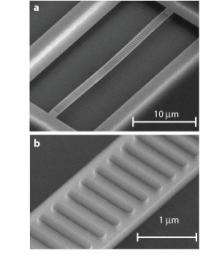
(At top) This is a scanning electron micrograph of the optomechanical crystal. (At bottom) This is a closer view of the device's nanobeam. Credit: M. Eichenfield, et. al., Nature, Advanced Online Publication (Oct. 18, 2009)

(PhysOrg.com) -- Researchers at the California Institute of Technology have created a nanoscale crystal device that, for the first time, allows scientists to confine both light and sound vibrations in the same tiny space.

"This is a whole new concept," notes Oskar Painter, associate professor of applied physics at Caltech. Painter is the principal investigator on the paper describing the work, which was published this week in the online edition of the journal Nature. "People have known how to manipulate , and they've known how to manipulate sound. But they hadn't realized that we can manipulate both at the same time, and that the waves will interact very strongly within this single structure."

Indeed, Painter points out, the interactions between sound and light in this device—dubbed an optomechanical crystal—can result in mechanical vibrations with frequencies as high as tens of , or 10 billion cycles per second. Being able to achieve such frequencies, he explains, gives these devices the ability to send large amounts of information, and opens up a wide array of potential applications—everything from lightwave communication systems to biosensors capable of detecting (or weighing) a single macromolecule. It could also, Painter says, be used as a research tool by scientists studying nanomechanics. "These structures would give a mass sensitivity that would rival conventional nanoelectromechanical systems because light in these structures is more sensitive to motion than a conventional electrical system is."

"And all of this," he adds, "can be done on a silicon microchip."

Optomechanical crystals focus on the most basic units—or quanta—of light and sound. (These are called photons and phonons, respectively.) As Painter notes, there has been a rich history of research into both photonic and phononic crystals, which use tiny energy traps called bandgaps to capture quanta of light or sound within their structures.

What hadn't been done before was to put those two types of crystals together and see what they are capable of doing. That is what the Caltech team has done.

"We now have the ability to manipulate sound and light in the same nanoplatform, and are able to interconvert energy between the two systems," says Painter. "And we can engineer these in nearly limitless ways."

The volume in which the light and sound are simultaneously confined is more than 100,000 times smaller than that of a human cell, notes Caltech graduate student Matt Eichenfield, the paper's first author. "This does two things," he says. "First, the interactions of the light and sound get stronger as the volume to which they are confined decreases. Second, the amount of mass that has to move to create the sound wave gets smaller as the volume decreases. We made the volume in which the light and sound live so small that the mass that vibrates to make the sound is about ten times less than a trillionth of a gram."

Eichenfield points out that, in addition to measuring high-frequency , the team demonstrated that it's actually possible to produce these waves using only light. "We can now convert light waves into microwave-frequency sound waves on the surface of a silicon ," he says.

These sound waves, he adds, are analogous to the light waves of a laser. "The way we have designed the system makes it possible to use these sound waves by routing them around on the chip, and making them interact with other on-chip systems. And, of course, we can then detect all these interactions again by using the light. Essentially, optomechanical crystals provide a whole new on-chip architecture in which light can generate, interact with, and detect high-frequency sound waves."

These optomechanical crystals were created as an offshoot of previous work done by Painter and colleagues on a nanoscale "zipper cavity," in which the mechanical properties of light and its interactions with motion were strengthened and enhanced.

Like the zipper cavity, optomechanical crystals trap light; the difference is that the crystals trap—and intensify—sound waves, as well. Similarly, while the zipper cavities worked by funneling the light into the gap between two nanobeams—allowing the researchers to detect the beams' motion relative to one another—optomechanical crystals work on an even tinier scale, trapping both light and sound within a single nanobeam.

"Here we can actually see very small vibrations of sound trapped well inside a single 'string,' using the light trapped inside that string," says Eichenfield. "Importantly, although the method of sensing the motion is very different, we didn't lose the exquisite sensitivity to motion that the zipper had. We were able to keep the sensitivity to motion high while making another huge leap down in mass."

"As a technology, optomechanical crystals provide a platform on which to create planar circuits of sound and light," says Kerry Vahala, the Ted and Ginger Jenkins Professor of Information Science and Technology and professor of applied physics, and coauthor on the Nature paper. "These circuits can include an array of functions for generation, detection, and control. Moreover," he says, "optomechanical crystal structures are fabricated using materials and tools that are similar to those found in the semiconductor and photonics industries. Collectively, this means that phonons have joined photons and electrons as possible ways to manipulate and process information on a chip."

And these information-processing possibilities are well within reach, notes Painter. "It's not one plus one equals two, but one plus one equals ten in terms of what you can do with these things. All of these applications are much closer than they were before."

"This novel approach to bringing both light and sound together and letting them play off of each other exemplifies the forward-thinking work being done by the Engineering and Applied Science (EAS) division," says Ares Rosakis, chair of EAS and Theodore von Kármán Professor of Aeronautics and Mechanical Engineering at Caltech.

More information: "Optomechanical crystals," Nature.

Source: California Institute of Technology (news : web)

4.5 /5 (19 votes)  

Filter


Move the slider to adjust rank threshold, so that you can hide some of the comments.


Display comments: newest first

holoman
Oct 26, 2009

Rank: 5 / 5 (1)
Ouch, Professor please tell me you have filed patents.

This is a major breakthru and I can see colossal applications already.
Dasan
Oct 26, 2009

Rank: 4 / 5 (1)
So does this mean that they can surpass fiber optics in electronics by a very significant speed by combining it with sound waves?

If thats so, then I agree with holoman. Fat Cash.
cedric
Oct 26, 2009

Rank: 5 / 5 (1)
I'm a layman with physics but I like thinking in pictures. It was mentioned that invention can create microwaves....and microwaves excite water (if I'm not mistaken). Isnt it then possible to have these chambers (many of them), have them activated by light and boil water to the point of being able to run a turbine; a new way of solar energy????
jimbo92107
Oct 27, 2009

Rank: not rated yet
So many directions this research can go... What happens if the walls of the cavities are tapered, rather than parallel? What are the effects of doping the surface materials? Could these cavities be used to speed up slow chemical reactions? Can this type of acoustic confinement allow phonons to form a coherent beam of sound energy?
megas08
Oct 27, 2009

Rank: not rated yet
@cedric. There is no need to build such expensive structures to transfer light into heat. A light absorbing pipe filled with water will do the trick.
fixer
Oct 27, 2009

Rank: 1 / 5 (1)
Confining light and sound, and releasing quickly?
Do I smell a new kind of weapon, Phasers anyone?
Better beam me up quick.
Auxon
Oct 28, 2009

Rank: not rated yet
So does this mean that they can surpass fiber optics in electronics by a very significant speed by combining it with sound waves?

If thats so, then I agree with holoman. Fat Cash.

I reading up on this research and the "zipper cavity" mentioned in the article above would do that. I quote: "... the zipper cavity could lead to applications in RF-over-optical communications and microwave photonics as well, where a laser source is modulated at microwave frequencies, allowing the signals to travel for kilometers along optical fibers. In such systems, the high-frequency mechanical vibrations of the zipper cavity could be used to filter and recover the RF or microwave signal riding on the optical wave."
http://www.physor...229.html
Auxon
Oct 28, 2009

Rank: not rated yet
I'm a layman with physics but I like thinking in pictures. It was mentioned that invention can create microwaves....and microwaves excite water (if I'm not mistaken). Isnt it then possible to have these chambers (many of them), have them activated by light and boil water to the point of being able to run a turbine; a new way of solar energy????

It might be able to be used to capture light and sound and convert that into electricity. Coat cars with that ... it would be more useful in cities than just solar panels, since there is more noise etc....
Auxon
Oct 28, 2009

Rank: not rated yet
Can this type of acoustic confinement allow phonons to form a coherent beam of sound energy?

The article says they can, "These sound waves, he adds, are analogous to the light waves of a laser." I read that this has been done in another way somewhere else ... they called it a Saser.
Rank 4.5 /5 (19 votes)
Related Stories
Relevant PhysicsForums posts
  • How physicists handle the idea of Free Will?
    created2 hours ago
  • Orbital Decay Question
    created3 hours ago
  • Pure energy
    created8 hours ago
  • How to remove the magnetic property for screw driver?
    created10 hours ago
  • How to magnetize a concrete wall?
    created15 hours ago
  • Upward speed of an object in water
    created16 hours ago
  • More from Physics Forums - General Physics

More news stories

Nanotube therapy takes aim at breast cancer stem cells

Wake Forest Baptist Medical Center researchers have again proven that injecting multiwalled carbon nanotubes (MWCNTs) into tumors and heating them with a quick, 30-second laser treatment can kill them.

Nanotechnology / Bio & Medicine

created 2 minutes ago | popularity not rated yet | comments 0 | with audio podcast

Inspired by steel, nanomanufacturing gets wear-resistant carbide tip

(PhysOrg.com) -- Scientists at the University of Pennsylvania, the University of Wisconsin-Madison and IBM Research - Zurich have fabricated an ultrasharp silicon carbide tip possessing such high strength ...

Nanotechnology / Nanophysics

created 5 hours ago | popularity 5 / 5 (1) | comments 0 | with audio podcast

New technology platform for molecule-based electronics

Researchers at the Nano-Science Center at the University of Copenhagen have developed a new nano-technology platform for the development of molecule-based electronic components using the wonder material graphene. At the same ...

Nanotechnology / Nanomaterials

created 2 hours ago | popularity 5 / 5 (2) | comments 0

Australians risking skin cancer to avoid nanoparticles

More than three in five Australians are concerned enough about the health implications of nanoparticles in sunscreens to want to know more about their impact. And while the initial scientific information released suggests ...

Nanotechnology / Bio & Medicine

created 3 hours ago | popularity 5 / 5 (1) | comments 0

New kind of solar cell could capture significantly more energy than current cells

New solar cells could increase the maximum efficiency of solar panels by over 25%, according to scientists from the University of Cambridge.

Nanotechnology / Nanophysics

created Feb 08, 2012 | popularity 4.3 / 5 (9) | comments 14 | with audio podcast


Secrets of immune response illuminated in new study

When disease-causing invaders like bacteria infect a human host, cells of various types swing into action, coordinating their activities to address the threat.

Touch screens create online shopping experiences at stores

Imagine browsing knife sets in an airport and then ordering one before you board your plane, or going to a department store to look at makeup without having to bounce from counter to counter to check out each brand's selection.

Genetic risks for type 2 diabetes span multiple ethnicities

A recent large and comprehensive analysis of 50,000 genetic variants across 2,000 genes linked to cardiovascular and metabolic function has identified four genes associated with type 2 diabetes (T2D) and six independent disease-associated ...

Digital photos could put kids at risk

A study published in the International Journal of Electronic Security and Digital Forensics this month suggests that parents and carers could be putting children at risk if they upload digital photos that are automatically "geota ...

Fuel from market waste

Mushy tomatoes, brown bananas and overripe cherries -- to date, waste from wholesale markets has ended up on the compost heap at best. In future it will be put to better use: Researchers have developed a new ...

University of Minnesota and start-up to develop antidote to cyanide poisoning

Cyanide poisoning is often fatal and typically affects victims of industrial accidents, terrorist attacks, or structural fires. Based on research conducted at the Center for Drug Design at the University of Minnesota, startup ...