Sperm may play leading role in spreading HIV
October 26, 2009
Sperm may play leading role in spreading HIV

Enlarge

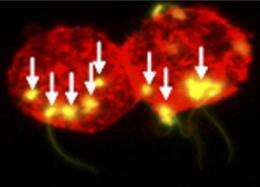
Spermatozoa (arrows) transmit HIV when they attach to dendritic cells (red). Credit: Ceballos, A., et al. 2009. J. Exp. Med. doi:10.1084/jem.20091579 .

Sperm, and not just the fluid it bathes in, can transmit HIV to macrophages, T cells, and dendritic cells (DCs), report a team led by Ana Ceballos at the University of Buenos Aires in Argentina. By infecting DCs, which carry the virus and potently pass it to T cells, sperm may play a leading role in spreading HIV. The article appears in the November 23, 2009 issue of the Journal of Experimental Medicine.

During , HIV-infected men transmit through their , which carries free-floating virus as well as HIV-infected leukocytes. Traces of HIV have been detected on as well, but the role they play in viral transmission has been a matter of debate. After all, men with vasectomies can transmit HIV. Now, Ceballos et al. show that HIV attaches to the surface of sperm and that these HIV carriers pass on the virus to DCs and other HIV targets.

Sperm express molecules known to interact with HIV's envelope, such as heparan sulfate and mannose receptors. The authors show that HIV relies on heparan sulfate to attach to sperm, but not mannose receptors as previously predicted.

Once attached, the virus was transmitted from sperm to DCs in culture. The DC receptors and DC-SIGN were required for transmission, suggesting that DCs pick up the virus by binding to sperm rather than by ingesting them. DCs matured after interacting with the sperm, producing tolerance-promoting cytokines like interleukin-10. The authors speculate that this immune-suppressing profile, versus an inflammatory profile, might also help the virus spread.

Sperm might reach DCs by passing through microabrasions in the vaginal or anal lining that often form during intercourse, suggest the authors. Or they might contact the finger-like projections of DCs that extend to the surface of mucosal linings. Furthermore, the team found that a slightly acidic pH, similar to the pH in the vagina after sex, promoted HIV-sperm binding and the subsequent rate of sperm-related DC infection.

More information: Ceballos, A., et al. 2009. J. Exp. Med. doi:10.1084/jem.20091579

Source: Rockefeller University (news : web)


Rank 5 /5 (1 vote)
Related Stories
Relevant PhysicsForums posts

More news stories

Complex wiring of the nervous system may rely on a just a handful of genes and proteins

Researchers at the Salk Institute have discovered a startling feature of early brain development that helps to explain how complex neuron wiring patterns are programmed using just a handful of critical genes. ...

Medicine & Health / Research

created 10 hours ago | popularity 4.9 / 5 (9) | comments 1 | with audio podcast

Team isolates nerve cells involved in storing long term memory and gene proteins associated with them

(Medical Xpress) -- A research team in Taiwan has succeeded in isolating two nerve cells in fruit fly brains that are believed to be the major players in allowing for the formation of long term memories. Furthermore, ...

Medicine & Health / Neuroscience

created 16 hours ago | popularity 5 / 5 (4) | comments 2 | with audio podcast report

Seeing colors in music, tasting flavors in shapes may happen in life's early months

Famed violinist Itzhak Perlman sees a deep forest green whenever he plays a B-flat on his Stradivarius' G string. The A on the E string is red.

Medicine & Health / Psychology & Psychiatry

created 17 hours ago | popularity 4.5 / 5 (2) | comments 2 | with audio podcast

Both maternal and paternal age linked to autism

Older maternal and paternal age are jointly associated with having a child with autism, according to a recently published study led by researchers at The University of Texas Health Science Center at Houston (UTHealth).

Medicine & Health / Psychology & Psychiatry

created 14 hours ago | popularity 4.3 / 5 (3) | comments 0 | with audio podcast

New understanding of DNA repair could eventually lead to cancer therapy

A research group in the Faculty of Medicine & Dentistry at the University of Alberta is hoping its latest discovery could one day be used to develop new therapies that target certain types of cancers.

Medicine & Health / Cancer

created 14 hours ago | popularity 4.8 / 5 (6) | comments 0 | with audio podcast


Anonymous knocks CIA website offline (Update)

The website of the Central Intelligence Agency was inaccessible on Friday after the hacker group Anonymous claimed to have knocked it offline.

Google users warned of threat to smartphone wallets

Users of Google smartphone wallets were being warned on Friday that there is a way to crack pass codes intended to thwart thieves from going on illicit shopping sprees.

New error-correcting codes guarantee the fastest possible rate of data transmission

Error-correcting codes are one of the triumphs of the digital age. They’re a way of encoding information so that it can be transmitted across a communication channel — such as an optical fiber o ...

Humans may have helped the decline of African rainforests 3000 years ago

(PhysOrg.com) -- Large areas of rainforests in Central Africa mysteriously disappeared over three thousand years ago, to be replaced by savannas. The prevailing theory has been that the cause was a change ...

New power source discovered

(PhysOrg.com) -- Researchers at the Massachusetts Institute of Technology (MIT) and RMIT University have made a breakthrough in energy storage and power generation.

Small modular reactor design could be a 'SUPERSTAR'

(PhysOrg.com) -- Though most of today's nuclear reactors are cooled by water, we've long known that there are alternatives; in fact, the world's first nuclear-powered electricity in 1951 came from a reactor ...