Ancient 'monster' insect offers Halloween inspiration
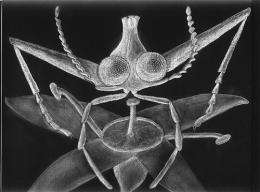
Just in time for Halloween, researchers have announced the discovery of a new, real-world "monster" - what they are calling a "unicorn" fly that lived about 100 million years ago and is being described as a new family, genus and species of fly never before observed.
A single, incredibly well-preserved specimen of the tiny but scary-looking fly was preserved for eternity in Burmese amber, and it had a small horn emerging from the top of its head, topped by three eyes that would have given it the ability to see predators coming. But despite that clever defense mechanism, it was apparently an evolutionary dead end that later disappeared.
"No other insect ever discovered has a horn like that, and there's no animal at all with a horn that has eyes on top," said George Poinar, Jr., a professor of zoology at Oregon State University who just announced the new species in Cretaceous Research, a professional journal.
"It was probably a docile little creature that fed on the pollen and nectar of tiny tropical flowers," Poinar said. "But it was really bizarre looking. One of the reviewers of the study called it a monster, and I have to admit it had a face only another fly could have loved. I was thinking of making some masks based on it for Halloween."
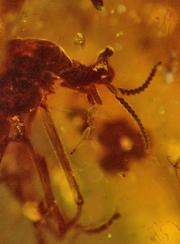
This fly lived in the jungles of Myanmar and was found trapped in amber that was from 97 to 110 million years old. The gooey, viscous tree sap that flowed down over the fly and later turned to stone preserved its features in lifelike detail, including its strange horn topped by three functional eyes.
"If we had seen nothing but the wings of this insect, it would have looked similar to some other flies in the family Bibionomorpha," Poinar said. "But this was near the end of the Early Cretacous when a lot of strange evolutionary adaptations were going on. Its specialized horn and eyes must have given this insect an advantage on very tiny flowers, but didn't serve as well when larger flowers evolved. So it went extinct."
Poinar named the new fly Cascoplecia insolitis - from the Latin "cascus" for old and "insolates" for strange and unusual.
The fly also had other very unusual characteristics, the study found, such as an odd-shaped antenna, unusually long legs that would have helped it crawl over flowers and extremely small vestigial mandibles that would have limited it to nibbling on very tiny particles of food.
Pollen grains found on the legs of the fly suggest that it primarily must have fed on flowers.
This fly lived during the time of the dinosaurs, but also in a period when Triassic and Jurassic species were becoming extinct, modern groups were appearing and angiosperms, or flowering plants, were diversifying. Some of the characteristics of the fly were common to other families found around that time, but others were extremely different - especially the horn with eyes on top.
The specimen found in amber was well-preserved, lacking only the rear left portion of the abdomen and a portion of the left hind leg. It's rare to find specimens with essentially a complete body as well as wings, scientists noted in the report. The fossil came from an amber mine in the Hukawng Valley of Myanmar, first excavated in 2001.
Poinar is an expert on insects and other life forms that have been preserved in amber, and has used them as clues to create detailed portraits of ancient ecosystems.
"None of the specialized body characters of Cascoplecia occurs on previously reported Cretaceous bibionids," the report concluded. "This 'unicorn' fly was one of the oddities of the Cretaceous world and was obviously an evolutionary dead end."
Unless, of course, it shows up once again as a scary looking Halloween costume - with wings, grasping claws, and a horn with three piercing eyes on top.
Source: Oregon State University (news : web)


