Test Detects Insect Carriers of Citrus Greening Disease
October 26, 2009 By Marcia Wood Test Detects Insect Carriers of Citrus Greening Disease

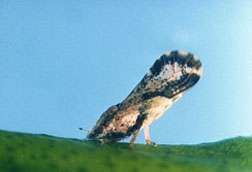
Adult Asian citrus psyllid. Photo courtesy of Jeffrey W. Lotz, Florida Department of Agriculture and Consumer Services, Bugwood.org

(PhysOrg.com) -- With their pleasing flavor, cheerful color, and health-imparting dose of vitamin C, it's not surprising that oranges are one of America's Top 10 favorite fruits. But some of the nation's citrus groves are threatened by a microbe that causes citrus greening disease, and by a tiny insect that carries this microbe.

To help protect citrus, Agricultural Research Service (ARS) plant pathologists Richard F. Lee and Keremane L. Manjunath developed a test that reveals whether tiny insects called Asian citrus psyllids are in fact carrying Candidatus Liberibacter asiaticus, one of three thought to cause the disease.

Developed over the past several years and reported in a 2008 article in the journal Phytopathology, the test is being used today by plant health officials in the United States and elsewhere.

Assaying psyllids may provide a way to detect citrus greening disease up to two years before symptoms become apparent in afflicted plants, according to the scientists. They're based at the ARS National Clonal Germplasm Repository for Citrus and Dates in Riverside, Calif.

First detected in the United States—in Florida—in 2005, citrus greening or citrus Huanglongbing disease (HLB) has already infected millions of citrus trees in that state, and has also shown up in Georgia, Louisiana and South Carolina.

Though not the first to detect HLB in Asian citrus psyllids, the assay apparently still is one of the newest of its kind to be based on what's known as "real-time qPCR" (short for "quantitative ") technology. The test is comparatively quick and relatively inexpensive, and can be performed by technicians working in any of the labs across the country that already handle PCR assays.

The scientists have used the assay to test more than 10,000 psyllids, Diaphorina citri, collected from orchards, backyards, retail nurseries and other venues in Florida where citrus plants are grown or sold.

The assay is one of the many accomplishments from ARS research laboratories nationwide that strengthen international food security—a top priority of the U.S. Department of Agriculture.

More information: Read more about the research in the October 2009 issue of Agricultural Research magazine.

Provided by USDA Agricultural Research Service


print this article email this article download pdf blog this article bookmark this article     Stumble it Digg this share on Facebook retweet share on Reddit add to delicious
Rate this story - not rated yet


October 26, 2009 all stories

Comments: 0

not rated yet
  • Stumble this up

  • Digg this

  • share this

  • hide
  • Related Stories

  • Yellowdragon threatens Florida citrus
    created Oct 15, 2005 | popularity not rated yet | comments 0
  • CALS genomicists aim to save citrus from 'greening'
    created Jul 17, 2009 | popularity not rated yet | comments 0
  • Scientists claim citrus originated in Australasia
    created Oct 01, 2007 | popularity not rated yet | comments 0
  • Graduate student discovers, names bacterium linked to psyllid yellows
    created Aug 12, 2008 | popularity not rated yet | comments 0
  • Calif. citrus farmers fear tree-killing disease
    created Oct 08, 2009 | popularity not rated yet | comments 0


  • hide
  • Relevant PhysicsForums posts

  • Super quick question about Starling forces?
    created 6 hours ago
  • Questions about diffusion
    created 12 hours ago
  • Human Leukocyte Antigen (HLA) typing
    created 18 hours ago
  • Breeding program
    created Nov 20, 2009
  • More from Physics Forums - Biology

Other News

The Monarchs' annual migration ritual has yet to be scientifically explained

Tree-eating bugs threaten Monarch butterfly in Mexico

Biology / Ecology

created 20 hours ago | popularity 4 / 5 (1) | comments 0

The mysterious Monarch butterfly, which migrates en masse annually between Canada and Mexico, is now facing a new peril: another insect thriving in Western Mexican forests.


Bigger not necessarily better, when it comes to brains

Bigger not necessarily better, when it comes to brains

Biology / Plants & Animals

created Nov 17, 2009 | popularity 4.5 / 5 (18) | comments 11

(PhysOrg.com) -- Tiny insects could be as intelligent as much bigger animals, despite only having a brain the size of a pinhead, say scientists at Queen Mary, University of London.


Extinct goat Myotragus balearicus

Extinct goat was cold-blooded

Biology / Plants & Animals

created Nov 18, 2009 | popularity 4.9 / 5 (33) | comments 10

(PhysOrg.com) -- An extinct goat that lived on a barren Mediterranean island survived for millions of years by reducing in size and by becoming cold-blooded, which has never before been discovered in mammals.


Right-handed chimpanzees provide clues to the origin of human language

Biology / Plants & Animals

created Nov 16, 2009 | popularity 3 / 5 (1) | comments 7

Most of the linguistic functions in humans are controlled by the left cerebral hemisphere. A study of captive chimpanzees at the Yerkes National Primate Research Center (Atlanta, Georgia), reported in the January 2010 issue ...


The creature was found at a depth of 161 metres

Japanese researchers film rare baby fish 'fossil'

Biology / Plants & Animals

created Nov 17, 2009 | popularity 4.7 / 5 (7) | comments 4

Japanese marine researchers said Tuesday they had found and successfully filmed a young coelacanth -- a rare type of fish known as "a living fossil" -- in deep water off Indonesia.