Ocean acidification may contribute to global shellfish decline
October 26, 2009 Ocean acidification may contribute to global shellfish decline

Enlarge

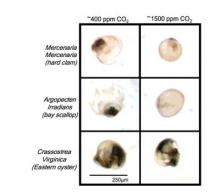
At the end of experiments (~20 days) larvae of the hard clam, bay scallop, and Eastern oyster that were raised in seawater with high carbon dioxide concentration (right column) were smaller and later to develop than larvae raised in seawater with carbon dioxide concentration matching current ocean levels (left column.) Credit: Stephanie Talmage

Relatively minor increases in ocean acidity brought about by high levels of carbon dioxide have significant detrimental effects on the growth, development, and survival of hard clams, bay scallops, and Eastern oysters, according to researchers at Stony Brook University's School of Marine and Atmospheric Sciences.

In one of the first studies looking at the effect of ocean acidification on shellfish, Stephanie Talmage, PhD candidate, and Professor Chris Gobler showed that the larval stages of these shellfish species are extremely sensitive to enhanced levels of carbon dioxide in seawater. Their work will be published in the November issue of the journal Limnology and and is now online.

"In recent decades, we have seen our oceans threatened by overfishing, harmful algal blooms, and warming. Our findings suggest ocean acidification poses an equally serious risk to our ocean resources," said Gobler.

During the past century the oceans absorbed nearly half of atmospheric carbon dioxide derived from human activities such as burning fossil fuels. As the ocean absorbs carbon dioxide it becomes more acidic and has a lower concentration of carbonate, which shell-making organisms use to produce their structures, such as the shells of shellfish.

In lab experiments, Talmage and Gobler examined the growth and survivorship of larvae from three species of commercially and ecologically valuable shellfish. They raised the larvae in containers bubbled with different levels of carbon dioxide in the range of concentrations that are projected to occur in the oceans during the 21st century and beyond.

Under carbon dioxide concentrations estimated to occur later this century, clam and scallop larvae showed a more than 50% decline in survival. These larvae were also smaller and took longer to develop into the juvenile stage. Oysters also grew more slowly at this level of carbon dioxide, but their survival was only diminished at carbon dioxide levels expected next century.

"The longer time spent in the larval stage is frightening on several levels," said Talmage. "Shellfish larvae are free swimming. The more time they spend in the water column, the greater their risk of being eaten by a predator. A small change in the timing of the larval development could have a large effect on the number of larvae that survive to the juvenile stage and could dramatically alter the composition of the entire population."

Although levels of carbon dioxide in marine environments will continue to rise during this century, organisms in some coastal zones are already exposed to high levels of carbon dioxide due to high levels of productivity and carbon input from sources on land.

"This could be an additional reason we see declines in local stocks of shellfish throughout history," said Talmage. "We've blamed shellfish declines on brown tide, overfishing, and local low-oxygen events. However it's likely that also contributes to shellfish declines."

Talmage and Gobler hope their work might help improve the success rate of shellfish restoration projects.

"On Long Island there are many aquaculturists who restock local waters by growing shellfish indoors at the youngest stages and then release them in local estuaries," said Talmage. "We might be able to advise them on ideal conditions for growth while larvae are in their facilities, and offer suggestions on release times so that conditions in the local marine environment provide the young shellfish the best shot at survival."

Source: Stony Brook University (news : web)


print this article email this article download pdf blog this article bookmark this article     Stumble it Digg this share on Facebook retweet share on Reddit add to delicious
Rate this story - 2.7 /5 (7 votes)

Rank Filter

Move the slider to adjust rank threshold, so that you can hide some of the comments.


Display comments: newest first

  • tpb - Oct 26, 2009
    • Rank: 3 / 5 (2)
    Quote:
    "They raised the larvae in containers bubbled with different levels of carbon dioxide in the range of concentrations that are projected to occur in the oceans during the 21st century and beyond."

    I hope this is a misrepresentation of the research.

    Bubbling CO2 into the water will give unrealistic levels of dissolved CO2 in the water.

    What was the actual increase of dissolved CO2 in the water as compared to "average" seawater at the depth the shellfish larvae normally grow.
  • GrayMouser - Oct 29, 2009
    • Rank: not rated yet
    This reeks of oversimplification.

October 26, 2009 all stories

Comments: 2

2.7 /5 (7 votes)
  • Stumble this up

  • Digg this

  • share this

  • hide
  • Related Stories

  • Regardless of global warming, rising CO2 levels threaten marine life
    created Mar 08, 2007 | popularity not rated yet | comments 0
  • Carbon dioxide poses risk to marine life survival
    created Aug 06, 2008 | popularity not rated yet | comments 0
  • Acidifying oceans add urgency to CO2 cuts
    created Jul 03, 2008 | popularity not rated yet | comments 0
  • Shellfish face an uncertain future in a high CO2 world
    created May 27, 2009 | popularity not rated yet | comments 0
  • CO2 emissions could violate EPA ocean-quality standards within decades
    created Sep 20, 2007 | popularity not rated yet | comments 0


  • hide
  • Relevant PhysicsForums posts

Other News

The shore of Deception Island in Antarctica, in 2008

Antarctic ice loss vaster, faster than thought: study

Space & Earth / Earth Sciences

created 5 hours ago | popularity 2.7 / 5 (9) | comments 6

The East Antarctic icesheet, once seen as largely unaffected by global warming, has lost billions of tonnes of ice since 2006 and could boost sea levels in the future, according to a new study.


Astronaut's baby daughter born as he circles Earth (AP)

Astronaut's baby daughter born as he circles Earth

Space & Earth / Space Exploration

created 5 hours ago | popularity 5 / 5 (1) | comments 0

(AP) -- Astronaut Randolph Bresnik jubilantly welcomed his new daughter into the world Sunday as he floated 220 miles above it.


Denmark: 65 world leaders for UN climate summit (AP)

Denmark: 65 world leaders for UN climate summit

Space & Earth / Environment

created 5 hours ago | popularity 1 / 5 (2) | comments 2

(AP) -- Sixty-five world leaders have said they will attend the Copenhagen climate summit in December, and several more have responded positively to invitations, Danish officials said Sunday.


Commuters wait on the platform shrouded by fog in London

Climate change not man-made, say majority of Britons: poll

Space & Earth / Environment

created Nov 15, 2009 | popularity 3.4 / 5 (16) | comments 46

Less than half of Britons believes that human activity is to blame for global warming, according to a poll carried out for The Times newspaper and published on Saturday.


Mysteriously warm times in Antarctica

Mysteriously warm times in Antarctica

Space & Earth / Earth Sciences

created Nov 18, 2009 | popularity 4.2 / 5 (21) | comments 31

(PhysOrg.com) -- A new study of Antarctica's past climate reveals that temperatures during the warm periods between ice ages (interglacials) may have been higher than previously thought. The latest analysis ...