Researchers identify dominant chemical that attracts mosquitoes to humans
October 26, 2009 mosquito

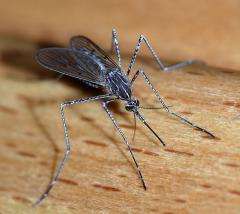
A female mosquito of the Culicidae family (Culiseta longiareolata). Image: Wikipedia

Scientists at the University of California, Davis, have identified the dominant odor naturally produced in humans and birds that attracts the blood-feeding Culex mosquitoes, which transmit West Nile virus and other life-threatening diseases.

The groundbreaking research, published this week in the early online edition of the , explains why mosquitoes shifted hosts from birds to humans and paves the way for key developments in mosquito and disease control.

Entomology professor Walter Leal and postdoctoral researcher Zain Syed found that nonanal (sounds like NAWN-uh-nawl) is the powerful semiochemical that triggers the mosquitoes' keen sense of smell, directing them toward a blood meal. A semiochemical is a chemical substance or mixture that carries a message.

"Nonanal is how they find us," Leal said. "The antennae of the Culex quinquefasciatus are highly developed to detect even extremely low concentrations of nonanal." Mosquitoes detect smells with the olfactory receptor neurons of their antennae.

Birds, the main hosts of mosquitoes, serve as the reservoir for the West Nile virus, Leal said. When infected mosquitoes take a blood meal, they transmit the virus to their hosts, which include birds, humans, horses, dogs, cats, bats, chipmunks, skunks, squirrels and domestic rabbits. Since 1999, the U.S. Centers for Disease Control and Prevention have recorded 29,397 human cases and 1,147 fatalities in the United States alone.

The UC Davis researchers tested hundreds of naturally occurring compounds emitted by people and birds. They collected chemical odors from 16 adult human subjects, representing multiple races and ethnic groups.

"We then determined the specificity and sensitivity of the olfactory receptor neurons to the isolated compounds on the antennae of the ," Syed said.

Leal and Syed found that nonanal acts synergistically with , a known mosquito attractant. "We baited mosquito traps with a combination of nonanal and carbon dioxide and we were drawing in as many as 2,000 a night in Yolo County, near Davis," Syed said. "Nonanal, in combination with carbon dioxide, increased trap captures by more than 50 percent, compared to traps baited with carbon dioxide alone."

Source: University of California - Davis


Rate this story - 4.8 /5 (18 votes)

Rank Filter

Move the slider to adjust rank threshold, so that you can hide some of the comments.


Display comments: newest first

  • tkjtkj - Oct 26, 2009
    • Rank: 5 / 5 (1)
    it would have been helful had the article said more about such an interesting chemical ..

    What other 'messages' does it communicate? Is it part of a collection of sex pheremones? Where is it made? How? Here's some answers:
    http://en.wikiped.../Nonanal
    Also called: nonanaldehyde ..fruity smell ...
    Seems its a chemical that's its also added to foods and to perfume!
  • Arikin - Oct 27, 2009
    • Rank: 5 / 5 (1)
    Hmmm... put the chemicals in the hollow center of a bug zapper. Come and get it, Zap!

    Or do they plan to mask our smelly semiochemical with a spray on? :-)
  • FerretPD - Oct 27, 2009
    • Rank: not rated yet
    I thought nonanol was a repellent...they didn't specify *which* type of nonanol...
    and I wonder when we'll see attractant baits for bbug zappers (I have a little list...)
  • david_42 - Oct 27, 2009
    • Rank: 5 / 5 (1)
    Nonanal, not nonanol.
  • FerretPD - Oct 28, 2009
    • Rank: not rated yet
    Well, *duh*. (wanders off, mumbling to himself: "One little letter...")

October 26, 2009 all stories

Comments: 5

4.8 /5 (18 votes)

  • hide
  • Related Stories

  • No more big stink: scent lures mosquitoes, but humans can't smell it
    created Aug 29, 2008 | popularity not rated yet | comments 0
  • Groundbreaking Research Shows DEET Not Sweet to Mosquitoes
    created Aug 18, 2008 | popularity not rated yet | comments 0
  • Mate-Seeking Fruit Flies Fooled by Silkworm Scent
    created Oct 24, 2006 | popularity not rated yet | comments 0
  • Wet or dry, Montana still threatened by West Nile
    created Jun 11, 2008 | popularity not rated yet | comments 0
  • Montana mosquito season is extended
    created Sep 14, 2006 | popularity not rated yet | comments 0


  • hide
  • Relevant PhysicsForums posts

Other News

New approach to treating breast and prostate cancers

Chemistry / Biochemistry

created 21 hours ago | popularity 2.5 / 5 (2) | comments 0

In a new approach to developing treatments for breast cancer, prostate cancer and enlarged hearts, Loyola University Chicago Stritch School of Medicine researchers are zeroing in on a workhorse protein called RSK.


Energy from light and water: New photocatalytic method for the clean production of hydrogen from water

Chemistry / Materials Science

created Feb 09, 2010 | popularity 4.6 / 5 (14) | comments 10 | with audio podcast

(PhysOrg.com) -- Hydrogen-powered fuel cells and solar energy are the best hope for a more environmentally friendly and resource-sparing energy supply in the future. A combination of the two is considered to be particularly ...


New research rejects 80-year theory of 'primordial soup' as the origin of life

Chemistry / Biochemistry

created Feb 02, 2010 | popularity 4.3 / 5 (36) | comments 29 | with audio podcast

For 80 years it has been accepted that early life began in a 'primordial soup' of organic molecules before evolving out of the oceans millions of years later. Today the 'soup' theory has been over turned in a pioneering paper ...


It looks, feels and tastes like chicken, but it's made of soy

It looks, feels and tastes like chicken, but it's made of soy

Chemistry / Biochemistry

created Feb 04, 2010 | popularity 4.5 / 5 (18) | comments 14 | with audio podcast

Sure, some delicacies might taste just like chicken, but they usually feel and look much different. Soy meat alternatives, such as the soy burger, have become more popular recently, with increased sales of ...


Compound could become important new antidepressant

Chemistry / Other

created Feb 04, 2010 | popularity 4.9 / 5 (11) | comments 7 | with audio podcast

Chemists at Oregon State University have discovered and synthesized a new compound that in laboratory and animal tests appears to be similar to, but may have advantages over one of the most important antidepressant medications ...