Where Did the Uranium Go?
October 26, 2009 Where Did the Uranium Go?

Enlarge

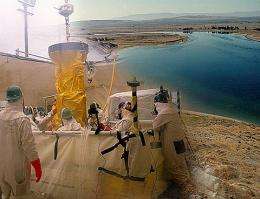
Research shows that the concentration of carbonate and the pH of the groundwater can slow uranium’s progress toward waterways.

(PhysOrg.com) -- Uranium's migration through the soil depends on groundwater's chemical composition, according to a recent study by Pacific Northwest National Laboratory. Scientists showed that uraniumattached to soil particles and moved slowly when the groundwater was at neutral pH and contained low levels of carbonate ion or dissolved carbon dioxide. Such conditions often occur at riverbanks when the river water rises and mixes with the groundwater. This work appeared in the September 1 issue of Environmental Science & Technology.

To control uranium's fate and transport, scientists must understand how fast attaches to and releases from particles under different chemical conditions. For example, at a former plutonium production site in southeastern Washington State, uranium-contaminated is moving toward the nearby Columbia River. Using the results of experiments and a mathematical model, scientists are learning how the river's changing levels slow uranium's movement.

The scientists began with uranium-contaminated sediment from an Integrated Field Research Challenge Site. This site is located on the southern tip of the Hanford Site, a former plutonium production site near the Columbia River in southeastern Washington State.

Then, they conducted experiments where they exposed the sediment to solutions with different pH, calcium, and carbonate levels. In these experiments, the sediment and solutions were constantly stirred.

The researchers found that uranium's detachment from the sediment was slowed when the groundwater's pH and carbonate concentration were decreased. The result implied that uranium release from the sediment will be slow where groundwater is diluted by river water with low levels of carbonate and at neutral pH, and will be much quicker at inland regions where groundwater contains high levels of carbonate and is more basic.

Next, the researchers used the experimental data to evaluate a mathematical model to describe the uranium absorption and desorption under variable chemical conditions. The model is designed based on the most advanced knowledge available. While the model provided a good description of the experimental results, discrepancies between the model and the experimental data exist.

Research is on-going to understand the fundamental theories behind the observed dependence of uranium adsorption and desorption on groundwater's . These theories will help improve or re-design the mathematical model.

More information: Liu C, Z Shi, and JM Zachara. 2009. "Kinetics of Uranium(VI) Desorption from Contaminated Sediments: Effect of Geochemical Conditions and Model Evaluation." Environmental Science & Technology 43(17):6560-6566. http://pubs.acs.org/journal/esthag

Provided by PNNL


print this article email this article download pdf blog this article bookmark this article     Stumble it Digg this share on Facebook retweet share on Reddit add to delicious
Rate this story - 4.5 /5 (4 votes)


October 26, 2009 all stories

Comments: 0

4.5 /5 (4 votes)
  • Stumble this up

  • Digg this

  • share this

  • hide
  • Related Stories

  • Cold Shot
    created Sep 12, 2006 | popularity not rated yet | comments 0
  • Where does stored nuclear waste go?
    created Nov 27, 2007 | popularity not rated yet | comments 0
  • Sophisticated monitoring array to address mystery of uranium plume
    created Sep 17, 2008 | popularity not rated yet | comments 0
  • Researchers Identify Problems in the Uranium Bioremediation Avenue
    created Mar 26, 2009 | popularity not rated yet | comments 0
  • Patience pays off with methanol for uranium bioremediation
    created Feb 23, 2009 | popularity not rated yet | comments 0


  • hide
  • Relevant PhysicsForums posts

  • Which countries around the world cause the most destruction to the rain forest
    created 2 hours ago
  • HadleyCru data hacked
    created Nov 20, 2009
  • Younger Dryas Caused by Ice Dam Collapse?
    created Nov 17, 2009
  • Modeling rainfall and flooding
    created Nov 15, 2009
  • More from Physics Forums - Earth

Other News

Astronauts finish another spacewalk, still no baby (AP)

Astronauts finish another spacewalk, still no baby

Space & Earth / Space Exploration

created 1hour ago | popularity 5 / 5 (1) | comments 0

(AP) -- A spacewalking astronaut put aside the impending birth of his daughter and blazed through his first-ever venture outside the International Space Station on Saturday.


Unseasonably hot and dry weather combined with strong winds to fan scores of blazes in the country's southeastern states

Australia issues 'catastrophic' alerts as fires rage

Space & Earth / Environment

created 7 hours ago | popularity 4 / 5 (1) | comments 0

Australia has issued "catastrophic" alerts after record-breaking temperatures and wild lightning storms sparked more than 100 fires across the country, officials said Saturday.


Commuters wait on the platform shrouded by fog in London

Climate change not man-made, say majority of Britons: poll

Space & Earth / Environment

created Nov 15, 2009 | popularity 3.3 / 5 (15) | comments 45

Less than half of Britons believes that human activity is to blame for global warming, according to a poll carried out for The Times newspaper and published on Saturday.


Mysteriously warm times in Antarctica

Mysteriously warm times in Antarctica

Space & Earth / Earth Sciences

created Nov 18, 2009 | popularity 4.3 / 5 (20) | comments 27

(PhysOrg.com) -- A new study of Antarctica's past climate reveals that temperatures during the warm periods between ice ages (interglacials) may have been higher than previously thought. The latest analysis ...


UN: Fight climate change with free condoms (AP)

UN: Fight climate change with free condoms

Space & Earth / Environment

created Nov 18, 2009 | popularity 3.1 / 5 (11) | comments 22

(AP) -- The battle against global warming could be helped if the world slowed population growth by making free condoms and family planning advice more widely available, the U.N. Population Fund said Wednesday.