LADEE Mission to Study the Moon's Fragile Atmosphere
Right now, the Moon is a ghost town. Nothing stirs. Here and there, an abandoned Apollo rover — or the dusty base of a lunar lander — linger as silent testimony to past human activity. But these days, only occasional asteroid impacts disrupt the decades-long spell of profound stillness.
And this stillness presents scientists with an important opportunity.
Currently, the Moon's tenuous atmosphere is relatively undisturbed. But that won't be true for long. NASA is planning to return people to the Moon, and human activity will kick up dust, expel rocket exhaust, and release other gaseous emissions into the lunar atmosphere. Because the atmosphere is so thin, these disturbances could quickly swamp its natural composition.
If scientists are ever to know the lunar atmosphere in a relatively natural state, now is the time to look. So researchers are building a probe called the Lunar Atmosphere and Dust Environment Explorer (LADEE) that will orbit the Moon and measure its wispy atmosphere better than ever before.
"It's important that we understand it in its pristine state before there's much perturbation," says Anthony Colaprete of NASA's Ames Research Center in Moffett Field, California. "It's such a fragile system. It's possible that it will be hard to study once humans are once more living and working on the Moon."
Thinner than thin
Right about now, you might be thinking to yourself: "Hold on a second. I thought the Moon doesn't have an atmosphere!" And you would be almost correct. The Moon's "atmosphere" is so tenuous that it's technically considered an exosphere, not an atmosphere.
"It's not anything like an atmosphere we would think of," Colaprete says. For example, a cubic centimeter of Earth's atmosphere at sea level contains about 100 billion billion molecules. That same volume of the Moon's exosphere contains only about 100 molecules.
In fact, that's so thin that molecules in the lunar exosphere almost never collide with each other. Rather than constantly ricocheting off each other to create a cohesive, swarming mass of molecules as happens in Earth's atmosphere, molecules in the lunar exosphere fly unimpeded, like microscopic cannon balls following curved, ballistic trajectories.
And the weirdness of the exosphere doesn't stop there. During the lunar night, the Moon's exosphere mostly falls to the ground. (Just imagine if our atmosphere fell to the ground at night!) When sunlight returns, the solar wind kicks up new particles to replenish the exosphere.
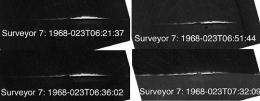
Also, intense ultraviolet sunlight kicks electrons off particles in the lunar soil, giving those particles an electric charge that can cause them to levitate. Ambient electric fields lift these charged dust particles as high as kilometers above the surface, forming an important part of the exosphere.
Lunar astronauts will have to live and work in this bizarre environment, so scientists want a better picture of the exosphere and its odd behaviors. Levitating dust can get into equipment, spacesuits, and computers, causing damage and shortening the hardware's useful life. In fact, moondust wrecked havoc with the Apollo spacesuits, which were nearly threadbare by the time they returned to Earth. Knowing how much dust is floating around in the exosphere and how it behaves will help engineers design next-generation lunar hardware.
After it launches in 2012, LADEE's spectrometers and dust detectors will measure the concentrations of 18 different chemicals in the exosphere, including methane and water vapor. These sensors will document how those chemicals vary, both from place to place and over time.
Beyond the inherent scientific value of understanding the chemical makeup of the Moon's exosphere, knowing how chemicals move within the exosphere could help answer a question of keen interest to future human habitants: How could the Moon have frozen reserves of water?
Evidence suggests that the Moon might harbor stores of ice in deep, dark polar craters. On the lunar surface, fierce sunlight would quickly sublimate any ice and the vapors would drift off into space. But a deep dark crater, combining unimaginable cold with an absence of sunlight, could provide a safe-haven for frozen water.
A popular idea is that icy comets brought water to the Moon in a series of ancient impacts. But there's a problem: Even if a comet landed in one of those dark polar craters by sheer luck, the heat of impact would evaporate most of the ice. So how could significant amounts of ice accumulate?
The Moon's exosphere could help.
Suppose a comet hits the Moon and leaves some H2O molecules on the exposed surface. That water could survive by, essentially, leaping to safety. Water molecules could "jump" across the lunar surface by escaping into the exosphere and later be recaptured by the surface as the exosphere breathes in and out. Individual water molecules could move around in this way until they land in one of the dark polar craters, where they would accumulate as solid ice.
Data from LADEE should show whether this "jumping" process works in a way that could explain how cometary ice could have found its way into those craters. "We can estimate the likelihood that the water on the Moon is cometary in origin," Colaprete says.
So much information from such a trifling amount of atmosphere! Stay tuned for results from LADEE.
Source: by Patrick Barry, Science@NASA


