New look for antiques: Paintings and gilt surfaces can be effectively and gently restored with water-based microemulsion
October 26, 2009 New look for antiques

Enlarge

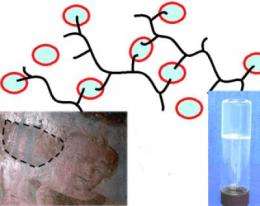
Oil-in-water nanocontainers within an aqueous polymer network were effective for the low-impact selective cleaning of painted and gilded surfaces. Interactions with the polymer (black in the schematic illustration) did not alter the structure of the microemulsion nanodroplets (light blue and red) significantly. A photograph of an equilibrated mixture of the microemulsion and the polymer is shown. Credit: (C) Wiley-VCH 2009

(PhysOrg.com) -- In the past, restoration of paintings and other old artwork often involved application of acrylic resins to consolidate and protect them. One of the most important tasks for modern restorers is thus to remove these layers, because it turns out that acrylic resins not only drastically change the optics of the treated artwork, but in many cases they accelerate their degradation.

Italian researchers working with Piero Baglioni at the University of Florence have now developed a technique to effectively remove such old polymer layers from sensitive historic artworks. As the researchers report in the journal Angewandte Chemie, the new cleaning system involves only a tiny proportion of . “We have demonstrated the first successful application of a water-based system for the removal of an organic layer from artwork,” says Baglioni. “In addition, our method is simpler and less invasive than traditional processes.”

The scientists use an oil-in-water microemulsion with the organic solvent para-xylene as the oil component. An emulsion is a fine dispersion of droplets of one liquid in another liquid with which the first is not miscible. One example from our daily lives is milk. A microemulsion is an emulsion that forms spontaneously and is stable. It contains substances that act as emulsifiers. Because the individual drops are only nanometer-sized, the mircoemulsion is not milky and opaque, but clear and transparent.

The Italian researchers embedded their micoremulsion in a matrix of a modified type of cellulose—a material used as a thickener for emulsion paints. The matrix makes the cleaning agent viscous, so that it cannot enter very far into the pores of a painting. Its activity is limited to the outer layer, whilst deeper layers of paint do not come into contact with the xylene. The environment is protected as well, because of the very low concentration of volatile solvent, the of which is further limited by the matrix. The optical transparency of the system also allows the restorer to continuously monitor the cleaning process.

“We successfully cleaned a mural from the 15th century,” reports Baglioni. This painting is located in the Santa Maria della Scala Sacristy in Siena. “It was covered with a 35 year old layer of acrylic from a previous restoration. Our new system allowed us to completely remove the undesirable shine. We were also able to clean another art work: a gilt frame from an 18th century painting.”

More information: Piero Baglioni, Nanoscience for Art Conservation: Oil-in-Water Microemulsions Embedded in a Polymeric Network for the Cleaning of Works of Art, International Edition, doi: 10.1002/anie.200904244

Provided by Wiley (news : web)


print this article email this article download pdf blog this article bookmark this article     Stumble it Digg this share on Facebook retweet share on Reddit add to delicious
Rate this story - 4 /5 (2 votes)


October 26, 2009 all stories

Comments: 0

4 /5 (2 votes)
  • Stumble this up

  • Digg this

  • share this

  • hide
  • Related Stories

  • Nanotechnology restores art masterpieces
    created May 15, 2007 | popularity not rated yet | comments 0
  • Nanomagnetic sponges to clean precious works of art
    created Sep 03, 2007 | popularity not rated yet | comments 0
  • Emulsion with a round-trip ticket
    created Jun 14, 2007 | popularity not rated yet | comments 0
  • Coming Soon: Blood Vessels from a Test Tube?
    created Jun 04, 2007 | popularity not rated yet | comments 0
  • Artificial Lotus Effect: Carbon nanotubes with nanoscopic paraffin coating form superhydrophobic, self-cleaning surfaces
    created Jul 23, 2008 | popularity not rated yet | comments 0


  • hide
  • Relevant PhysicsForums posts

  • More from

Other News

Accidental discovery produces durable new blue pigment for multiple applications

Accidental discovery produces durable new blue pigment for multiple applications

Chemistry / Biochemistry

created Nov 16, 2009 | popularity 4.5 / 5 (30) | comments 6

An accidental discovery in a laboratory at Oregon State University has apparently solved a quest that over thousands of years has absorbed the energies of ancient Egyptians, the Han dynasty in China, Mayan ...


One word: bioplastics

One word: bioplastics

Chemistry / Materials Science

created Nov 17, 2009 | popularity 4.5 / 5 (11) | comments 4

(PhysOrg.com) -- Every year, more than 250 billion pounds of plastic are produced worldwide. Much of it ends up in the world's oceans, a fact that troubles MIT biology professor Anthony Sinskey.


New on-off 'switch' triggers and reverses paralysis in animals with a beam of light

New on-off 'switch' triggers and reverses paralysis in animals with a beam of light (w/ Video)

Chemistry / Biochemistry

created Nov 18, 2009 | popularity 4.8 / 5 (5) | comments 3

In an advance with overtones of Star Trek phasers and other sci-fi ray guns, scientists in Canada are reporting development of an internal on-off "switch" that paralyzes animals when exposed to a beam of ultraviolet ...


New research provides blueprint for molecular basis of global warming

New research provides blueprint for molecular basis of global warming

Chemistry / Materials Science

created Nov 17, 2009 | popularity 4 / 5 (4) | comments 3

A new study indicates that major chemicals most often cited as leading causes of climate change, such as carbon dioxide and methane, are outclassed in their warming potential by compounds receiving less attention.


Ethanol

Microbes to Take Over Ethanol Production?

Chemistry / Biochemistry

created Nov 20, 2009 | popularity 3.8 / 5 (5) | comments 0

(PhysOrg.com) -- Not too long ago, it seemed that ethanol production was the wave of the future. The use of trash, wood chips or different types of plants -- usually grass or corn -- to make ethanol was considered ...