Nepotism has its benefits when it comes to survival
October 26, 2009 Nepotism has its benefits when it comes to survival

Enlarge

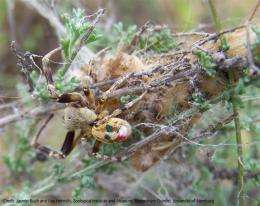
Stegodyphus tentoriicola

While nepotism may have negative connotations in politics and the workplace, being surrounded by your relatives does lead to better group dynamics and more cooperation in some animals. That certainly seems to be the case for spiders, according to a new study published in the open access journal BMC Evolutionary Biology.

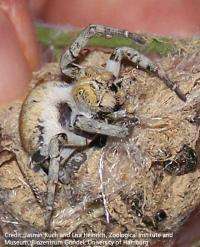
In an extensive study, the researchers found that Stegodyphus tentoriicola spiders are far more efficient at foraging for food and cooperate better when they're related to each other. Like with humans and other animals, relatedness may favour the evolution of less selfish behavior, more collaboration and better group dynamics.

Jutta Schneider and her students Jasmin Ruch and Lisa Heinrich from University of Hamburg, Germany, and Trine Bilde from Aarhus University, Denmark, organized spiders into different groups to collect food. While some groups were entirely made up of siblings, others included only non-siblings. Spiders working with their kin were more motivated to share with the other spiders, allowing them to consume their prey more quickly. The spiders that were related also worked more communally when foraging for food, which benefited the entire group.

This study shows that working with relatives also seems to be important for maintaining harmony as the size of a group increases. In larger groups, there is an increased tendency to reduce collaboration and exploit other group members so groups become more fractured, competitive and unproductive. This phenomenon is known as 'the tragedy of the commons'. However, social groupings of spiders composed of siblings were able to offset those self-destructive patterns and maintain a higher level of productivity.
Nepotism has its benefits when it comes to survival
Enlarge

Stegodyphus tentoriicola

"Stegodyphus spiders represent one of the few study systems of the evolution of cooperation with convincing empirical evidence for genuine kin discrimination as opposed to nest-mate recognition," says one of the authors, Jasmin Ruch.

As well as providing valuable information about the importance of family unity in survival, these findings offer hints about the future success of various social groups. Given that cooperation among relatives is common throughout the animal kingdom, groups consisting of relatives will be more likely to remain together and develop social structures to maintain more lasting groups. These findings strongly echo behavior in humans throughout history.

More information: Relatedness facilitates cooperation in the subsocial , Stegodyphus tentoriicola, Jasmin Ruch, Lisa Heinrich, Trine Bilde and Jutta M Schneider, (in press), http://www.biomedcentral.com/bmcevolbiol/

Source: BioMed Central (news : web)


print this article email this article download pdf blog this article bookmark this article     Stumble it Digg this share on Facebook retweet share on Reddit add to delicious
Rate this story - 4.5 /5 (6 votes)


October 26, 2009 all stories

Comments: 0

4.5 /5 (6 votes)
  • Stumble this up

  • Digg this

  • share this

  • hide
  • Related Stories

  • Black widows invade Romanian shore
    created Jul 06, 2007 | popularity not rated yet | comments 0
  • Caught in a trap: bumblebees vs. robotic crab spiders
    created Sep 04, 2008 | popularity not rated yet | comments 0
  • Spiders Who Eat Together, Stay Together
    created Aug 05, 2008 | popularity not rated yet | comments 0
  • 'Ballooning' spiders grounded by infection
    created Jun 19, 2009 | popularity not rated yet | comments 0
  • Mosquitoes supply spider with blood
    created Oct 11, 2005 | popularity not rated yet | comments 0


  • hide
  • Relevant PhysicsForums posts

  • What is transpulmonary pressure?
    created 8 hours ago
  • Is there a gay gene?
    created Nov 23, 2009
  • Super quick question about Starling forces?
    created Nov 22, 2009
  • Questions about diffusion
    created Nov 22, 2009
  • More from Physics Forums - Biology

Other News

A male flanged orangutan hangs from a tree in Malaysian Borneo's Sabah State

Malaysia tracks orangutans with implants

Biology / Plants & Animals

created 1hour ago | popularity not rated yet | comments 0

Malaysian wildlife authorities are using electronic implants to keep track of orangutans in a bid to protect the endangered apes after they are freed into the wild, an official said Tuesday.


A coating for life: Biodegradable fibers advance stent technology and brain surgery, then disappear

A coating for life: Biodegradable fibers advance stent technology and brain surgery, then disappear

Biology / Biotechnology

created 4 hours ago | popularity 5 / 5 (2) | comments 0

Stents that keep weakened and flabby arteries from collapsing have been true life-savers. But after six months, those stents are no longer needed -- once the arteries are strengthened, they become unnecessary. ...


Fish food fight: Fish don't eat trees after all, says new study

Fish food fight: Fish don't eat trees after all, says new study

Biology / Ecology

created 6 hours ago | popularity 4.5 / 5 (2) | comments 0

(PhysOrg.com) -- What constitutes fish food is a matter of debate. A high-profile study a few years ago suggested that fish get almost 50 percent of their carbon from trees and leaves, evidence for a very ...


Rocket science leads to new whale discovery

Rocket science leads to new whale discovery

Biology / Other

created 1hour ago | popularity not rated yet | comments 0

Rocket science is opening new doors to understanding how sounds associated with Navy sonar might affect the hearing of a marine mammal - or if they hear it at all.


Report shows dramatic decline in Siberian tigers

Report shows dramatic decline in Siberian tigers

Biology / Ecology

created 2 hours ago | popularity 5 / 5 (1) | comments 0

The Wildlife Conservation Society (WCS) announced today a report revealing that the last remaining population of Siberian tigers has likely declined significantly due to the rising tide of poaching and habitat ...