Particles are back in the LHC
October 26, 2009
Particles are back in the LHC

Enlarge

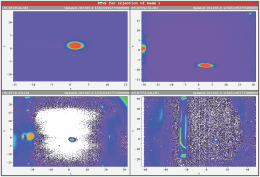
The first ion beam entering point 2 of the LHC, just before the ALICE detector (23 October 2009)

During the last weekend (23-25 October) particles have once again entered the LHC after the one-year break that followed the incident of September 2008.

Friday afternoon a first beam of ions entered the clockwise beam pipe through the TI2 transfer line. The beam was successfully guided through the ALICE detector until point 3 where it was dumped. The did not travel along the whole circumference of the LHC.

During the late evening on Friday, the first beam of protons also entered the LHC clockwise ring and travelled until point 3. In the afternoon of Saturday, protons travelled from the SPS through the TI8 transfer line and the LHCb experiment, until point 7 where they were dumped.

All settings and parameters showed a perfect functioning of the machine, which is preparing for its first circulating beam in the coming weeks.

CERN is preparing the for a restart in 2009. The first circulating beam of the year is likely to be injected in mid-November. This will be followed by a short period of collisions at the injection energy of 450GeV per beam and a ramp in energy to 3.5TeV per .

Following this, LHC physics will begin with collisions at this energy. The time from first injection to first high-energy collisions will be at least four weeks. However, the complexity of scheduling coupled with inevitable glitches in a machine of this complexity could lead to this process taking longer. The first high collisions will most likely occur at a date after mid-December 2009.

Provided by CERN

4.6 /5 (30 votes)  

Filter


Move the slider to adjust rank threshold, so that you can hide some of the comments.


Display comments: newest first

thematrix606
Oct 27, 2009

Rank: 3.5 / 5 (6)
Hurray! Go CERN, go! Prove for once and for all that there shall be no black hole!
frajo
Oct 27, 2009

Rank: 3.7 / 5 (6)
There are Black Holes. But not in the LHC.
I'm more interested in the tale of the Higgs.
Rank 4.6 /5 (30 votes)
Related Stories
Relevant PhysicsForums posts
  • How to remove the magnetic property for screw driver?
    created3 hours ago
  • How to magnetize a concrete wall?
    created7 hours ago
  • Physics behind Nerf Guns
    created7 hours ago
  • Upward speed of an object in water
    created8 hours ago
  • flipping quarks
    created9 hours ago
  • partial derivation question
    created9 hours ago
  • More from Physics Forums - General Physics

More news stories

Quantum physicist explains $100K offer for proof scaled-up quantum computing is impossible

(PhysOrg.com) -- MIT researcher Scott Aaronson has certainly riled the physics community with his offer this past Friday, of $100,000 to anyone who can prove that scaled-up quantum computing is impossible. ...

Physics / Quantum Physics

created 21 hours ago | popularity 4 / 5 (10) | comments 29 | with audio podcast weblog

Physicists build highly efficient 'no-waste' laser

A team of University of California, San Diego researchers has built the smallest room-temperature nanolaser to date, as well as an even more startling device: a highly efficient, "thresholdless" laser that ...

Physics / General Physics

created 16 hours ago | popularity 5 / 5 (17) | comments 3 | with audio podcast

Transparent iron? For the first time, an experiment shows that atomic nuclei can become transparent

At the high-brilliance synchrotron light source PETRA III, a team of DESY scientists headed by Dr. Ralf Röhlsberger has succeeded in making atomic nuclei transparent with the help of X-ray light. At the ...

Physics / General Physics

created 16 hours ago | popularity 5 / 5 (7) | comments 1 | with audio podcast

Unusual 'collapsing' iron superconductor sets record for its class

(PhysOrg.com) -- A team from the National Institute of Standards and Technology and the University of Maryland has found an iron-based superconductor that operates at the highest known temperature for a material ...

Physics / Superconductivity

created 20 hours ago | popularity 4.3 / 5 (3) | comments 2 | with audio podcast

Dutch team has solution for troubled ITER nuclear fusion reactor

(PhysOrg.com) -- The superconducting cables designed for the ITER fusion reactor (cost: 16 billion euros = $21.2 billion) are unable to withstand the planned forty to sixty thousand charge cycles. Barring a solution, the ...

Physics / General Physics

created 20 hours ago | popularity 5 / 5 (2) | comments 3


Amazing skin gives sharks a push

Shark skin has long been known to improve the fish's swimming performance by reducing drag, but now George Lauder and Johannes Oeffner from Harvard University show that in addition, the skin generates thrust, giving the fish ...

Fruit flies drawn to the sweet smell of youth

Aging takes its toll on sex appeal and now an international team of researchers led by Baylor College of Medicine and the University of Michigan find that in fruit flies, at least, it even diminishes the come-hither ...

Life in Antarctic lake? It's everywhere else

If scientists find microbes in a frigid lake two miles beneath the thick ice of Antarctica, it will illustrate once again that somehow life finds a way to survive in the strangest and harshest places.

New study shows high cost of defensive medicine

Vanderbilt University Medical Center researchers estimate that U.S. orthopaedic surgeons create approximately $2 billion per year in unnecessary health care costs associated with orthopaedic care due to the practice of defensive ...

Continental mosquito with 'vector' potential found breeding in UK after 60 year absence

A species of mosquito has been discovered breeding in the UK that has not been seen in the country since 1945. Populations of the mosquito, found across mainland Europe and known only by its Latin name Culex modestus, were r ...

Presdisposition to common heart disease 'passed on from father to son'

A common heart disease which kills thousands each year may be passed genetically from father to son, according to a study led by the University of Leicester.