INL scientist is harnessing the power of plasma
Most schoolchildren learn that everything in the universe is a solid, a liquid or a gas. But those lessons miss the fourth and by far most common state of matter: plasma.
Plasma is like a gas, but many of its atoms have been stripped of an electron or two. These positively charged atoms swim about in a crackling-hot sea of negatively charged loose electrons, making plasmas great electrical conductors.
Plasma is mysterious and powerful, the stuff of stars, of lightning. Scientists have harnessed it to make welding torches, fluorescent lights and bright, sharp big-screen TVs, as well as those glass novelty globes full of snaking purple current that make your hair stand on end when you touch them. But plasma can do more, much more, and Idaho National Laboratory's Peter Kong is giving the world a glimpse of its true potential.
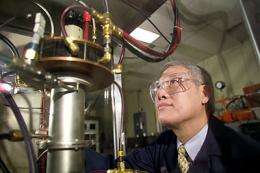
Kong, technical lead for plasma processing at INL, has built a career of putting plasma to work. He's using it to mass-produce nanoparticles, a project that in August received $1 million in federal stimulus funding. He's also employing plasma to find ways to store hydrogen efficiently, and he'll soon start a project using plasma to convert natural gas, coal and heavy oil to gasoline and diesel. These last two efforts could help the United States break its addiction to foreign oil and, perhaps, to fossil fuels altogether.
A nanoparticle factory
Kong, a quiet, affable man who keeps a pair of soccer shoes in his INL office, first started working with plasma as a doctoral student at the University of Minnesota, where he studied under one of the top experts in the field.
"I found plasma to be a very interesting subject," he says, "one that could be applied to a lot of areas other than welding, cutting or spraying."
One of these areas is the production of nanoparticles, bits of matter tens of thousands of times smaller than the diameter of a human hair. Because nanoparticles are so tiny, a high percentage of their constituent atoms are on their surfaces rather than hidden away inside. Surface interactions thus dominate the lives of nanoparticles, and as a result, nano-sized specks of a particular substance often have different physical and chemical properties than larger chunks. Scientists are just beginning to exploit nanoparticles, but they hold great promise in many applications, including anti-microbial and cancer-fighting drugs, stronger, corrosion-resistant materials and more efficient solar panels, fuel cells and batteries.
But nanoparticles can be difficult and expensive to make. Kong is hoping to change that with his unique Plasma Nanoparticle Fabricator, a man-sized conglomeration of cables and shiny steel that looks a bit like a robotic squid. Sand-size grains of material fed into the PNF get vaporized by a plasma arc exceeding 12,000 degrees Celsius, twice as hot as the surface of the sun. As the vapor exits the reactor's processing zone, the gas cools down so fast—a rate of 1 million degrees per second—that its atoms have very little time to glom together. Each atom clumps with only a few others, forming nanoparticles.
Other nanoparticle-production methods grind raw materials down, burn them up using fossil fuels or dunk them in various chemical baths. But Kong's PNF is a step above. It makes high-quality (very small and relatively uniform) nanoparticles more cheaply and can handle a wider range of raw materials. And, because it converts 100 percent of its feedstock to nanoparticles, it generates no byproducts. Other conventional plasma reactors can't come close to this conversion rate, which the PNF achieves with a much longer plasma arc. Also contributing are the higher, more uniform temperatures in the PNF's processing zones, and the fact that raw materials remain in these zones for longer periods of time.
At the moment, the PNF is in a pre-pilot stage. Kong and his team will use the newly awarded grant money to test and tweak the invention further. Within a couple of years, he hopes to build a bigger, more powerful version that is completely user-friendly, so that anyone can operate it with minimal training. And he wants the new, improved PNF to make even smaller, more uniform nanoparticles. This is possible, Kong says; he just needs to increase the velocity of the vapor coming out of the reactor, and cool it down faster—perhaps at 10 million degrees per second or even faster. He has ideas about how to do this but is not yet ready to discuss the details publicly.
Sometime in the coming year, Kong may also begin work on a more specialized version of the PNF. He has a proposal in to the U.S. Army to manufacture nanocomposite materials for lightweight armors. Nanomaterials have great protective potential; the fine grain, high surface area and many boundaries of nanoparticles can greatly diffuse a projectile's impact. And they can form more bonds with each other than can larger building blocks, generating more strength.
"The material I want to develop and produce will have multi-hit capability, up to large-caliber small arms, such as a sniper rifle," Kong says. It's possible his proposed nanocomposite armor could work against heavier projectiles, too, according to Kong, but such capabilities would require more work and more testing.
Kong's armor would contain layered composite materials made of lightweight metal and ceramic nanoparticles. His team would manufacture these composites with a new, special PNF. Using the existing, general-purpose PNF wouldn't work, because the production of such materials is tricky and cannot tolerate any cross-contamination. Kong thinks the Army will make a decision about his proposal sometime during the current fiscal year.
Cracking heavy hydrocarbons
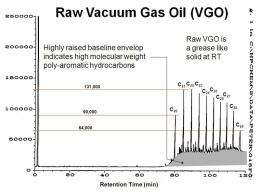
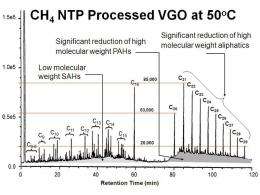
The PNF does not monopolize Kong's time. He recently signed on as a consultant to a large U.S.-based multinational corporation that wants to use microwave plasma to convert coal to liquid fuels such as gasoline and diesel. Kong brings a wealth of experience to the project. In the 1990s, he developed several plasma technologies to process hard-to-refine very heavy hydrocarbons, such as heavy crude oil, oil sands and oil shale. His methods activated natural gas into plasma, producing large amounts of hydrogen and super-reactive molecules called radicals. The radicals "cracked" heavy hydrocarbon molecules into lighter and shorter fragments, which then combined with the radicals and hydrogen atoms to form usable transportation fuels. Industry showed little interest in the technologies at the time, he says, because light, sweet crude — which is easier to process — was still abundant and cheap.
That's no longer the case. In 2005, an Exxon-Mobil spokesman told The Boston Globe, "All the easy oil and gas in the world has pretty much been found." As a result, oil companies are increasingly turning their attention to heavy hydrocarbons. Finding efficient ways to process them could aid the American push for energy independence. The U.S. has the world's largest deposits of oil shale, by some estimates the equivalent of 2 trillion barrels of oil — enough to last 280 years based on current consumption rates. According to Kong, his plasma technology is simpler and, perhaps, more cost- and energy-efficient than traditional refining processes. Oil companies may yet come calling.
"This technology could revolutionize the entire refinery structure," he says.
Storing hydrogen
Kong is also working with a large multinational chemical company to find better ways to store hydrogen. Hydrogen, many researchers believe, has great potential to power vehicles, appliances and other devices. Further, it could help carry and convert energy generated by intermittent renewable sources like wind and solar, whose production does not always mesh with demand.
Before hydrogen can help wean the world off fossil fuels, however, scientists need to develop efficient ways to store it. Simply putting hydrogen in a tank to power a car or appliance is difficult, because the element is a gas at all but extremely low temperatures (its boiling point is -253 degrees Celsius). Tanks holding enough low-density hydrogen gas to power anything would have to be very large, in many cases prohibitively so. Hydrogen could be liquefied — either by compression or cooling — to bring tank size down, but this would require a great deal of energy and raise safety concerns, as elemental hydrogen is very reactive.
Chemical storage — in which hydrogen is locked into more complex molecules, then released later after exposure to heat and/or catalysts — strikes many scientists as more practical. But current technologies for making such chemical hydrides are complicated and energy-intensive. Kong is using plasma in an attempt to revolutionize the production process.
"The current method of making these complex chemical hydrides is a 13-step process," he says. "What we're working on is potentially a one- to two-step process." Eliminating so many steps involves tricky, difficult and unstable reactions, and Kong and his team are still working out the details.
The future
Kong is the first INL scientist to secure at least 20 patents. He has "about 26"—it must be hard to keep track when the numbers get so high—with several more pending. He was INL's Inventor of the Year in 2005, and the lab inducted him into its Hall of Fame in Inventorship in 2003. He has dedicated much of his career to plasma research, and a good deal of his success stems from his understanding of plasma's potential. Yet he feels there's a lot more to do, a lot more to learn.
"I think I'll be working with plasma until the day I retire," he says.
Source: Idaho National Laboratory, This feature story has originally appeared here.


