Facebook for scientists: Map your expertise
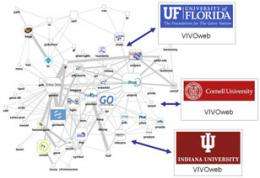
(PhysOrg.com) -- Indiana University has received more than $1.8 million from the National Institutes of Health to collaborate on a $12.2 million, seven-university project designed to network researchers around the country.
While the proposed new networking system will contain authentication mechanisms to protect sensitive data and intellectual property, it is being described as a Facebook for scientists.
IU's portion of the project is led by Katy Börner, Victor H. Yngve Professor of Information Science and director of the Cyberinfrastructure for Network Science Center at IU. Co-investigators with Börner at IU are Ying Ding, an assistant professor of Information Science, and Robert McDonald, associate dean for library technologies at IU and associate director for the Data to Insight Center at the Pervasive Technology Institute.
Börner's team at the Cyberinfrastructure for Network Science Center will conduct research and development on data analysis and visualization, Ding will be responsible for ontology development and McDonald will be responsible for implementation at IU of VIVO, a networking template currently in place at Cornell University that brings together publicly available information on the people, departments, graduate fields, facilities and other resources that collectively make up the research and scholarship environment in all disciplines at Cornell.
Ding explained that ontology is a formally represented community consensus that enables data integration into a form that allows for machine involvement for information understanding and processing.
"One of the major VIVO ontologies models the scholarly activities of research communities, where paper, grant, teaching, research interest, organization and event are interlinked and formally represented," she said. "This could gather all the related information for one researcher into one place and further links to any other related semantic datasets. Linking and formal representation generate great power to realize more intelligent knowledge discovery."
In a recent announcement referencing the importance of the agency's disbursement of 12,000 American Reinvestment and Recovery Act grants that included the $12.2 million VIVO project, NIH director Francis Collins said scientists like Börner, Ding and McDonald were committed to improving the lives of Americans.
"We're investigating new problems with powerful new tools and looking at old problems from entirely new perspectives," he said. "President Obama began his administration by making a strong commitment to 'listening to scientists.' This is not just because he didn't want to hurt our feelings. It's because he sees great opportunities to use science to improve lives, whether it's creating new medicines, developing better prevention strategies, or devising smarter policies to do everything from reducing greenhouse gas emissions to building a more effective health care system."
Success of the VIVO project could translate into enhancing scientific gains in each of those areas noted by Collins, and even more broadly, Börner said.
"There are many sites that extract and serve researcher profiles, plus there are services that aim to help people communicate and connect more efficiently," she said. "Many researchers have profiles and evolving networks on multiple, but incompatible, sites. They try to use Facebook and Google for their research, however, these tools and services do not completely address the needs of scholars."
McDonald said the Cornell VIVO software will offer IU significant opportunities for advancing enhanced data mining capabilities towards discovering semantic relationships among faculty research both within the IU system and in external comparison to other research institutions that also use the software.
"For a multi-faceted area like translational medicine this type of enhanced researcher relationship will strengthen research collaboration as well as provide new insights into the types of research collections that are needed by the libraries to support researchers who work in a multi-disciplinary framework," he noted.
As it is currently envisioned, the system will federate information about faculty and staff from institutional repositories, listings of published articles from academic publishers, and researchers would provide information regarding their own interests. Users will still view the information on what looks like regular Web pages, but VIVO is designed to then collect the facts a researcher wants and then assemble a unique page.
In addition to IU and Cornell, also involved in the project are the University of Florida, Weill Cornell Medical College, Washington University in St. Louis, the Scripps Research Institute and the Ponce School of Medicine in Puerto Rico.
Provided by Indiana University (news : web)


