PhD student solves decade-long mystery of magnetism
October 27, 2009 PhD student solves decade-long mystery of magnetism

Enlarge

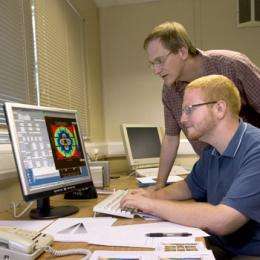
Toby Perring and Andrew Walters at UCL Mathematical & Physical Sciences

(PhysOrg.com) -- A PhD student from the London Centre for Nanotechnology has won a prize for solving a decade-long mystery central to understanding modern magnetic systems.

Andrew Walters has won the 2009 Marshall Stoneham Prize, a newly established prize awarded annually to an outstanding PhD thesis in the area of condensed matter and materials physics.

Mr Walters and colleagues from the Science and Technology Facilities Council and Brookhaven National Laboratory in New York have been studying magnetism in the cuprates, chemical compounds containing .

The study of superconductivity, where a material has absolutely no electrical resistance below a certain temperature, occupies an important place in today.

Since their discovery in the late 1980s, scientists have extensively studied the cuprates, which are high-temperature superconductors containing planes of copper and oxygen atoms.

In addition to their unusual electrical conducting properties, the electrons from the copper atoms have been shown to have unique which may be linked to the superconductivity.

However, for all the work done over the last twenty years, the location of these magnetic electrons in the planes of copper and oxygen atoms has been unclear.

Most studies have assumed that these electrons remain near the copper atoms, and are unaffected by the neighbouring oxygen atoms.

But Mr Walters and his colleagues’ experiments and analysis have revealed new information about the location of the magnetic electrons.

They discovered that the average position of the magnetic electrons is much further away from the copper atoms than had been previously thought, and in fact the chance of finding an electron in the region of an oxygen atom is far higher than anticipated.

This new understanding puts a question mark over a lot of the current understanding of magnetism in the cuprates, and may have important implications for the superconductivity in these materials.

Provided by University College London (news : web)


print this article email this article download pdf blog this article bookmark this article     Stumble it Digg this share on Facebook retweet share on Reddit add to delicious
Rate this story - 4.2 /5 (31 votes)

Rank Filter

Move the slider to adjust rank threshold, so that you can hide some of the comments.


Display comments: newest first

  • eurekalogic - Nov 02, 2009
    • Rank: not rated yet
    Alot of article with few facts. A hint of a possibility is not information.
  • Alexa - Nov 05, 2009
    • Rank: not rated yet
    In Humphreys theory holes are magnetically paired by spin of electrons involved and superconductivity pairs march collectively along the channels, like trams on pairs of tramlines running between the blocks of houses. There is one hole on each tramline, according to this model, and the pairs of holes move down the channels, hopping from oxygen to oxygen via adjacent copper sites. The image of real hole stripes illustrates this situation clearly.

    http://tinyurl.com/yf3luht
  • SincerelyTwo - Nov 09, 2009
    • Rank: not rated yet
    Alexa; I can't find anything on "Humpherys Theory", got any sources?

October 27, 2009 all stories

Comments: 3

4.2 /5 (31 votes)
  • Stumble this up

  • Digg this

  • share this

  • hide
  • Related Stories

  • Study Yields Surprising New Insight into High-Temp Superconductors
    created Mar 17, 2009 | popularity not rated yet | comments 0
  • Puzzled Physicists Solve Decade-Long Discrepancies
    created Oct 09, 2009 | popularity not rated yet | comments 0
  • A 'squeeze' in cuprates may explain superconducting temperatures
    created May 07, 2008 | popularity not rated yet | comments 0
  • Imaging Challenges Theory of High-temperature Superconductivity
    created Aug 02, 2006 | popularity not rated yet | comments 0
  • Three-dimensional polymer with unusual magnetism
    created Nov 13, 2006 | popularity not rated yet | comments 0


  • hide
  • Relevant PhysicsForums posts

  • Voltage drop in diode
    created 15 hours ago
  • ZENER BREAKDOWN has caused me a breakdown
    created Nov 20, 2009
  • Transistor AMPLifier HelP !!!!
    created Nov 20, 2009
  • A loophole in Kubo formula
    created Nov 20, 2009
  • More from Physics Forums - Atomic, Solid State, Comp. Physics

Other News

Quick restart of Big Bang machine stuns scientists (AP)

Quick restart of Big Bang machine stuns scientists

Physics / General Physics

created 4 hours ago | popularity 4.4 / 5 (11) | comments 2

(AP) -- Scientists moved Saturday to prepare the world's largest atom smasher for exploring the depths of matter after successfully restarting the $10 billion machine following more than a year of repairs.


nuclear power plant

Doubts raised on nuclear industry viability

Physics / General Physics

created Nov 19, 2009 | popularity 3.2 / 5 (17) | comments 18

(PhysOrg.com) -- The investment in nuclear power has been growing around the world over the last few years, being viewed as a means for countries to control their energy security, avoid the price fluctuations ...


Researchers Find Innate Correlations Among Different Power Law Phenomena

Researchers Find Innate Correlations Among Different Power Law Phenomena

Physics / General Physics

created Nov 17, 2009 | popularity 4.3 / 5 (15) | comments 12

(PhysOrg.com) -- Studying the patterns that emerge in natural and social phenomena is a popular area of research, although usually individual phenomena are studied separately from each other. In a recent study, ...


Scientists demonstrate 'universal' programmable quantum processor

Scientists demonstrate 'universal' programmable quantum processor

Physics / Quantum Physics

created Nov 15, 2009 | popularity 4.6 / 5 (21) | comments 11

Physicists at the National Institute of Standards and Technology have demonstrated the first "universal" programmable quantum information processor able to run any program allowed by quantum mechanics -- th ...


Proton's party pals may alter its internal structure

Proton's party pals may alter its internal structure

Physics / General Physics

created Nov 18, 2009 | popularity 4.6 / 5 (17) | comments 9

A recent experiment at the DOE's Thomas Jefferson National Accelerator Facility has found that a proton's nearest neighbors in the nucleus of the atom may modify the proton's internal structure.