Study examines how much is too much visual information when it comes to learning
October 27, 2009 Study examines how much is too much visual information when it comes to learning

Enlarge

(PhysOrg.com) -- It’s been said that a picture is worth a thousand words. But with advances in computer graphics capabilities, more recent cognitive theory related to multimedia learning suggests that very visually complex images could actually hinder learning.

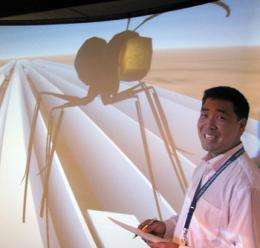
That idea was put to the test recently by Macquarie University PhD student Iwan Kartiko. He decided to explore whether images of ants used in an educational virtual reality application could become so visually complex that they would ultimately hinder students learning, processing and retaining new material.

Kartiko devised a series of virtual reality simulations designed to teach second-year psychology students about the navigational capabilities of Cataglyphis ants.

“The students had no prior knowledge of the ants and how they navigate without landmark visual cues,” Kartiko said.

Students watched three types of progressively more complex ant-like animated virtual actors or AVAs, navigate on featureless on-screen terrain while listening to an audio explanation of how ants navigate. The ants were either flat, cartoon-like or closer to life-like in physical appearance.

Surprisingly, regardless of the level of detail and physical complexity of the ant AVAs, the results of the test showed no significant difference in how much of the information the were able to retain and use to problem-solve.

Based on current theory, Kartiko had originally predicted their scores would be lower as the visual representations of the ants became progressively more complex.

For the next phase of his study, Kartiko plans to add richer background detail to the physical surroundings of the simulation to test what impact a more complex visual background environment has on learning. His results will ultimately be used to help develop the most effective online educational materials and content.

Provided by Macquarie University


Rate this story - 4 /5 (3 votes)


October 27, 2009 all stories

Comments: 0

4 /5 (3 votes)

  • hide
  • Related Stories

  • How ants find their way
    created Oct 18, 2006 | popularity not rated yet | comments 0
  • Scientists: Ants have internal pedometer
    created Jul 04, 2006 | popularity not rated yet | comments 0
  • Desert ants smell their way home
    created Feb 27, 2009 | popularity not rated yet | comments 0
  • Breathing second life into language teaching
    created Oct 09, 2008 | popularity not rated yet | comments 0
  • Fire ants reappearing in Orange County
    created Apr 24, 2006 | popularity not rated yet | comments 0


  • hide
  • Relevant PhysicsForums posts

Other News

Helicobacter pylori and EBV in gastric carcinomas

Medicine & Health / Cancer

created 15 minutes ago | popularity not rated yet | comments 0

Mechanisms of gastric carcinogenesis are still not yet understood. Studies have linked genetic and epigenetic factors or microbiological agents to gastric cancer, but they didn't look for these events together. Dr. Ferrasi ...


Depression and lack of concentration do not necessarily go together

Medicine & Health / Psychology & Psychiatry

created 2 hours ago | popularity 5 / 5 (1) | comments 0

Many clinicians believe that depression goes hand in hand with cognitive difficulties such as memory problems or difficulties concentrating and paying attention, but a recent review of nearly 20 years of literature conducted ...


Feeling blue? You'll shun the new

Feeling blue? You'll shun the new

Medicine & Health / Psychology & Psychiatry

created 6 hours ago | popularity 5 / 5 (3) | comments 0 | with audio podcast

A sick or sad child might cling to mom's leg. But that same child - fed, rested and generally content - will happily toddle off to explore every nook and cranny of the known world. Or: You're chipper and you ...


New finding of the expression of Helicobacter pylori in Chilean patients

Medicine & Health / Diseases

created 2 hours ago | popularity not rated yet | comments 0

Helicobacter pylori (H. pylori) colonize the human stomach and present genetic mechanisms to evade the host immune response allowing their persistence in this habitat for years. A study involving 130 H. pylori strains isolated ...


boredom

Bored to death? It's possible

Medicine & Health / Psychology & Psychiatry

created 17 hours ago | popularity 4.1 / 5 (14) | comments 7 | with audio podcast report

(PhysOrg.com) -- Scientists from the University College London in the U.K. have found that living a life of boredom can kill you.