HPV vaccine makes girls more cautious about sex
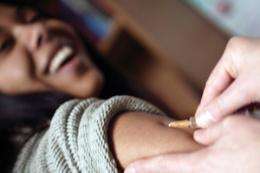
(PhysOrg.com) -- Nearly 80% of girls say that having the HPV vaccine makes them think twice about the risks of having sex, according to a University of Manchester study published in the British Journal of Cancer.
The survey - the first to focus on girls’ views of the vaccine rather than their parents’ - showed that, despite speculation that the vaccine could make girls more likely to start having sex younger, it highlighted the risks of sex for the overwhelming majority.
The study also revealed that the support of parents is crucial to the success of the vaccination programme - of the girls whose parents refused the vaccine, 42 per cent actually wanted it. And 10 per cent of those who were vaccinated didn’t want it.
Dr Loretta Brabin, study author based at the University’s School of Cancer and Imaging Sciences, said: “This is the first insight into how a girl decides whether the vaccine is important to her and who influences her decision.
“Talking to their parents was massively influential on the girls, and mums and dads will play an important role in maintaining the success of the programme so far.
“The thing that put girls off the most was fear of needles and how much it would hurt.
“Some girls had also heard rumours about side-effects, which had filtered down from the media and their parents and had been exaggerated along the way.
“Interestingly, media suggestions that the vaccine could make girls more likely to start having sex at a younger age hadn’t affected them. In fact, the vaccine actually made them more aware of the risks of sex.”
The researchers questioned over 500 twelve and thirteen year olds who had been offered the vaccine in a study in Manchester before the vaccine was available nationally.
Although 79 per cent of girls said the vaccine reminded them of the risks of sex, 14 per cent said they might take more sexual risks because of it.
Nearly four in five girls said they discussed the decision to have the vaccine with their parents. Ninety-three per cent of girls said having the vaccine shows that you are serious about your health and 54 per cent felt the jab was very important to them.
In the UK, girls aged 12 to 13 are offered the HPV vaccine as a part of the government’s vaccination programme that started last year. The vaccine has the potential to prevent at least 7 out of 10 cervical cancers.
Dr Lesley Walker, director of cancer information at Cancer Research UK, said: “Despite the scare-stories, this research suggests that the HPV vaccine could make the majority of girls more cautious about sex.
“The HPV vaccine is an important step towards preventing cervical cancer in the UK but it will only be truly successful if uptake is high.
“It’s important that girls also get appropriate sex education so that they’re all aware of the risks.
“This research gives us important insights into how we can help to maximise the uptake of the vaccine and allay any fears girls and parents may have.”
More information: A survey of adolescent experiences of human papillomavirus vaccination in the Manchester study. Brabin et al. British Journal of Cancer. October 2009.
Provided by University of Manchester (news : web)


