Students demonstrate flux pinning in low gravity
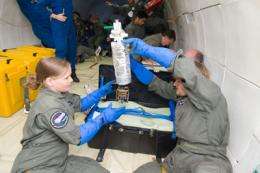
(PhysOrg.com) -- A team of Cornell researchers recently tested their work on the mysterious physical phenomenon of flux pinning aboard a near-zero gravity aircraft.
It looks and sounds like something straight out of Star Trek. But spacecraft that move, dock and separate using only electromagnetism -- no human behind the controls, no mechanical moving parts -- might not be very far into the future.
A team of Cornell researchers led by Mason Peck, assistant professor of mechanical and aerospace engineering, recently tested their work on the mysterious physical phenomenon of flux pinning aboard a near-zero gravity aircraft.
Flux pinning happens when a magnetic field becomes trapped inside an extremely cold superconductor, causing the magnet and superconductor to move together without contact. The team hopes to demonstrate how flux pinning could be applied to aerospace engineering, from docking spacecraft to self-assembling telescopes.
"The interesting thing about flux pinning is that it lets things stick together without physically touching," explained Joseph Shoer, a graduate student working on the project. "They attract one another, but they don't have any danger of colliding."
The team took a step forward in their goal of sending flux pinning into space in August, when members boarded a near-zero gravity aircraft as one of 21 teams selected for NASA's Facilitated Access to the Space Environment for Technology Development and Training (FAST) program. The program invites researchers to test emerging technologies in the zero-gravity environment to, hopefully, take them from the lab bench to the real world.
Using prototypes of two 10-centimeter cubic satellites, or CubeSats, the team demonstrated, among other things, that small spacecraft with magnets and superconductors can stick together in the weightless environment. They ran a bevy of experiments, including the formation of a hinge in which individual components were pinned to a magnetic axis.
On board the aircraft, the team used a container of liquid nitrogen -- cooled to below 80 Kelvin (-315 Fahrenheit) -- to bring their superconductors, placed inside the container, to the ideal temperature. Bringing a CubeSat containing magnets in close contact with the superconductor, the magnetic field's invisible lines pinned themselves to impurities in the crystal structure of the superconductor. The result: the magnet and the superconductor were pinned together, but were not touching.
What's more, if the two objects are physically ripped apart, the superconductor remembers the equilibrium that was initially set up, so they keep attracting each other until the temperature increases again.
The team plans to apply again to the FAST program, as well as to a similar experimental program for undergraduate researchers called Microgravity University. Among other improvements, they plan to replace the liquid nitrogen -- considered a hazardous material -- with an alternative, more reliable cooling system.
The research team has been supported by Northrop Grumman Space Technologies and the NASA Institute for Advanced Concepts. The microgravity experiment team includes Shoer, graduate student Laura Jones, and master of engineering students William Wilson and Max Knobel.
Provided by Cornell University (news : web)


