Researchers bring noise to virtual worlds
October 27, 2009 By Bill Steele Researchers bring noise to virtual worlds

Enlarge

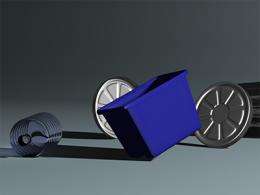
Whether metal or plastic, objects made up of thin shells have a characteristic way of making noise that can be simulated by a computer to synthesize sound for animated films and virtual reality. Image: James Lab/Cornell University

(PhysOrg.com) -- Computer scientists have developed a method to synthesize the sounds of cymbals, falling garbage cans and lids, and plastic water-cooler bottles and recycling bins.

When you kick over a garbage can, it doesn't make a pure, musical tone. That's why the sound is so hard to synthesize.

But now Cornell have developed a practical method to generate the crashing and rumbling sounds of objects made up of thin "harmonic shells," including the sounds of cymbals, falling garbage cans and lids, and plastic water-cooler bottles and recycling bins.

The work by graduate students Jeffrey Chadwick and Steven An and Doug James, associate professor of computer science, will be presented at the SIGGRAPH Asia conference in Yokohama, Japan, in December.

As virtual environments become more realistic and immersive, the researchers point out, computers will have to generate sounds that match the behavior of objects in real time. Even in an animated movie, where sound effects can be dubbed in after the fact from recordings of real sounds, synthesized sounds can match more realistically to the action. So the goal is to start with the computer model of an object already created by animators, analyze how such an object would vibrate when dropped or struck, and how that vibration would be transferred to the air to radiate as sound.

When a thin-shelled object is struck or falls, the metal or plastic sheet slightly deforms and snaps back, triggering a vibration. To simulate the deformation, the computer divides the shell into many small triangles and calculates how the angles between triangles change and how much the sides of the triangles are stretched. What makes this difficult is that the shell vibrates in several different ways at once, and these modes of vibration are "coupled" -- energy transfers from one to another and back again. Previous methods of sound synthesis for shells did not take this into account, James said, and the result was a clean, clear sound, appropriate for bells and wind chimes, but not for things that crash and rumble.

The calculation must be stepped through time at audio frequencies, in this case seeing how the object will look every 1/44,100 of a second. Time-stepping a large mesh of triangles would take weeks of computer time, so the researchers approximate the response by sampling a few hundred triangles (out of thousands) and interpolate between them, a process they call "cubature."

The final step is to map out how the sound waves radiate to determine how the event will sound to a listener at any particular location. Calculating how vibrations of the object move the air is a standard, off-the-shelf process used by engineers who design real-world objects (a lot of work goes into making machinery quieter), but it's too slow for sound synthesis, so the radiation model is pre-computed to save time.

Even with these refinements, the system is not ready for real time, James reported. The computations for simple demonstrations still take about an hour on a laptop computer.

"There's some hope that we can speed this up," he said, "by making other approximations." Nevertheless, he said, previous methods of generating these sounds could take weeks, "but now we can do it in hours."

The work on thin shells is part of a larger project in James' lab to synthesize a variety of sounds, including those of dripping and splashing fluids, small objects clattering together and shattering glass.

Provided by Cornell University (news : web)


print this article email this article download pdf blog this article bookmark this article     Stumble it Digg this share on Facebook retweet share on Reddit add to delicious
Rate this story - 5 /5 (2 votes)

Rank Filter

Move the slider to adjust rank threshold, so that you can hide some of the comments.


Display comments: newest first

  • SmartK8 - Oct 28, 2009
    • Rank: not rated yet
    This is a slowly advancing field, but I'm glad they're still trying. It is the way to go. The sound cards will probably have a great comeback one day. It is a good news, that they solved the friction involved vibrations, even thou it's still slow as yet.

October 27, 2009 all stories

Comments: 1

5 /5 (2 votes)
  • Stumble this up

  • Digg this

  • share this

  • hide
  • Related Stories

  • Making realistic sounds for computer animation (w/Video)
    created Jun 01, 2009 | popularity not rated yet | comments 0
  • Modeling the Sound of Music
    created Oct 03, 2005 | popularity not rated yet | comments 0
  • Scientists develop better method for converting sounds to electronic signals
    created Feb 23, 2006 | popularity not rated yet | comments 0
  • DISSCO makes 'music' for Argonne, UIUC researchers
    created Jun 21, 2005 | popularity not rated yet | comments 0
  • Researchers produce 'neural fingerprint' of speech recognition
    created Nov 10, 2008 | popularity not rated yet | comments 0


  • hide
  • Relevant PhysicsForums posts

  • Help with a camera choice
    created Nov 18, 2009
  • casio calculator that's similar to TI-89
    created Nov 08, 2009
  • Advice on what cell phone to get
    created Nov 08, 2009
  • Changing the language options on your phone.
    created Nov 03, 2009
  • More from Physics Forums - Computing & Technology

Other News

Hackers leak e-mails, stoke climate debate

Technology / Internet

created 4 hours ago | popularity 4.3 / 5 (12) | comments 5

(AP) -- Computer hackers have broken into a server at a well-respected climate change research center in Britain and posted hundreds of private e-mails and documents online - stoking debate over whether some scientists have ...


plug-in hybrid electric vehicle

Pulling the plug on hybrid myths

Technology / Energy

created Nov 19, 2009 | popularity 3.8 / 5 (12) | comments 17

(PhysOrg.com) -- Whether you call them myths, urban legends, fables or old wives' tales, there's a lot of misinformation out there about plug-in electric hybrid vehicles. These vehicles, abbreviated PHEVs, ...


UK police make 2 Trojan computer virus arrests

Technology / Internet

created Nov 18, 2009 | popularity 5 / 5 (1) | comments 10

(AP) -- A couple suspected of helping spread some of the Internet's most aggressive computer viruses has been arrested in the English city of Manchester, police said Wednesday.


A sign marks the entrance to IBM Corporate Headquarters

IBM makes Big Blue cloud

Technology / Software

created Nov 16, 2009 | popularity 2.9 / 5 (8) | comments 8

IBM on Monday announced it has created the world's largest business computing "cloud" capable of holding an amount of digital data on a par with 250 billion iTunes songs.


Google SPDY

Google's SPDY will speed up downloads

Technology / Internet

created Nov 16, 2009 | popularity 4.4 / 5 (16) | comments 7

(PhysOrg.com) -- As part of its effort to speed up the Web, Google is experimenting with SPDY, a new application layer protocol, that it hopes will speed up the conversation between browsers and Web servers ...