Rot-resistant wheat could save farmers millions

October 28, 2009
Rot-resistant wheat could save farmers millions

Enlarge

Fusarium causes head blight of barley. Credit: CSIRO

(PhysOrg.com) -- CSIRO researchers have identified wheat and barley lines resistant to Crown Rot - a disease that costs Australian wheat and barley farmers $79 million in lost yield every year.

Crown Rot, which is a chronic problem throughout the Australian wheat belt, is caused by the Fusarium.

Dr Chunji Liu and his CSIRO Plant Industry team in Brisbane are using sophisticated screening methods to scan over 2400 wheat lines and 1000 barley lines from around the world to find the ones resistant the fungal disease.

"The wheat and barley lines showing resistance to Crown Rot are now being used in pre-breeding programs to incorporate the resistance into adapted varieties for delivery to the wheat breeding companies," Dr Liu says.

Crown Rot infects many grasses and weeds found in wheat growing regions and minimum till cropping encourages Fusarium which survives in cereal stubbles.
Rot-resistant wheat could save farmers millions
Enlarge

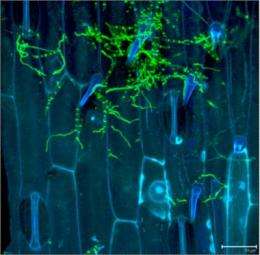
This image shows Fusarium growing on a wheat stem base. Credit: CSIRO

Minimum till cropping minimises disturbance and retains plant stubble from previous crops in order to promote soil health and limit erosion.

Developing Crown Rot resistant wheat and barley varieties is an essential strategy in fighting the disease.

"As well as developing Crown Rot resistant varieties, we are also studying how Fusarium invades the plant, how resist Fusarium infection and what genes may be involved in defending the plant against Fusarium or reducing its effect on yield," Dr Liu says.

Another of the most serious wheat diseases in Australia, Head Blight, is also caused by Fusarium.

Source: CSIRO Australia

4.8 /5 (4 votes)  

Rank 4.8 /5 (4 votes)
Related Stories
Relevant PhysicsForums posts
  • Factors affecting beet root cell membrane
    created7 hours ago
  • Stem cell question.
    createdFeb 10, 2012
  • Protease cleavage
    createdFeb 10, 2012
  • Pertubance in a model
    createdFeb 10, 2012
  • Cancer drugs and Alzheimer's, Oh my!
    createdFeb 09, 2012
  • Squishing cells
    createdFeb 09, 2012
  • More from Physics Forums - Biology

More news stories

A mitosis mystery solved: How chromosomes align perfectly in a dividing cell

Although the process of mitotic cell division has been studied intensely for more than 50 years, Whitehead Institute researchers have only now solved the mystery of how cells correctly align their chromosomes during symmetric ...

Biology / Cell & Microbiology

created 3 hours ago | popularity 5 / 5 (4) | comments 0 | with audio podcast

The proteins ensuring genome protection

Researchers from the University of Geneva (UNIGE), Switzerland, have discovered the crucial role of two proteins in developing a cell 'anti-enzyme shield'. This protection system, which operates at the level of molecular ...

Biology / Cell & Microbiology

created 3 hours ago | popularity 5 / 5 (2) | comments 0 | with audio podcast

Researchers find extensive RNA editing in human transcriptome

In a new study published online in Nature Biotechnology, researchers from BGI, the world's largest genomics organization, reported the evidence of extensive RNA editing in a human cell line by analysis of RNA-seq data, demons ...

Biology / Biotechnology

created 3 hours ago | popularity 5 / 5 (3) | comments 0 | with audio podcast

Entire genome of extinct human decoded from fossil

(PhysOrg.com) -- In 2010, Svante Pääbo and his colleagues presented a draft version of the genome from a small fragment of a human finger bone discovered in Denisova Cave in southern Siberia. The ...

Biology / Biotechnology

created Feb 07, 2012 | popularity 4.7 / 5 (59) | comments 48 | with audio podcast

Why are there so few fish in the Earth's oceans?

(PhysOrg.com) -- A Stony Brook University researcher has found that, contrary to popular belief, there are not plenty of fish in the sea.

Biology / Plants & Animals

created Feb 08, 2012 | popularity 4.3 / 5 (17) | comments 27 | with audio podcast


Google might launch Drive for cloud storage soon

(PhysOrg.com) -- Google's next big move, according to the Wall Street Journal, is a cloud storage service called Drive. Hardly first to the plate, Google is simply catching up to introducing its cloud reposi ...

Scientists discover molecular secrets of 2,000-year-old Chinese herbal remedy

For roughly two thousand years, Chinese herbalists have treated Malaria using a root extract, commonly known as Chang Shan, from a type of hydrangea that grows in Tibet and Nepal. More recent studies suggest that halofuginone, ...

New method to examine batteries -- MRI from the inside

There is an ever-increasing need for advanced batteries for portable electronics, such as phones, cameras, and music players, but also to power electric vehicles and to facilitate the distribution and storage of energy derived ...

Lab study raises questions over nano-particle impact

Tests involving chickens have raised questions about the impact on health from engineered nano-particles, the ultra-fine grains commonly used in drugs and processed foods, scientists said on Sunday.

Injured boomers beware: Know when to see doctor

(AP) -- It happened to nurse Jane Byron years after an in-line skating fall, business owner Haralee Weintraub while doing "men's" push-ups, and avid cyclist Gene Wilberg while lifting a heavy box.

Starve a virus, feed a cure? Findings show how some cells protect themselves against HIV

A protein that protects some of our immune cells from the most common and virulent form of HIV works by starving the virus of the molecular building blocks that it needs to replicate, according to research published online ...