Next-generation microcapsules deliver 'chemicals on demand'
October 28, 2009
Next-generation microcapsules deliver 'chemicals on demand'

Enlarge

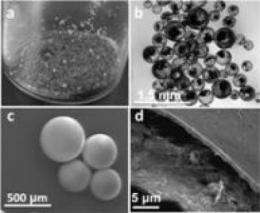
A new generation of microcapsules, shown above, promise to deliver "chemicals on demand" for a wide range of uses, including medicine and personal care. Credit: The American Chemical Society

Scientists in California are reporting development of a new generation of the microcapsules used in carbon-free copy paper, in which capsules burst and release ink with pressure from a pen. The new microcapsules burst when exposed to light, releasing their contents in ways that could have wide-ranging commercial uses from home and personal care to medicine. Their study appears in the Journal of the American Chemical Society.

Jean Fréchet, Alex Zettl and colleagues note that liquid-filled have many other uses, including self-healing plastics. Those plastics contain one group of microscapsules filled with monomer and another with a catalyst. When scratches rip open the capsules, the contents flow, mix, and form a seal. Microcapsules that burst open when exposed to light would have great advantages, the scientists say. Light could be focused to a pinpoint to kill cancer cells, for instance, or shined over an large area to print a pattern.

The new microcapsules consist of nylon spheres about the size of a grain of sand. They enclose a liquid chemical sprinkled with carbon nanotubes. The nanotubes convert laser light to heat that bursts the nylon capsule, releasing the chemical. Using such a system, doctors, for example, might inject microcapsules containing anti-cancer drugs to specific cells and make the capsules burst upon exposure to laser light, delivering their contents precisely where and when they are needed in the body.

More information: "Chemicals On Demand with Phototriggerable Microcapsules", , http://pubs.acs.org/stoken/presspac/presspac/full/10.1021/ja905378v

Source: American Chemical Society (news : web)


Rank not rated yet
Related Stories
Relevant PhysicsForums posts
  • Factors affecting beet root cell membrane
    created22 hours ago
  • Stem cell question.
    createdFeb 10, 2012
  • Protease cleavage
    createdFeb 10, 2012
  • Pertubance in a model
    createdFeb 10, 2012
  • Cancer drugs and Alzheimer's, Oh my!
    createdFeb 09, 2012
  • Squishing cells
    createdFeb 09, 2012
  • More from Physics Forums - Biology

More news stories

NDSU nano research could impact flexible electronic devices

A discovery by a research team at NDSU and the National Institute of Standards and Technology shows the flexibility and durability of carbon nanotube films and coatings are intimately linked to their electronic properties. ...

Nanotechnology / Nanomaterials

created 41 minutes ago | popularity not rated yet | comments 0

Lab study raises questions over nano-particle impact

Tests involving chickens have raised questions about the impact on health from engineered nano-particles, the ultra-fine grains commonly used in drugs and processed foods, scientists said on Sunday.

Nanotechnology / Bio & Medicine

created 18 hours ago | popularity 5 / 5 (8) | comments 4

New kind of solar cell could capture significantly more energy than current cells

New solar cells could increase the maximum efficiency of solar panels by over 25%, according to scientists from the University of Cambridge.

Nanotechnology / Nanophysics

created Feb 08, 2012 | popularity 4.5 / 5 (13) | comments 14 | with audio podcast

'Dark plasmons' transmit energy

Microscopic channels of gold nanoparticles have the ability to transmit electromagnetic energy that starts as light and propagates via "dark plasmons," according to researchers at Rice University.

Nanotechnology / Nanophysics

created Feb 09, 2012 | popularity 4.8 / 5 (10) | comments 1 | with audio podcast

Revealing how a battery material works

Since its discovery 15 years ago, lithium iron phosphate (LiFePO4) has become one of the most promising materials for rechargeable batteries because of its stability, durability, safety and ability to deliver ...

Nanotechnology / Nanomaterials

created Feb 08, 2012 | popularity 5 / 5 (6) | comments 0 | with audio podcast


With climate change, today's '100-year floods' may happen every three to 20 years: research

Last August, Hurricane Irene spun through the Caribbean and parts of the eastern United States, leaving widespread wreckage in its wake. The Category 3 storm whipped up water levels, generating storm surges ...

Researchers make better heat sensor based on butterfly wings

(PhysOrg.com) -- Scientists have long known that butterfly wings produce their iridescent colors by bouncing light around and between tiny ridges in structures made of chitin. More recently they’ve discovered ...

Manipulating genes with hidden TALENs

(PhysOrg.com) -- A better understanding of gene function in model plant and animal systems could be used to develop useful traits in livestock and crop plants, and might someday lead to developments in stem ...

Alien matter in the solar system: A galactic mismatch

This just in: The Solar System is different from the space just outside it.

Couples in the same place emotionally stay together, study says

(Medical Xpress) -- Despite life’s ups and downs, couples whose feelings are in sync consistently over time are more likely to stay together, says a University of California, Davis, study.

Georgia Tech develops software for the rapid analysis of foodborne pathogens

2011 brought two of the deadliest bacterial outbreaks the world has seen during the last 25 years. The two epidemics accounted for more than 4,200 cases of infectious disease and 80 deaths. Software developed at Georgia Tech ...