NASA's Ares I-X moon rocket makes first test flight
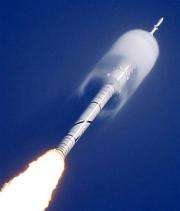
(PhysOrg.com) -- NASA's Ares I-X test rocket lifted off at 11:30 a.m. EDT Wednesday from NASA's Kennedy Space Center in Florida for a two-minute powered flight.
NASA's Ares I-X test rocket lifted off at 11:30 a.m. EDT Wednesday from NASA's Kennedy Space Center in Florida for a two-minute powered flight. The test flight lasted about six minutes from its launch from the newly-modified Launch Complex 39B until splash down of the rocket's booster stage nearly 150 miles down range.
"This is a huge step forward for NASA's exploration goals," said Doug Cooke, associate administrator for the Exploration Systems Mission Directorate at NASA Headquarters in Washington. "Ares I-X provides NASA with an enormous amount of data that will be used to improve the design and safety of the next generation of American spaceflight vehicles -- vehicles that could again take humans beyond low Earth orbit."
The 327-foot tall Ares I-X test vehicle produced 2.6 million pounds of thrust to accelerate the rocket to nearly 3 g's and Mach 4.76, just shy of hypersonic speed. It capped its easterly flight at a sub-orbital altitude of 150,000 feet after the separation of its first stage, a four-segment solid rocket booster.
Parachutes deployed for recovery of the booster and the solid rocket motor will be recovered at sea for later inspection. The simulated upper stage, Orion crew module, and launch abort system will not be recovered.
"The most valuable learning is through experience and observation," said Bob Ess, Ares I-X mission manager. "Tests such as this -- from paper to flight -- are vital in gaining a deeper understanding of the vehicle, from design to development."
Wednesday's flight offered an early opportunity to test and prove hardware, facilities, and ground operations - important data for future space vehicles. During the flight, a range of performance data was relayed to the ground and also stored in the onboard flight data recorder. The 700 sensors mounted on the vehicle provide flight test engineering data to correlate with computer models and analysis. The rocket's sensors gathered information in several areas, including assembly and launch operations, separation of the vehicle's first and second stages, controllability and aerodynamics, the re-entry and recovery of the first stage and new vehicle design techniques.
The Ares I-X efforts are led by the Ares I-X mission management office of the Constellation Program, based at NASA's Johnson Space Center in Houston, and NASA's Exploration Systems Mission Directorate in Washington. NASA's Glenn Research Center in Cleveland designed and built the vehicle's upper stage mass simulator. NASA's Langley Research Center in Hampton, Va., provided aerodynamic characterization, flight test vehicle integration and the crew module/launch abort system mass simulator. NASA's Marshall Space Flight Center in Huntsville, Ala., with contractor support, provided management for the development of Ares I-X avionics, roll control, and first stage systems. The Kennedy Space Center provided operations and associated ground activities and launch operations.
Provided by NASA


