Review: $99 WikiReader is a pocket encyclopedia
October 28, 2009 By PETER SVENSSON , AP Technology Writer
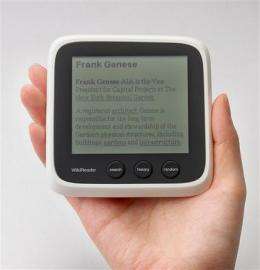
In this undated product image released by Openmoko, the new Wikireader is shown. (AP Photo/Openmoko)
(AP) -- When I was a kid, my dad bought a copy of the Encyclopedia Britannica. It had 32 volumes and took up 4 feet in the book case. I loved to sit on the couch and flip through it, reading articles at random.
Now, I'm returning the favor, giving my father an encyclopedia that has the equivalent of 1,000 volumes. Yet it fits in his pocket, and it costs just $99.
There are few better illustrations of the staggering advance of digital technology than the new WikiReader. It's the size of a thick table coaster, and contains nearly the entire text of the English-language Wikipedia. That's 3.1 million articles, written and edited by volunteers around the globe.
The WikiReader is sold online and made by OpenMoko Inc., a Taiwanese company. The founder, Sean Moss-Pultz, says the inspiration for the gadget comes from the electronic translation dictionaries that are common in Asia.
Now, a lot of cell phones can access Wikipedia, so why would anyone want a WikiReader? Well, the fact that the WikiReader carries the text on a memory chip, rather than using an Internet connection, means you can use it anywhere: overseas, on a plane, in the subway. It's also faster and easier to use than most cell phones, and it has a bigger screen. The battery life is, to believe OpenMoko, outstanding. It says two AAA batteries will last in the WikiReader for a year, if you use it 15 minutes per day. I certainly wasn't able to exhaust it in a few weeks.
The face of the device is nearly filled by a monochrome LCD touch screen. To search the encyclopedia, you bring up an on-screen keyboard. To select links, you tap on them. To scroll, you move your finger across the glass.
There are four buttons: one for power, one for the search screen, one that lists the pages you just visited, and one that brings up a random article. I'm fond of that last one - it brings back memories of my childhood reading habits.
Given the depth of Wikipedia, the Random button brings up the most obscure articles: An article about Caribbean vampire mythology is followed by the entry for a village in Poland, then a region of Antarctica, then the men's results from the 1967 Alpine Skiing World Cup, and so forth.
The simplicity of the device does come at a cost. It's hard to type search terms on the screen, and scrolling through long articles is tedious. There's no backlighting, so you can't read in weak light. Because the screen doesn't show color, the WikiReader doesn't even bother to show images.
Because the screen is narrow, the WikiReader doesn't show tabular material either. For instance, online, the "List of Battlestar Galactica episodes" is organized into a table, but it's missing from the device. OpenMoko says it plans to include tables once it figures out how to display them in a way that works on the screen.
The online Wikipedia changes every minute, but the WikiReader's content does not. It's a static snapshot. However, the manufacturer plans to provide free updates four times a year. To take advantage of that, you'd have to extract the chip from the WikiReader's battery compartment, stick it in a computer's card reader, and download the entire database.
OpenMoko also plans to provide a subscription service that mails new memory cards with updated content four times per year, for $29.
Limitations aside, the WikiReader is a cool idea and comes at the right time of the year. It makes an interesting gift for people without "smart" phones, or are heading out to see the world. Bookish kids will be entertained - there's no dinosaur you can't find in Wikipedia. And imagine what one of these could mean to a poor but literate teenager in a developing country.
Wikipedia doesn't encompass all of human knowledge, but it's certainly a delicious slice of it, and the fact that we can now pocket it is something to be amazed by and thankful for.
On the Net: http://thewikireader.com
©2009 The Associated Press. All rights reserved. This material may not be published, broadcast, rewritten or redistributed.
-
English Wikipedia hosts three millionth article
Aug 17, 2009 |
not rated yet |
0
-
Wired editor acknowledges lifting Wiki material
Jun 24, 2009 |
not rated yet |
0
-
Wikipedia operator gets $500,000 foundation grant
Aug 21, 2009 |
not rated yet |
0
-
Wikipedia testing new method to curb false info
Aug 25, 2009 |
not rated yet |
0
-
Microsoft closing Encarta online encyclopedia
Mar 30, 2009 |
not rated yet |
0
-
Engineers build first sub-10-nm carbon nanotube transistor
Feb 01, 2012 |
4.9 / 5 (32) |
30
-
Something old, something new: Evolution and the structural divergence of duplicate genes
Jan 31, 2012 |
4.6 / 5 (7) |
1
-
The hidden nanoworld of ice crystals: Revealing the dynamic behavior of quasi-liquid layers
Jan 30, 2012 |
5 / 5 (4) |
1
-
Stock market network reveals investor clustering
Jan 27, 2012 |
3.9 / 5 (23) |
8
-
Of microchemistry and molecules: Electronic microfluidic device synthesizes biocompatible probes
Jan 26, 2012 |
5 / 5 (2) |
0
-
Need help reading 3-D
19 hours ago
-
A way to send and receive wireless data
Feb 11, 2012
-
Calling function with no input argument
Feb 10, 2012
-
Force free body diagram problem on gym equipment
Feb 10, 2012
-
Empirical data regarding shower heads and water
Feb 10, 2012
-
feed hold button on CNC lathe
Feb 09, 2012
- More from Physics Forums - General Engineering
More news stories
Japan scientist makes 'Avatar' robot
A Japanese-developed robot that mimics the movements of its human controller is bringing the Hollywood blockbuster "Avatar" one step closer to reality.
Feb 10, 2012 |
5 / 5 (8) |
13
Intel packs performance and reliability into its latest SSD 520 series
Intel Corporation announced today its fastest, most robust client/consumer solid-state drive (SSD) to date, the Intel Solid-State Drive 520 Series (Intel SSD 520), a 6 gigabit-per-second (gbps) SATA III SSD ...
Feb 07, 2012 |
5 / 5 (1) |
4
Google rumored to have built Heads-Up-Display glasses prototype
(PhysOrg.com) -- 9to5Google is reporting that they have received a tip from someone they believe to be a reliable source saying that Google is working on a Heads-Up-Display (HUD) pair of eye-glasses. The per ...
New Kindle Touch is an impressive e-reader
When it comes to reading digital books, tablets are all the rage. But there's a lot to like about simple e-readers, which over the past year have become both a lot cheaper and a lot less clunky.
Electronics / Consumer & Gadgets
Feb 09, 2012 |
5 / 5 (4) |
1
Apple to debut 'iPad 3' in March: report
Apple will unveil a new version of its market-ruling iPad table computer in March, according to a report in Dow Jones-owned technology blog All Things D.
Electronics / Consumer & Gadgets
Feb 09, 2012 |
1.9 / 5 (21) |
0
Scientists discover molecular secrets of 2,000-year-old Chinese herbal remedy
For roughly two thousand years, Chinese herbalists have treated Malaria using a root extract, commonly known as Chang Shan, from a type of hydrangea that grows in Tibet and Nepal. More recent studies suggest that halofuginone, ...
New method to examine batteries -- MRI from the inside
There is an ever-increasing need for advanced batteries for portable electronics, such as phones, cameras, and music players, but also to power electric vehicles and to facilitate the distribution and storage of energy derived ...
A mitosis mystery solved: How chromosomes align perfectly in a dividing cell
Although the process of mitotic cell division has been studied intensely for more than 50 years, Whitehead Institute researchers have only now solved the mystery of how cells correctly align their chromosomes during symmetric ...
Starve a virus, feed a cure? Findings show how some cells protect themselves against HIV
A protein that protects some of our immune cells from the most common and virulent form of HIV works by starving the virus of the molecular building blocks that it needs to replicate, according to research published online ...
Researchers find extensive RNA editing in human transcriptome
In a new study published online in Nature Biotechnology, researchers from BGI, the world's largest genomics organization, reported the evidence of extensive RNA editing in a human cell line by analysis of RNA-seq data, demons ...
The proteins ensuring genome protection
Researchers from the University of Geneva (UNIGE), Switzerland, have discovered the crucial role of two proteins in developing a cell 'anti-enzyme shield'. This protection system, which operates at the level of molecular ...