Scientists Cryopreserve Pest-Imperiled Ash Trees
October 28, 2009 By Jan Suszkiw ARS Scientists Cryopreserve Pest-Imperiled Ash Trees

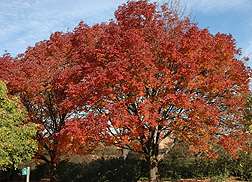
ARS scientists have devised a way to freeze viable budwood from ash trees to help preserve the genetic diversity of these attractive native species, which are threatened by the emerald ash borer. Photo courtesy of Andrew Bell, Chicago Botanic Garden.

(PhysOrg.com) -- Using cryopreservation methods, Agricultural Research Service (ARS) scientists have devised a procedure for storing frozen budwood from ash trees (Fraxinus) and thawing the delicate buds for later use in propagation.

The advance, reported in the journal CryoLetters, should complement ongoing seed-conservation efforts aimed at preserving the genetic diversity of America's native ash species, which are susceptible to the emerald ash borer (EAB), Agrilus planipennis.

Metallic green and 1/2-inch long, this exotic beetle from northern Asia has killed tens of millions of ash in several states since first being detected near Detroit, Mich., in June 2002. Since then, the EAB has spread to 12 other states and two Canadian provinces.

The stored budwood samples, along with conserved seed, can serve as a national source for reintroducing ash trees once the devastation from EAB can be controlled, according to Mark Widrlechner, a horticulturist with the ARS North Central Regional Plant Introduction Station in Ames, Iowa. Widrlechner co-developed the budwood cryopreservation method with plant physiologist Gayle Volk and colleagues at the ARS National Center for Genetic Resources Preservation in Fort Collins, Colo.

Ash trees--among America's most prized shade trees--are at risk in both managed landscapes and natural habitats. Besides the ecological harm, the loss of to EAB infestations is of economic concern. Indeed, numerous forest products are derived from the species, including lumber for furniture, tool handles and baseball bats.

Building on earlier cryopreservation successes with apple and willow tissues, the researchers devised a series of preconditioning steps necessary to store and remove dormant ash budwood from liquid-nitrogen vapor without significant loss of vigor. In trials, the team successfully grafted 42 to 100 percent of cryopreserved budwood stems onto rootstocks used to generate new trees of specific clones or cultivars.

The study's storage times ranged from two to 18 months. But according to Volk, similar procedures used on apples suggest that ash budwood can likely be cryopreserved for at least 20 years.

Provided by USDA Agricultural Research Service


print this article email this article download pdf blog this article bookmark this article     Stumble it Digg this share on Facebook retweet share on Reddit add to delicious
Rate this story - 4.3 /5 (4 votes)


October 28, 2009 all stories

Comments: 0

4.3 /5 (4 votes)
  • Stumble this up

  • Digg this

  • share this

  • hide
  • Related Stories


  • hide
  • Relevant PhysicsForums posts

  • Human Leukocyte Antigen (HLA) typing
    created 5 hours ago
  • Breeding program
    created Nov 20, 2009
  • How does a concentration gradient provide energy?
    created Nov 20, 2009
  • Eyesight and Neural Damage from Electronics
    created Nov 19, 2009
  • More from Physics Forums - Biology

Other News

The Monarchs' annual migration ritual has yet to be scientifically explained

Tree-eating bugs threaten Monarch butterfly in Mexico

Biology / Ecology

created 6 hours ago | popularity 4 / 5 (1) | comments 0

The mysterious Monarch butterfly, which migrates en masse annually between Canada and Mexico, is now facing a new peril: another insect thriving in Western Mexican forests.


Extinct goat Myotragus balearicus

Extinct goat was cold-blooded

Biology / Plants & Animals

created Nov 18, 2009 | popularity 4.9 / 5 (33) | comments 10

(PhysOrg.com) -- An extinct goat that lived on a barren Mediterranean island survived for millions of years by reducing in size and by becoming cold-blooded, which has never before been discovered in mammals.


Bigger not necessarily better, when it comes to brains

Bigger not necessarily better, when it comes to brains

Biology / Plants & Animals

created Nov 17, 2009 | popularity 4.5 / 5 (17) | comments 11

(PhysOrg.com) -- Tiny insects could be as intelligent as much bigger animals, despite only having a brain the size of a pinhead, say scientists at Queen Mary, University of London.


Right-handed chimpanzees provide clues to the origin of human language

Biology / Plants & Animals

created Nov 16, 2009 | popularity 3 / 5 (1) | comments 7

Most of the linguistic functions in humans are controlled by the left cerebral hemisphere. A study of captive chimpanzees at the Yerkes National Primate Research Center (Atlanta, Georgia), reported in the January 2010 issue ...


The creature was found at a depth of 161 metres

Japanese researchers film rare baby fish 'fossil'

Biology / Plants & Animals

created Nov 17, 2009 | popularity 4.7 / 5 (7) | comments 4

Japanese marine researchers said Tuesday they had found and successfully filmed a young coelacanth -- a rare type of fish known as "a living fossil" -- in deep water off Indonesia.