Remotely Operated Vehicles and Satellite Tags Aid Turtle Studies
(PhysOrg.com) -- Researchers are using a remotely operated vehicle (ROV) and satellite-linked data loggers to learn more about turtle behavior in commercial fishing areas and to develop new ways to avoid catching turtles in fishing gear. This marks the first time an ROV has been used to follow turtles in the wild to learn about their behavior and how they interact with their habitat.
Heather Haas, Henry Milliken, Kimberly Murray , and Eric Matzen of NOAA's Northeast Fisheries Science Center (NEFSC) laboratory in Woods Hole, Mass. and colleagues Ron Smolowitz and Matthew Weeks of Coonamessett Farm in East Falmouth, Mass,. have been tracking two juvenile loggerhead turtles with satellite-linked tags since August, and following other non-tagged loggerheads with an ROV.
The two juvenile loggerheads have been followed since August 24, when they were captured off New Jersey and equipped with satellite-linked data loggers that continually record water temperature, depth, location and time of day. The turtles are now about 30 miles off North Carolina.
"The most commonly caught sea turtles are juvenile loggerheads," Haas said. "Understanding their behaviors at sea, such as where they go in the water column and when, could help us reduce their chances of getting caught in nets and dredges."
With support from the commercial fishing industry, the team and fellow turtle scientist Jeff Seminoff from NOAA's Southwest Fisheries Science Center lab in La Jolla, Calif., spent three days in late August aboard the commercial scallop vessel F/V Kathy Anne from Barnegat Light, N.J., attempting to catch two juvenile loggerhead turtles to tag.
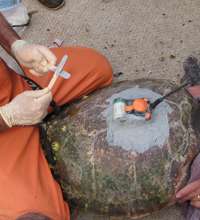
On August 24, the team captured two juvenile loggerheads and attached the data loggers to the turtles' shells. The instruments log and store data, and should stay affixed to the turtles for at least six months and could remain attached as long as 18 months or more. Data are relayed back to the lab via satellite when the animals are at the ocean's surface.
The two turtles were in the northern part of a controlled access scallop fishing area known as Elephant Trunk. Since being tagged, the turtles have been located in water depths between 165 and 230 feet and in water temperatures between 50 degrees Fahrenheit on the bottom to 72 degrees Fahrenheit on the surface. Temperatures are important because turtles get "cold-stunned" if the waters get too cold and can become stranded, a common occurrence on Cape Cod in the fall.
Haas, Milliken, Matzen and Murray all work in the Woods Hole Fisheries lab's Protected Species Branch, which studies marine mammals, sea turtles and sea birds. Loggerhead turtles, the most common sea turtle in U.S. coastal waters, are currently a threatened species under the Endangered Species Act.
Smolowitz has worked with the NEFSC group since 2002 trying to learn more about sea turtles. He has received a number of grants from the Atlantic sea scallop fishery's research set-aside program. He has also been contracted by NEFSC to develop technologies to reduce the numbers of turtles caught in scallop dredges, such as excluder devices and modified dredges that deflect turtles away from the dredge opening. The current project is being funded by NOAA Fisheries Service and the Atlantic sea scallop fishing industry.
"The commercial scallop industry understands the importance of this research and has been very supportive of our efforts to understand and reduce turtle bycatch," Milliken said. "There is still a lot to learn about turtle behavior. Knowing more would improve our ability to reduce bycatch and estimate turtle distribution and abundance. The tags and the ROV images will provide some insights, but are only the start."
Smolowitz says the F/V Kathy Anne is ideal for the turtle research studies because the commercial scallop vessel has a crow's nest atop the mast, making it easier to see turtles in the water. Approximately 50 turtles have been located and followed with the ROV. Researchers pay special attention to their behavior, including observing their feeding, swimming, how they interact with the ocean bottom and with each other.
"I view this pilot project as a chance to work out the kinks for a larger, more comprehensive effort to study turtle behavior in commercial fishing grounds," Haas said. "We timed this study to coincide with scallop fishing activity, and we are already gaining new and unique information on turtle behavioral patterns in the wild."
Source: NOAA


