Fermi Telescope Caps First Year With Glimpse of Space-Time (w/ Video)
October 28, 2009 by Francis Reddy
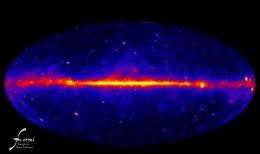
This view of the gamma-ray sky constructed from one year of Fermi LAT observations is the best view of the extreme universe to date. The map shows the rate at which the LAT detects gamma rays with energies above 300 million electron volts -- about 120 million times the energy of visible light -- from different sky directions. Brighter colors equal higher rates. Credit: NASA/DOE/Fermi LAT Collaboration
During its first year of operations, NASA's Fermi Gamma Ray Space Telescope mapped the extreme sky with unprecedented resolution and sensitivity. It captured more than one thousand discrete sources of gamma rays -- the highest-energy form of light. Capping these achievements was a measurement that provided rare experimental evidence about the very structure of space and time, unified as space-time in Einstein's theories.
"Physicists would like to replace Einstein's vision of gravity -- as expressed in his relativity theories -- with something that handles all fundamental forces," said Peter Michelson, principal investigator of Fermi's Large Area Telescope, or LAT, at Stanford University in Palo Alto, Calif. "There are many ideas, but few ways to test them."
This video is not supported by your browser at this time.
Fermi has detected more than 1,000 gamma-ray sources. Half are associated with active galaxies called blazars. This movie shows one year of blazar activity, starting on Aug. 4, 2008, around the galactic north pole. This region includes the constellations Ursa Major, Virgo, Leo, Boötes and Coma Berenices. Credit: NASA/DOE/Fermi LAT Collaboration
Many approaches to new theories of gravity picture space-time as having a shifting, frothy structure at physical scales trillions of times smaller than an electron. Some models predict that the foamy aspect of space-time will cause higher-energy gamma rays to move slightly more slowly than photons at lower energy.Such a model would violate Einstein's edict that all electromagnetic radiation -- radio waves, infrared, visible light, X-rays and gamma rays -- travels through a vacuum at the same speed.
On May 10, 2009, Fermi and other satellites detected a so-called short gamma ray burst, designated GRB 090510. Astronomers think this type of explosion happens when neutron stars collide. Ground-based studies show the event took place in a galaxy 7.3 billion light-years away. Of the many gamma ray photons Fermi's LAT detected from the 2.1-second burst, two possessed energies differing by a million times. Yet after traveling some seven billion years, the pair arrived just nine-tenths of a second apart.
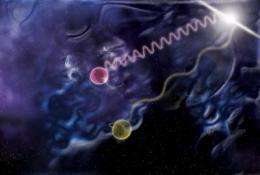
In this illustration, one photon (purple) carries a million times the energy of another (yellow). Some theorists predict travel delays for higher-energy photons, which interact more strongly with the proposed frothy nature of space-time. Yet Fermi data on two photons from a gamma-ray burst fail to show this effect, eliminating some approaches to a new theory of gravity. The animation link below shows the delay scientists had expected to observe. Credit: NASA/Sonoma State University/Aurore Simonnet
"This measurement eliminates any approach to a new theory of gravity that predicts a strong energy dependent change in the speed of light," Michelson said. "To one part in 100 million billion, these two photons traveled at the same speed. Einstein still rules."Fermi's secondary instrument, the Gamma ray Burst Monitor, has observed low-energy gamma rays from more than 250 bursts. The LAT observed 12 of these bursts at higher energy, revealing three record setting blasts.
GRB 090510 displayed the fastest observed motions, with ejected matter moving at 99.99995 percent of light speed. The highest energy gamma ray yet seen from a burst -- 33.4 billion electron volts or about 13 billion times the energy of visible light -- came from September's GRB 090902B. Last year's GRB 080916C produced the greatest total energy, equivalent to 9,000 typical supernovae.
Scanning the entire sky every three hours, the LAT is giving Fermi scientists an increasingly detailed look at the extreme universe. "We've discovered more than a thousand persistent gamma ray sources -- five times the number previously known," said project scientist Julie McEnery at NASA's Goddard Space Flight Center in Greenbelt, Md. "And we've associated nearly half of them with objects known at other wavelengths."
This video is not supported by your browser at this time.
Credit: NASA/Sonoma State University/Aurore Simonnet
Blazars -- distant galaxies whose massive black holes emit fast-moving jets of matter toward us -- are by far the most prevalent source, now numbering more than 500. In our own galaxy, gamma ray sources include 46 pulsars and two binary systems where a neutron star rapidly orbits a hot, young star."The Fermi team did a great job commissioning the spacecraft and starting its science observations," said Jon Morse, Astrophysics Division director at NASA Headquarters in Washington. "And now Fermi is more than fulfilling its unique scientific promise for making novel, high-impact discoveries about the extreme universe and the fabric of space-time."
-
Gamma Ray Delay May Be Sign of 'New Physics'
Oct 01, 2007 |
not rated yet |
0
-
Fermi Gamma-Ray Space Telescope Sees Most Extreme Gamma-Ray Blast Ever
Feb 19, 2009 |
not rated yet |
0
-
First gamma-ray-only pulsar observation opens new window on stellar evolution
Oct 16, 2008 |
not rated yet |
0
-
Searching the heavens -- GLAST
May 01, 2008 |
not rated yet |
0
-
A Violent History of Time
Jan 24, 2008 |
not rated yet |
0
-
Engineers build first sub-10-nm carbon nanotube transistor
Feb 01, 2012 |
4.9 / 5 (31) |
30
-
Something old, something new: Evolution and the structural divergence of duplicate genes
Jan 31, 2012 |
4.6 / 5 (7) |
1
-
The hidden nanoworld of ice crystals: Revealing the dynamic behavior of quasi-liquid layers
Jan 30, 2012 |
5 / 5 (3) |
1
-
Stock market network reveals investor clustering
Jan 27, 2012 |
3.9 / 5 (23) |
8
-
Of microchemistry and molecules: Electronic microfluidic device synthesizes biocompatible probes
Jan 26, 2012 |
5 / 5 (1) |
0
-
Scale of the Universe
8 hours ago
-
Titan's lack of impact craters
Feb 09, 2012
-
Real pictures of black hole eating a star?
Feb 08, 2012
-
Hypothetical way to travel faster than light, but not technically exceed lightspeed
Feb 06, 2012
-
How do scientists monitor the Sun's activity?
Feb 05, 2012
-
Search patterns in observational studies
Feb 05, 2012
- More from Physics Forums - General Astronomy
More news stories
Humans may have helped the decline of African rainforests 3000 years ago
(PhysOrg.com) -- Large areas of rainforests in Central Africa mysteriously disappeared over three thousand years ago, to be replaced by savannas. The prevailing theory has been that the cause was a change ...
Could Venus be shifting gear?
(PhysOrg.com) -- ESAs Venus Express spacecraft has discovered that our cloud-covered neighbour spins a little slower than previously measured. Peering through the dense atmosphere in the infrared, the ...
Space & Earth / Space Exploration
15 hours ago |
5 / 5 (7) |
7
|
NASA budget will axe Mars deal with Europe: scientists
US President Barack Obama's budget proposal to be submitted next week for 2013 will cut NASA's budget by 20 percent and eliminate a major partnership with Europe on Mars exploration, scientists said Thursday.
Space & Earth / Space Exploration
18 hours ago |
5 / 5 (2) |
18
Mars Science Laboratory computer issue resolved
(PhysOrg.com) -- Engineers have found the root cause of a computer reset that occurred two months ago on NASA's Mars Science Laboratory and have determined how to correct it.
Space & Earth / Space Exploration
16 hours ago |
4.7 / 5 (6) |
3
|
Two new moons for Jupiter
Advances in technology have lead to the discovery of new planets outside of our Solar System, and now even new moons in our own backyard.
Space & Earth / Space Exploration
15 hours ago |
4 / 5 (1) |
7
Google users warned of threat to smartphone wallets
Users of Google smartphone wallets were being warned on Friday that there is a way to crack pass codes intended to thwart thieves from going on illicit shopping sprees.
Anonymous knocks CIA website offline (Update)
The website of the Central Intelligence Agency was inaccessible on Friday after the hacker group Anonymous claimed to have knocked it offline.
New error-correcting codes guarantee the fastest possible rate of data transmission
Error-correcting codes are one of the triumphs of the digital age. Theyre a way of encoding information so that it can be transmitted across a communication channel such as an optical fiber o ...
New power source discovered
(PhysOrg.com) -- Researchers at the Massachusetts Institute of Technology (MIT) and RMIT University have made a breakthrough in energy storage and power generation.
Complex wiring of the nervous system may rely on a just a handful of genes and proteins
Researchers at the Salk Institute have discovered a startling feature of early brain development that helps to explain how complex neuron wiring patterns are programmed using just a handful of critical genes. ...
The power of estrogen -- male snakes attract other males
A new study has shown that boosting the estrogen levels of male garter snakes causes them to secrete the same pheromones that females use to attract suitors, and turned the males into just about the sexiest ...

Oct 28, 2009
Rank: 1 / 5 (1)
Oct 28, 2009
Rank: 5 / 5 (27)
Another confirmation of (non quantum) relativity.
Oct 28, 2009
Rank: 2 / 5 (4)
http://www.scienc...lery.php
Oct 28, 2009
Rank: 1 / 5 (2)
My own view pet theory is that it all hinges around photons. Why can all matter be expressed in terms of photons mc2? I also consider that a photon is comprised of 2 charged sub-components. This explains polarization and wave particle duality. The other clue is that the g field equations is idententical the q field equation.
Nov 02, 2009
Rank: not rated yet