Expect the unexpected when adapting to climate change in Africa, says researcher
October 28, 2009
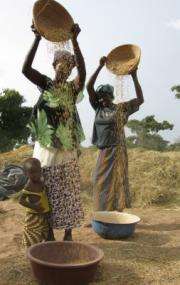
Professor Conway says that one way to adapt to climate change in Africa is to introduce drought- and flood-resistant crops.
(PhysOrg.com) -- Nations, communities and families in Africa need to safeguard their homes and livelihoods against the unpredictable effects of climate change, according to a discussion paper written by Imperial College London's Professor Sir Gordon Conway, published today (28 October).
The paper describes how predicting climate change's impact on specific countries, regions or towns in Africa is extremely difficult. Africa's climate is driven by three very complex factors - the cycle of hot air and rain in the tropics, the monsoons and the El-Niño/ La Niña phenomena in the Pacific ocean. This makes it hard to forecast what will happen, when and where.
Climate change could cause more frequent and severe floods, droughts and other extreme weather events; decreased access to drinking water; damage to agricultural land and crops; and the spread of diseases like malaria into previously unaffected areas - all of which could have serious consequences for the poorest members of society.
The uncertainty about where these effects will be felt in Africa presents a unique set of challenges, as Sir Gordon explains:
"Essentially it means having to prepare for the unknown," he said. "This might sound impossible but it's not - the key is helping people develop more resilient lifestyles and livelihoods, so that unknown and unpredictable 'shocks' and extreme weather events are not so damaging."
Sir Gordon is calling for governments, NGOs and the private sector to work together to increase communities' resilience to extreme weather events associated with climate change:
"For example, individual countries can build flood defences and set up weather insurance schemes. Communities can build cyclone shelters and introduce drought- and flood-resistant crops. Families can make sure they have more than one source of income - in rural areas this could involve women selling fruit and vegetables from home gardens, or weaving and selling handcrafts, to supplement the household income if agriculture fails," he said.
In addition, he says more research is needed to better understand the complexities of Africa's climate drivers.
"There is much that is known but also many unknowns," he concludes. "We need more scientific understanding and we need better, more detailed weather data from Africa."
Professor Sir Brian Hoskins, Director of the Grantham Institute for Climate Change at Imperial College London, adds:
"At present we are uncertain over the regional impacts of climate change, and we must gain more confidence in our predictions based on better understanding of how climate works. However it seems that Africa may be particularly badly hit: we urgently need to find ways of ensuring that communities can cope with the possible changes."
A full copy of the discussion paper, entitled: 'The science of climate change in Africa: impacts and adaptation' can be downloaded here.
-
New climate forceasting system to be created
Sep 04, 2009 |
not rated yet |
0
-
New clues to air circulation in the atmosphere
Aug 21, 2008 |
not rated yet |
0
-
Costs of adapting to climate change significantly underestimated
Aug 27, 2009 |
not rated yet |
0
-
Climate change threatens rice production
Oct 16, 2009 |
not rated yet |
0
-
The Prince of Wales outlines concerns about climate change in interview
Sep 30, 2008 |
not rated yet |
0
-
Engineers build first sub-10-nm carbon nanotube transistor
Feb 01, 2012 |
4.9 / 5 (33) |
30
-
Something old, something new: Evolution and the structural divergence of duplicate genes
Jan 31, 2012 |
4.6 / 5 (7) |
1
-
The hidden nanoworld of ice crystals: Revealing the dynamic behavior of quasi-liquid layers
Jan 30, 2012 |
5 / 5 (4) |
1
-
Stock market network reveals investor clustering
Jan 27, 2012 |
3.9 / 5 (23) |
8
-
Of microchemistry and molecules: Electronic microfluidic device synthesizes biocompatible probes
Jan 26, 2012 |
5 / 5 (2) |
0
-
Do some geologists actually act a lot like Randy Marsh?
Feb 11, 2012
-
Discrepancy between oxygen and carbon-dioxide levels
Feb 09, 2012
-
where gems are found in the world
Feb 09, 2012
-
Wind Waves in Reservoir ~ Wind run-up and Wind set-up
Feb 08, 2012
-
Balance of oxygen in the atmosphere
Feb 01, 2012
-
The case for a methanol-based economy
Jan 30, 2012
- More from Physics Forums - Earth
More news stories
Latin America mining boom clashes with conservation
Latin America is experiencing a mining boom as prices rise fuelled by a hike in global demand, but the region is also being hit by a wave of violent protests, strikes and rallies by environmentalists.
20 hours ago |
5 / 5 (1) |
1
Salvage workers begin pumping fuel from Italian shipwreck
Salvage workers Sunday began pumping fuel from the shipwrecked Italian cruise liner Costa Concordia, a day ahead of schedule, officials said.
12 hours ago |
5 / 5 (2) |
0
Political leaders play key role in how worried Americans are by climate change: study
More than extreme weather events and the work of scientists, it is national political leaders who influence how much Americans worry about the threat of climate change, new research finds.
Feb 06, 2012 |
5 / 5 (8) |
75
NASA budget will axe Mars deal with Europe: scientists
US President Barack Obama's budget proposal to be submitted next week for 2013 will cut NASA's budget by 20 percent and eliminate a major partnership with Europe on Mars exploration, scientists said Thursday.
Space & Earth / Space Exploration
Feb 10, 2012 |
5 / 5 (4) |
58
Humans may have helped the decline of African rainforests 3000 years ago
(PhysOrg.com) -- Large areas of rainforests in Central Africa mysteriously disappeared over three thousand years ago, to be replaced by savannas. The prevailing theory has been that the cause was a change ...
Scientists discover molecular secrets of 2,000-year-old Chinese herbal remedy
For roughly two thousand years, Chinese herbalists have treated Malaria using a root extract, commonly known as Chang Shan, from a type of hydrangea that grows in Tibet and Nepal. More recent studies suggest that halofuginone, ...
New method to examine batteries -- MRI from the inside
There is an ever-increasing need for advanced batteries for portable electronics, such as phones, cameras, and music players, but also to power electric vehicles and to facilitate the distribution and storage of energy derived ...
A mitosis mystery solved: How chromosomes align perfectly in a dividing cell
Although the process of mitotic cell division has been studied intensely for more than 50 years, Whitehead Institute researchers have only now solved the mystery of how cells correctly align their chromosomes during symmetric ...
Google might launch Drive for cloud storage soon
(PhysOrg.com) -- Google's next big move, according to the Wall Street Journal, is a cloud storage service called Drive. Hardly first to the plate, Google is simply catching up to introducing its cloud reposi ...
Lab study raises questions over nano-particle impact
Tests involving chickens have raised questions about the impact on health from engineered nano-particles, the ultra-fine grains commonly used in drugs and processed foods, scientists said on Sunday.
Starve a virus, feed a cure? Findings show how some cells protect themselves against HIV
A protein that protects some of our immune cells from the most common and virulent form of HIV works by starving the virus of the molecular building blocks that it needs to replicate, according to research published online ...
Oct 29, 2009
Rank: 5 / 5 (1)
Oct 29, 2009
Rank: 1 / 5 (1)
When Sokrates confessed "I only know that I don't know anything" he wasn't humble at all. Because he continued "But that guy with his sophistry doesn't even know this much."
Nov 02, 2009
Rank: not rated yet
The truth is that more draconian big govt regulations imposed on poor people in the name of the myth of manmade global warming will only cause their lives to be more burdened, more oppressed, and more impoverished. The answer for helping the poor of the Third World is importing capitalism and American-style constitutional democracy, which has been shown time after time to lift people up instead of bringing them down, as totalitarian socialism does.
Nov 02, 2009
Rank: 1 / 5 (1)
Tell this the Chinese.