Mirinae intensifying while moving away from the northern Marianas

October 28, 2009 Mirinae intensifying while moving away from the northern Marianas

Enlarge

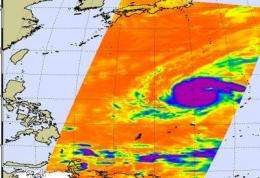
Microwave images are created when data from NASA's Aqua satellite AIRS and AMSU instruments are combined. The cold areas in this image (yellow-green) indicates where there is precipitation or ice in the cloud tops. This microwave image of Typhoon Mirinae suggests cold, high thunderstorms have developed and an eye is forming. Credit: NASA JPL, Ed Olsen

Typhoon Mirinae is moving west and away from the Northern Marianas Islands on a track to a landfall in the Philippines by the weekend. As Mirinae has moved west, NASA's infrared and microwave satellite imagery have seen high, strong thunderstorm development, and a developing eye.

Typhoon Mirinae's are now up to 98 mph (157 km/hr), and its center is approximately 930 nautical miles (that's 1,070 miles or 1,722 kilometers) east of Manila, Philippines. The coordinates of its center are 16.2 North latitude and 136.9 East longitude. Mirinae is moving west at 17 mph.

Tropical storm-force winds extend out to 100 miles from Mirinae's center, while typhoon/hurricane-force winds extend 20 miles out from its center. Mirinae is stirring up waves up to 22 feet high.

Mirinae is intensifying in part because of "strong radial outflow and warm sea surface temperatures," according to forecasters at the U.S. Navy's Joint Warning Center (JTWC). JTWC is the organization that forecasts storms in the Western Pacific Ocean. Radial outflow is important in a tropical cyclone development because it spreads ice particles outward from the center of the storm, spreading clouds and precipitation. Basically it helps the storm grow larger.
Mirinae intensifying while moving away from the northern Marianas
Enlarge

NASA's Aqua satellite captured cold thunderstorm cloud tops of Mirinae in this infrared image Oct. 28 at 12:35 a.m. local Asia/Manila Time (Oct. 27 at 12:35 p.m. EDT). The system now has the developed signature shape of a mature tropical cyclone. Credit: NASA JPL, Ed Olsen

The Atmospheric Infrared Sounder (AIRS) instrument on NASA's Aqua satellite captured a microwave and infrared image of Mirinae on October 28 at 12:35 a.m. local Asia/Manila Time.

The revealed that the cloud tops of Mirinae are close to the top of the troposphere. That means they are strong thunderstorms, where temperatures are colder than -63 Fahrenheit.

AIRS data is also coupled with data from the Advanced Microwave Sounding Unit (AMSU) that flies with AIRS on Aqua to create microwave images of storms. The AMSU image uses the radiances of the 89 GHz channel, and the cold areas in those images indicate where there is precipitation or ice in the cloud tops.

Mirinae has intensified steadily and will continue to do so until landfall in the Philippines on Saturday. Landfall in Luzon between the cities of Soliven and San Jose is still expected to occur around 0600 UTC (2 a.m. EDT, 2 p.m. Asia/Manila local time) on Halloween.

Source: NASA/Goddard Space Flight Center


print this article email this article download pdf blog this article bookmark this article     Stumble it Digg this share on Facebook retweet share on Reddit add to delicious
Rate this story - not rated yet


October 28, 2009 all stories

Comments: 0

not rated yet
  • Stumble this up

  • Digg this

  • share this

  • hide
  • Related Stories

  • Microwave satellite imagery shows an eye developing in Mirinae
    created Oct 27, 2009 | popularity not rated yet | comments 0
  • NASA satellite tracking Typhoon Lupit on a march toward the northern Philippines
    created Oct 16, 2009 | popularity not rated yet | comments 0
  • Luzon expecting a Lupit landfall
    created Oct 20, 2009 | popularity not rated yet | comments 0
  • Typhoon Choi-Wan swinging by Japan on weekend
    created Sep 18, 2009 | popularity not rated yet | comments 0
  • Super typhoon Lupit heading west in the Philippine Sea
    created Oct 19, 2009 | popularity not rated yet | comments 0


  • hide
  • Relevant PhysicsForums posts

  • Which countries around the world cause the most destruction to the rain forest
    created 12 hours ago
  • HadleyCru data hacked
    created Nov 20, 2009
  • Younger Dryas Caused by Ice Dam Collapse?
    created Nov 17, 2009
  • Modeling rainfall and flooding
    created Nov 15, 2009
  • More from Physics Forums - Earth

Other News

Baby can wait as expectant dad finishes spacewalk (AP)

Baby can wait as expectant dad finishes spacewalk

Space & Earth / Space Exploration

created 12 hours ago | popularity 3 / 5 (2) | comments 0

(AP) -- A spacewalking astronaut put aside the impending birth of his daughter and blazed through his first-ever venture outside the International Space Station on Saturday.


Unseasonably hot and dry weather combined with strong winds to fan scores of blazes in the country's southeastern states

Australia issues 'catastrophic' alerts as fires rage

Space & Earth / Environment

created 18 hours ago | popularity 4 / 5 (3) | comments 0

Australia has issued "catastrophic" alerts after record-breaking temperatures and wild lightning storms sparked more than 100 fires across the country, officials said Saturday.


Commuters wait on the platform shrouded by fog in London

Climate change not man-made, say majority of Britons: poll

Space & Earth / Environment

created Nov 15, 2009 | popularity 3.3 / 5 (15) | comments 46

Less than half of Britons believes that human activity is to blame for global warming, according to a poll carried out for The Times newspaper and published on Saturday.


Mysteriously warm times in Antarctica

Mysteriously warm times in Antarctica

Space & Earth / Earth Sciences

created Nov 18, 2009 | popularity 4.2 / 5 (21) | comments 28

(PhysOrg.com) -- A new study of Antarctica's past climate reveals that temperatures during the warm periods between ice ages (interglacials) may have been higher than previously thought. The latest analysis ...


UN: Fight climate change with free condoms (AP)

UN: Fight climate change with free condoms

Space & Earth / Environment

created Nov 18, 2009 | popularity 3.1 / 5 (11) | comments 24

(AP) -- The battle against global warming could be helped if the world slowed population growth by making free condoms and family planning advice more widely available, the U.N. Population Fund said Wednesday.