Trees facilitate wildfires as a way to protect their habitat
October 28, 2009 Trees facilitate wildfires as a way to protect their habitat

Enlarge

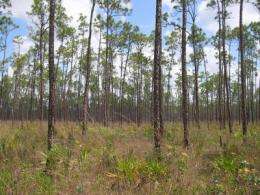
Savanna trees such as these pines may help facilitate frequent fires in order to prevent other trees from displacing savanna trees and shifting the community from an open savanna to a closed forest. Credit: Brian Beckage/UVM

Fire is often thought of something that trees should be protected from, but a new study suggests that some trees may themselves contribute to the likelihood of wildfires in order to promote their own abundance at the expense of their competitors.

The study, which appears in the December 2009 issue of the journal The American Naturalist, says that positive feedback loops between fire and trees associated with savannas can make fires more likely in these ecosystems.

"We used a to show that positive feedback loops between fire frequency and savanna trees, alone or together with grasses, can stabilize ecological communities in a savanna state, blocking conversion of savannas to forest," said the study's leading author Brian Beckage, associate professor in the Department of Plant Biology at the University of Vermont. The study's co-authors are William Platt, professor of biology at Louisiana State University, and Louis Gross, director of the National Institute for Mathematical and Biological Synthesis and professor of ecology and and mathematics at the University of Tennessee. Beckage was a short-term visitor conducting research at NIMBioS in 2009 and will be on sabbatical at NIMBioS in 2010.

The promotion of fire by the savanna trees increases their own abundance by limiting the establishment and growth of tree species that are better competitors for resources and that might ultimately displace the savanna trees. The research results suggest that some trees may modify or "engineer" their environment, including the characteristic fire frequencies in a landscape, to facilitate their own persistence at the expense of their competitors, Beckage said.

The research proposes a scenario for the development of savannas in landscapes that would otherwise become closed forests. Examples of savanna that facilitate frequent low-intensity fires include the longleaf pine and the south Florida slash pine, both of which frequently shed their needles providing fodder for wildfires. The tree initially invades grassland, but by facilitating frequent fires, it limits its own density and thus prevents conversion to a forest.

More information: The study was recently published in the journal The American Naturalist. It can be viewed at http://www.journals.uchicago.edu/toc/an/0/0

Source: National Institute for Mathematical and Biological Synthesis


print this article email this article download pdf blog this article bookmark this article     Stumble it Digg this share on Facebook retweet share on Reddit add to delicious
Rate this story - 4.5 /5 (2 votes)


October 28, 2009 all stories

Comments: 0

4.5 /5 (2 votes)
  • Stumble this up

  • Digg this

  • share this

  • hide
  • Related Stories

  • Study identifies two types of savannas
    created Dec 08, 2005 | popularity not rated yet | comments 0
  • Logging may increase fire risk
    created Jan 06, 2006 | popularity not rated yet | comments 0
  • Live Oak Trees Struggle for Survival in Growth Areas
    created Sep 28, 2006 | popularity not rated yet | comments 0
  • Large trees declining in Yosemite
    created Jul 29, 2009 | popularity not rated yet | comments 0
  • The vicious cycle of rainforest destruction
    created May 22, 2006 | popularity not rated yet | comments 0


  • hide
  • Relevant PhysicsForums posts

  • Breeding program
    created Nov 20, 2009
  • How does a concentration gradient provide energy?
    created Nov 20, 2009
  • Eyesight and Neural Damage from Electronics
    created Nov 19, 2009
  • Quick question about the Golgi Apparatus?
    created Nov 19, 2009
  • More from Physics Forums - Biology

Other News

Extinct goat Myotragus balearicus

Extinct goat was cold-blooded

Biology / Plants & Animals

created Nov 18, 2009 | popularity 4.9 / 5 (29) | comments 10

(PhysOrg.com) -- An extinct goat that lived on a barren Mediterranean island survived for millions of years by reducing in size and by becoming cold-blooded, which has never before been discovered in mammals.


Bigger not necessarily better, when it comes to brains

Bigger not necessarily better, when it comes to brains

Biology / Plants & Animals

created Nov 17, 2009 | popularity 4.4 / 5 (14) | comments 10

(PhysOrg.com) -- Tiny insects could be as intelligent as much bigger animals, despite only having a brain the size of a pinhead, say scientists at Queen Mary, University of London.


Right-handed chimpanzees provide clues to the origin of human language

Biology / Plants & Animals

created Nov 16, 2009 | popularity 3 / 5 (1) | comments 7

Most of the linguistic functions in humans are controlled by the left cerebral hemisphere. A study of captive chimpanzees at the Yerkes National Primate Research Center (Atlanta, Georgia), reported in the January 2010 issue ...


The creature was found at a depth of 161 metres

Japanese researchers film rare baby fish 'fossil'

Biology / Plants & Animals

created Nov 17, 2009 | popularity 4.7 / 5 (7) | comments 4

Japanese marine researchers said Tuesday they had found and successfully filmed a young coelacanth -- a rare type of fish known as "a living fossil" -- in deep water off Indonesia.


Studies suggest males have more personality

Studies suggest males have more personality

Biology / Plants & Animals

created Nov 18, 2009 | popularity 3.7 / 5 (9) | comments 3

(PhysOrg.com) -- Males have more pronounced personalities than females across a range of species - from humans to house sparrows - according to new research. Consistent personality traits, such as aggression ...