Things To Ponder While Eating Halloween Candy
October 28, 2009 By Chris Gorski, ISNS
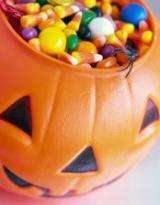
For kids, ringing a neighbor's doorbell, yelling "trick or treat," and receiving candy brings plenty of smiles, but for many the real fun of Halloween happens when you turn your plastic jack-o'-lantern candy bucket upside down, unleashing a candy tsunami onto a tabletop or bedspread. From there it's easy to pick out the holiday-inappropriate items that somehow made it into the mix -- kids need pencils, and eating the occasional apple is swell, but not on Halloween night.
Some kids eat their favorites right away while others try to make their candy last for weeks, rationing the specially-sized packages as well as self-control allows. For some, it's important to count up all the pieces, split them into categories, and trade with siblings -- four packs of raisins for a Butterfinger, or maybe a handful of candy corn for a Hershey's bar.
Well, maybe that last one is what kids who end up writing for Inside Science News Service do.
Here are a few facts to chew on this Halloween:
• The U.S. Census Bureau estimates that there are 36 million potential trick-or-treaters this year -- kids aged 5 to 13. If the average kid knocks on 25 doors, occupied housing units throughout the country will average nine costumed visitors (occupants who dole out countless bags of candy every year may beg to differ).
• If each of those houses decided to give out Snickers Fun Size bars, that would require that adults purchase 23 million bags to provision their visitors. Countering the calories from all of that confectionary magnificence would require that a team of a thousand 160-pound men complete 8,000 Ironman Triathlons (calculation preformed with help from an online calories-burned calculator from Stevens Creek Software).
• Farmers in major pumpkin producing states produced 1.1 billion pounds of pumpkins in 2008, according to the U.S. Census Bureau, almost 4 pounds for every person in the country. Illinois alone produced 496 million pounds -- 38 pounds for every state resident, or enough pumpkin per capita to make about 8 big pies and set a couple aside to carve into jack-o'-lanterns.
• 9 billion candy corn pieces are produced every year -- according to Candy Corn Wonderland -- which, depending on your own deeply personal feelings, is either way too many or way too few per person. For the record, that means that each U.S. resident's ration is about 30 pieces.
By the way, if you would like to know about how far someone would have to walk to work off some common satisfying, but calorie-rich Halloween treats, take a look at this online calculator from About.com.
Happy Halloween!
Source: Inside Science News Service

-
Food 'tricks' that combat sneaky, creepy Halloween treats
Oct 30, 2007 |
not rated yet |
0
-
Orthodontists plan for post-Halloween rush
Nov 01, 2007 |
not rated yet |
0
-
The Medical Minute: There's no trick to a safe Halloween
Oct 21, 2009 |
not rated yet |
0
-
Candy cigarettes: Bringing the candy man home
Jun 18, 2007 |
not rated yet |
0
-
Ornamentals to Brighten the Fall Garden Palette
Oct 02, 2009 |
not rated yet |
0
-
Engineers build first sub-10-nm carbon nanotube transistor
Feb 01, 2012 |
4.9 / 5 (33) |
30
-
Something old, something new: Evolution and the structural divergence of duplicate genes
Jan 31, 2012 |
4.6 / 5 (7) |
1
-
The hidden nanoworld of ice crystals: Revealing the dynamic behavior of quasi-liquid layers
Jan 30, 2012 |
5 / 5 (4) |
1
-
Stock market network reveals investor clustering
Jan 27, 2012 |
3.9 / 5 (23) |
8
-
Of microchemistry and molecules: Electronic microfluidic device synthesizes biocompatible probes
Jan 26, 2012 |
5 / 5 (2) |
0
-
Bohr-Einstein debate: why did Bohr not simply say...
Feb 06, 2012
-
Best/Worst U.S. Presidents
Jan 31, 2012
- More from Physics Forums - History & Humanities
More news stories
A frank discussion of the power law and linking correlation to causation
(PhysOrg.com) -- Michael Stumpf a mathematics professor at Imperial College in London, and Mason Porter a lecturer at Oxford have teamed together to write and publish a perspective piece in Science regarding the in ...
US workers are 'giving away the store,' costing firms billions
Nearly 70 percent of the nation's service employees give away free goods and services from hamburgers to cable TV costing companies billions of dollars a year, according to a groundbreaking study.
Other Sciences / Economics & Business
Feb 09, 2012 |
3 / 5 (5) |
11
Employers feel no love for unscrupulous practice of 'service sweethearting'
A new study led by two Florida State University marketing professors finds that some frontline service employees who are rewarded for hikes in customer loyalty and satisfaction also may engage in "service ...
Other Sciences / Economics & Business
Feb 10, 2012 |
3.3 / 5 (3) |
10
New insights into how to correct false knowledge
The abundance of false information available on the Internet, in movies and on TV has created a big challenge for educators.
Other Sciences / Social Sciences
Feb 07, 2012 |
4.9 / 5 (7) |
9
|
Neanderthal demise due to many influences, including cultural changes: study
As an ice age crept upon them thousands of years ago, Neanderthals and modern human ancestors expanded their territory ranges across Asia and Europe to adapt to the changing environment.
Other Sciences / Archaeology & Fossils
Feb 07, 2012 |
4.4 / 5 (5) |
8
|
Scientists discover molecular secrets of 2,000-year-old Chinese herbal remedy
For roughly two thousand years, Chinese herbalists have treated Malaria using a root extract, commonly known as Chang Shan, from a type of hydrangea that grows in Tibet and Nepal. More recent studies suggest that halofuginone, ...
New method to examine batteries -- MRI from the inside
There is an ever-increasing need for advanced batteries for portable electronics, such as phones, cameras, and music players, but also to power electric vehicles and to facilitate the distribution and storage of energy derived ...
A mitosis mystery solved: How chromosomes align perfectly in a dividing cell
Although the process of mitotic cell division has been studied intensely for more than 50 years, Whitehead Institute researchers have only now solved the mystery of how cells correctly align their chromosomes during symmetric ...
Google might launch Drive for cloud storage soon
(PhysOrg.com) -- Google's next big move, according to the Wall Street Journal, is a cloud storage service called Drive. Hardly first to the plate, Google is simply catching up to introducing its cloud reposi ...
Lab study raises questions over nano-particle impact
Tests involving chickens have raised questions about the impact on health from engineered nano-particles, the ultra-fine grains commonly used in drugs and processed foods, scientists said on Sunday.
Overeating may double risk of memory loss
New research suggests that consuming between 2,100 and 6,000 calories per day may double the risk of memory loss, or mild cognitive impairment (MCI), among people age 70 and older. The study was released today and will be ...
Oct 28, 2009
Rank: 5 / 5 (1)