Opening up a colorful cosmic jewel box
October 29, 2009 Opening up a colorful cosmic jewel box

Enlarge

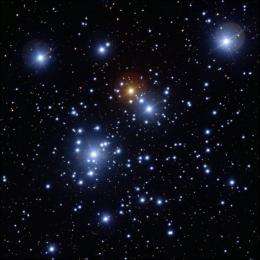
The FORS1 instrument on the ESO Very Large Telescope (VLT) at ESO's Paranal Observatory was used to take this exquisitely sharp close up view of the colorful Jewel Box cluster, NGC 4755. The telescope's huge mirror allowed very short exposure times: just 2.6 seconds through a blue filter (B), 1.3 seconds through a yellow/green filter (V) and 1.3 seconds through a red filter (R). The field of view spans about seven arcminutes. Credit: ESO/Y. Beletsky

(PhysOrg.com) -- Star clusters are among the most visually alluring and astrophysically fascinating objects in the sky. One of the most spectacular nestles deep in the southern skies near the Southern Cross in the constellation of Crux.

The Kappa Crucis Cluster, also known as NGC 4755 or simply the "Jewel Box" is just bright enough to be seen with the unaided eye. It was given its nickname by the English astronomer John Herschel in the 1830s because the striking colour contrasts of its pale blue and orange stars seen through a telescope reminded Herschel of a piece of exotic jewellery.

Open clusters such as NGC 4755 typically contain anything from a few to thousands of stars that are loosely bound together by gravity. Because the stars all formed together from the same cloud of gas and dust their ages and are similar, which makes them ideal laboratories for studying how stars evolve.

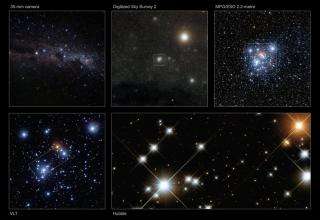
The position of the cluster amongst the rich star fields and dust clouds of the southern Milky Way is shown in the very wide field view generated from the Digitized Sky Survey 2 data. This image also includes one of the stars of the Southern Cross as well as part of the huge dark cloud of the Coal Sack.

A new image taken with the Wide Field Imager (WFI) on the MPG/ESO 2.2-metre telescope at ESO's in Chile shows the cluster and its rich surroundings in all their multicoloured glory. The large field of view of the WFI shows a vast number of stars. Many are located behind the dusty clouds of the Milky Way and therefore appear red.
Opening up a colorful cosmic jewel box
Enlarge

This composite image serves as a still “zoom-in”, showing the rich star field in which NGC 4755 nestles and then moving in to the detailed Hubble image of the Kappa Crucis Cluster, or Jewel Box, itself. The range of images begins with a very wide-field view of the sky surrounding NGC 4755. The images then progressively “zoom in” to reveal a “close-up” of the Jewel Box, featuring several very bright, pale blue supergiant stars, a solitary ruby-red supergiant and a variety of other brilliantly coloured stars. The picture on the top left was taken from the ground with a 35-mm camera. The next image is from the Digitized Sky Survey 2, a large digital atlas of the sky. Next is a very sharp image from the FORS1 instrument on the ESO Very Large Telescope at ESO’s Paranal Observatory. The first image (left) on the bottom row was taken by the Wide Field Imager (WFI) on the MPG/ESO 2.2-metre telescope at ESO’s La Silla Observatory. The last image (at bottom right) is the one taken by the legendary (and now retired) WFPC2 aboard Hubble.

The FORS1 instrument on the ESO Very Large Telescope (VLT) allows a much closer look at the cluster itself. The telescope's huge mirror and exquisite image quality have resulted in a brand-new, very sharp view despite a total exposure time of just 5 seconds. This new image is one of the best ever taken of this cluster from the ground.

The Jewel Box may be visually colourful in images taken on Earth, but observing from space allows the NASA/ESA Hubble Space Telescope to capture light of shorter wavelengths than can not be seen by telescopes on the ground. This new Hubble image of the core of the cluster represents the first comprehensive far ultraviolet to near-infrared image of an open galactic cluster. It was created from images taken through seven filters, allowing viewers to see details never seen before. It was taken near the end of the long life of the Wide Field Planetary Camera 2 ― Hubble's workhorse camera up until the recent Servicing Mission, when it was removed and brought back to Earth. Several very bright, pale blue supergiant stars, a solitary ruby-red supergiant and a variety of other brilliantly coloured stars are visible in the Hubble image, as well as many much fainter ones. The intriguing colours of many of the stars result from their differing intensities at different ultraviolet wavelengths.

The huge variety in brightness of the stars in the cluster exists because the brighter stars are 15 to 20 times the mass of the Sun, while the dimmest stars in the Hubble image are less than half the mass of the Sun. More massive stars shine much more brilliantly. They also age faster and make the transition to giant much more quickly than their faint, less-massive siblings.

The Jewel Box cluster is about 6400 light-years away and is approximately 16 million years old.

Source: ESO (news : web)


print this article email this article download pdf blog this article bookmark this article     Stumble it Digg this share on Facebook retweet share on Reddit add to delicious
Rate this story - 4.5 /5 (6 votes)

Rank Filter

Move the slider to adjust rank threshold, so that you can hide some of the comments.


Display comments: newest first

  • yyz - Oct 30, 2009
    • Rank: not rated yet
    Check out the link to the ESO press release, as it has much wider array of pics available, including the HST image shown in the mosaic above.

October 29, 2009 all stories

Comments: 1

4.5 /5 (6 votes)
  • Stumble this up

  • Digg this

  • share this

  • hide
  • Related Stories

  • A sparkling spray of stars
    created Dec 16, 2008 | popularity not rated yet | comments 0
  • Extreme star cluster bursts into life in new Hubble image
    created Oct 02, 2007 | popularity not rated yet | comments 0
  • Omega Centauri -- The Glittering Giant of the Southern Skies
    created Dec 02, 2008 | popularity not rated yet | comments 0
  • Massive star cluster in our backyard - astronomically speaking!
    created Mar 23, 2005 | popularity not rated yet | comments 0
  • An Eagle of Cosmic Proportions
    created Jul 16, 2009 | popularity not rated yet | comments 0


  • hide
  • Relevant PhysicsForums posts

  • Earth v. Moon
    created 2 hours ago
  • help me with coordinates and orbits
    created 2 hours ago
  • basic 'our universe' question..
    created 12 hours ago
  • deriving keplers law
    created Nov 19, 2009
  • rotation of Earth
    created Nov 18, 2009
  • elliptical orbits
    created Nov 18, 2009
  • More from Physics Forums - General Astronomy

Other News

Cassini's Big Sky: The View from the Center of Our Solar System

Cassini's Big Sky: The View from the Center of Our Solar System

Space & Earth / Space Exploration

created 20 hours ago | popularity 4.7 / 5 (10) | comments 1

(PhysOrg.com) -- When NASA's Cassini spacecraft began orbiting Saturn five years ago, a dozen highly-tuned science instruments set to work surveying, sniffing, analyzing and scrutinizing the Saturnian system.


Some 6,000 families were affected by the drought in the Chaco region of Paraguay, particularly indigenous populations

El Nino intensifies Latin America drought

Space & Earth / Earth Sciences

created 23 hours ago | popularity 5 / 5 (2) | comments 0

From a devastating food crisis in Guatemala to water cuts in Venezuela, El Nino has compounded drought damage across Latin America this year.


More than 18 million cubic metres of sand are set to be poured onto the new coastal band of dunes until 2011

Dutch build more dunes against rising seas

Space & Earth / Environment

created 15 hours ago | popularity 4.2 / 5 (5) | comments 0

On the beach at Monster, bulldozers painstakingly turn sand dredged from the bottom of the North Sea bed into dunes in an ambitious effort to safeguard the Netherlands from flooding.


New Method to Measure Snow, Soil Moisture With GPS May Benefit Meteorologists, Farmers

Space & Earth / Earth Sciences

created 15 hours ago | popularity not rated yet | comments 1

(PhysOrg.com) -- A research team led by the University of Colorado at Boulder has found a clever way to use traditional GPS satellite signals to measure snow depth as well as soil and vegetation moisture, a technique expected ...


Astronauts await word of baby girl on Earth (AP)

Astronauts await word of baby girl on Earth

Space & Earth / Space Exploration

created 17 hours ago | popularity 5 / 5 (1) | comments 0

(AP) -- Atlantis' astronauts anxiously awaited word on the birth of one crewman's daughter Friday, as they moved more supplies into the International Space Station and geared up for another spacewalk.