Russia hopes nuclear ship will fly humans to Mars
October 29, 2009 By VLADIMIR ISACHENKOV , Associated Press Writer
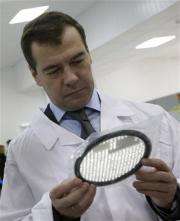
Russian President Dmitry Medvedev inspects a piece of equipment at a facility in Fryazino, outside Moscow, Wednesday, Oct. 28, 2009. Medvedev urged his government to find resources for building a prospective nuclear-powered spaceship. (AP Photo/ RIA Novosti, Vladimir Rodionov, Presidential Press Service)
(AP) -- Russia should build a new nuclear-powered spaceship for prospective manned missions to Mars and other planets, the nation's space chief said Thursday.
Anatoly Perminov first proposed building the ship at a government meeting Wednesday but didn't explain its purpose. President Dmitry Medvedev backed the project and urged the government to find the money.
In remarks posted Thursday on his agency's Web site, Perminov said the nuclear spaceship should be used for human flights to Mars and other planets. He said the project is challenging technologically, but could capitalize on the Soviet and Russian experience in the field.
Perminov said the preliminary design could be ready by 2012, and then it would take nine more years and cost 17 billion rubles (about $600 million, or euro400 million) to build the ship.
"The project is aimed at implementing large-scale space exploration programs, including a manned mission to Mars, interplanetary travel, the creation and operation of planetary outposts," Perminov's Web statement said.
The ambitious plans contrast with Russia's slow progress on building a replacement to its mainstay spacecraft - the Soyuz.
Russia is using Soyuz booster rockets and capsules, developed 40 years ago, to send crews to the International Space Station. The development of a replacement rocket and a prospective spaceship with a conventional propellant has dragged on with no end in sight.
Despite its continuing reliance on the old technology, Russia stands to take a greater role in space exploration in the coming years. NASA's plan to retire its shuttle fleet next year will force the United States and other nations to rely on the Russian spacecraft to ferry their astronauts to and from the International Space Station until NASA's new manned ship becomes available.
Perminov said the new nuclear-powered ship should have a megawatt-class nuclear reactor, as opposed to small nuclear reactors that powered some Soviet military satellites. The Cold War-era Soviet spy satellites had reactors that produced just a few kilowatts of power and had a life span of about a year.
Igor Lisov, a Moscow-based expert on Russian space program, said the prospective ship would use a nuclear reactor to run an electric rocket engine.
"It will be quite efficient for flight to Mars," he told The Associated Press on Thursday.
Lisov said Soviet work on a nuclear-powered electric rocket engine dates back to the 1960s when Soviet engineers began developing plans for a manned flight to Mars.
He said Russia's experience in building nuclear-powered satellites would also help develop the new spaceship. "It will require a significantly more powerful nuclear reactor, but the task is quite realistic," Lisov said.
Stanley Borowski, a senior engineer at NASA specializing in nuclear rocket engines, said they have many advantages for deep space missions, such as to take astronauts and gear to Mars. In deep space, nuclear rockets are twice as fuel-efficient as conventional rockets, he said.
NASA has used small amounts of plutonium in deep space probes, including those to Jupiter, Saturn, Pluto and heading out of the solar system.
The only planetary mission currently considered by Russia is a plan to send a probe to one of Mars' twin moons, Phobos. It was set to launch this year, but was delayed.
©2009 The Associated Press. All rights reserved. This material may not be published, broadcast, rewritten or redistributed.
-
Russia, China plan moon exploration
Sep 11, 2006 |
not rated yet |
0
-
Russia to exhibit new Clipper spaceship
Aug 11, 2005 |
not rated yet |
0
-
Russia planning new space platform
Dec 18, 2007 |
not rated yet |
0
-
In Brief: Russia to build moon rocket
Oct 19, 2006 |
not rated yet |
0
-
Russia To Assist China's Lunar Research Program
Nov 10, 2005 |
not rated yet |
0
-
Engineers build first sub-10-nm carbon nanotube transistor
Feb 01, 2012 |
4.9 / 5 (33) |
30
-
Something old, something new: Evolution and the structural divergence of duplicate genes
Jan 31, 2012 |
4.6 / 5 (7) |
1
-
The hidden nanoworld of ice crystals: Revealing the dynamic behavior of quasi-liquid layers
Jan 30, 2012 |
5 / 5 (4) |
1
-
Stock market network reveals investor clustering
Jan 27, 2012 |
3.9 / 5 (23) |
8
-
Of microchemistry and molecules: Electronic microfluidic device synthesizes biocompatible probes
Jan 26, 2012 |
5 / 5 (2) |
0
-
Never ending outer space.....
Feb 11, 2012
-
Neutron Star fragments?
Feb 11, 2012
-
stationary or not?
Feb 11, 2012
-
Scale of the Universe
Feb 10, 2012
-
Titan's lack of impact craters
Feb 09, 2012
-
Real pictures of black hole eating a star?
Feb 08, 2012
- More from Physics Forums - General Astronomy
More news stories
Salvage workers begin pumping fuel from Italian shipwreck
Salvage workers Sunday began pumping fuel from the shipwrecked Italian cruise liner Costa Concordia, a day ahead of schedule, officials said.
10 hours ago |
5 / 5 (2) |
0
Latin America mining boom clashes with conservation
Latin America is experiencing a mining boom as prices rise fuelled by a hike in global demand, but the region is also being hit by a wave of violent protests, strikes and rallies by environmentalists.
18 hours ago |
5 / 5 (1) |
1
Political leaders play key role in how worried Americans are by climate change: study
More than extreme weather events and the work of scientists, it is national political leaders who influence how much Americans worry about the threat of climate change, new research finds.
Feb 06, 2012 |
5 / 5 (8) |
75
NASA budget will axe Mars deal with Europe: scientists
US President Barack Obama's budget proposal to be submitted next week for 2013 will cut NASA's budget by 20 percent and eliminate a major partnership with Europe on Mars exploration, scientists said Thursday.
Space & Earth / Space Exploration
Feb 10, 2012 |
5 / 5 (3) |
58
Humans may have helped the decline of African rainforests 3000 years ago
(PhysOrg.com) -- Large areas of rainforests in Central Africa mysteriously disappeared over three thousand years ago, to be replaced by savannas. The prevailing theory has been that the cause was a change ...
Scientists discover molecular secrets of 2,000-year-old Chinese herbal remedy
For roughly two thousand years, Chinese herbalists have treated Malaria using a root extract, commonly known as Chang Shan, from a type of hydrangea that grows in Tibet and Nepal. More recent studies suggest that halofuginone, ...
New method to examine batteries -- MRI from the inside
There is an ever-increasing need for advanced batteries for portable electronics, such as phones, cameras, and music players, but also to power electric vehicles and to facilitate the distribution and storage of energy derived ...
Google might launch Drive for cloud storage soon
(PhysOrg.com) -- Google's next big move, according to the Wall Street Journal, is a cloud storage service called Drive. Hardly first to the plate, Google is simply catching up to introducing its cloud reposi ...
A mitosis mystery solved: How chromosomes align perfectly in a dividing cell
Although the process of mitotic cell division has been studied intensely for more than 50 years, Whitehead Institute researchers have only now solved the mystery of how cells correctly align their chromosomes during symmetric ...
Lab study raises questions over nano-particle impact
Tests involving chickens have raised questions about the impact on health from engineered nano-particles, the ultra-fine grains commonly used in drugs and processed foods, scientists said on Sunday.
Starve a virus, feed a cure? Findings show how some cells protect themselves against HIV
A protein that protects some of our immune cells from the most common and virulent form of HIV works by starving the virus of the molecular building blocks that it needs to replicate, according to research published online ...
Oct 29, 2009
Rank: 4.3 / 5 (6)
Link: www.physorg.com/news174031552.html
Nasa will use this propulsion technology in 2012-2013. So Russia can not left behind.
Oct 29, 2009
Rank: 4.7 / 5 (6)
I was just wondering: why don't they have this universal space station/science lab/etc. and each country can contribute to it (so it's planning a manned mission to Mars -- all countries donate some money therefore the burden on just one country is lightened) and then everyone who participates gets credit for first mission to Mars instead of us fighting over the spot (like the Space Race during the cold war).
So instead of "USA went to Mars" it's "The Earth made it to Mars" O.o ...maybe?
Oct 29, 2009
Rank: 3 / 5 (2)
Oct 29, 2009
Rank: 3 / 5 (4)
. . . go russia! Lets have a red flag on the red planet first! Hopefully, you guys/gals settle there as well! Tap those infinit resources without destroying living ecosystems(not likely on mars or various asteroids); and free energy! whew hew! Somebody clearly is thinking better than others here! And it's those scientific russians!
Full speed ahead!
Oct 29, 2009
Rank: 4.6 / 5 (5)
Cooperation and coordination should really be the way ahead as demonstrated at CERN. It is so wasteful of resources to have various nations all expending resources to achieve the same end.
Oct 29, 2009
Rank: 4.3 / 5 (3)
Oct 29, 2009
Rank: 3 / 5 (2)
So thats what the Cold War was for (among other things)- producing the few thousand tons of fissionable material civilization needs to colonize space. Ships, autonomous tunnel borers, mine machines and factories preparing the way for us hatchlings-
Oct 29, 2009
Rank: 2.3 / 5 (3)
technology which is recognised by AIAA.
Search for "Advanced Linear Electron Beam Phased Propulsion"
Oct 29, 2009
Rank: 4 / 5 (4)
Are you saying...that they should be sued for making one??? (if so...what a typically American thing to say!) I for one applaud them for overcoming great obstacles, and wish them nothing but success! They were on the moon long before the U.S. (robotically-speaking of course) but never got their just recognition.
Oct 29, 2009
Rank: 3.5 / 5 (2)
Oct 29, 2009
Rank: 4 / 5 (1)
Oct 30, 2009
Rank: 3.7 / 5 (3)
Oct 30, 2009
Rank: 1 / 5 (1)
Oct 30, 2009
Rank: 2.3 / 5 (3)
Oct 30, 2009
Rank: not rated yet
I think it would be strategic to pour everything into space elevator development, then you have a work horse to build the ship (amongst many other things) in space with a nuclear engine, both should be international co-operative efforts.
Go the Russians!
Oct 30, 2009
Rank: 1 / 5 (1)
Oct 30, 2009
Rank: not rated yet
Oct 30, 2009
Rank: not rated yet
Oct 30, 2009
Rank: 1 / 5 (1)
Oct 30, 2009
Rank: 5 / 5 (1)
tom p
Oct 31, 2009
Rank: 4 / 5 (1)
Oct 31, 2009
Rank: not rated yet
Oct 31, 2009
Rank: not rated yet
Oct 31, 2009
Rank: not rated yet
Now, the Russians do make good nuclear reactors. A 200 MWatt reactor is needed to power the VASIMR engine. So it makes perfect sense to combine the two. I also believe that with enough funding the Russians can make their own version of the VASIMR, it is not a new concept.
They would need to pull some new tech out of their rear, and I'm sure it's possible with enough funding, I just don't think they are going to actually get funded, which is quite sad. Russian mentality = "don't fix it till it breaks", that's why they still fly in the Soyuz, simply because it still works for them.
Oct 31, 2009
Rank: 5 / 5 (1)
http://www.youtub...FowOge_M
Nov 01, 2009
Rank: not rated yet
has a thrust of more than FIVE newtons, not 300 kilonewtons. Specific impulse is around 6000 seconds.
NERVA managed 72 kilonewtons, with a specific impulse of
about 875 seconds, in the 1970s. I think the design
burn time was 20 hours.
By contrast, the Space Shuttle engines have a specific
impulse of 453, and the solid boosters of between 240 and
268.
However, the solid rocket boosters are good for
FIVE MILLION newtons of thrust. The space shuttle
engines are good for less than ONE MILLION newtons
of thrust. Russian RD0410 is good for less than one
28th of the space shuttle thrust. The best VASIMR
thruster is good for one SEVEN THOUSANDTH of the
RDO410.
See the trend? Thrust is inversely proportional to efficiency.
Find that inflection point on that curve, and apply it to Mars.
There's an unimplemented thermal/fusion drive between
the fission drive and the chemical drive, but it's silly
to talk about it now.
Nov 01, 2009
Rank: not rated yet
http://www.astron...erva.htm
Burn time time of a NERVA engine is 20 minutes due to fast degradation of the active zone of this high power engine. The nuclear reactor of RD0410 is still working.
All developments, including the Russian one, are only research stage devices.
Nov 01, 2009
Rank: not rated yet
VASIMR it is a project on a plasma engine, i.e. it is different from NERVA and RD0410. It requires a nuclear power source. The most powerful ones was Russian space-tested TOPAZ (http://www.redsta...ear.htm) bought by the USA in 90s. It has the electric power 150 kW. Space flights require 5-15 Mw, minimum.
Nov 01, 2009
Rank: not rated yet
This nuclear fusion reactor could provide an Isp of over 1 million seconds.
http://www.crossf...ons.html
Nov 01, 2009
Rank: not rated yet
"NASA's plan to retire its shuttle fleet next year will force the United States and other nations to rely on the Russian spacecraft to ferry their astronauts to and from the International Space Station until NASA's new manned ship becomes available."
This ignores the existence of SpaceX.
Nov 02, 2009
Rank: 1 / 5 (1)
Nov 02, 2009
Rank: not rated yet
Nov 02, 2009
Rank: 1 / 5 (1)
Nov 02, 2009
Rank: 3.5 / 5 (2)
I don't know the guy, he may very well be a very smart, well-intentioned fellow, but he's asking the government of a country that has an average life expectancy of 50-something years, more alcohol related deaths than anywhere on the planet, serious corruption problems, a very weak economy(for a country with massive resources), has recently been involved in a territorial war and generally isn't doing too well domestically, to spend 400 mil. euros(seriously? is there a discount shop I'm not aware of?) on speculative technologies with little short to mid-term gain.
Seriously, why the bloody hell does everyone think that getting to Mars will solve all of Earth's problems? Let's prove we can sustain ourselves on one planet before we start f*cking up outer space.
Nov 02, 2009
Rank: not rated yet
Just find a rich space tourist to finance the trip for you... Bill Gates could afford to fly there dozens of times
Nov 05, 2009
Rank: 1 / 5 (1)