New rechargeable zinc-air batteries coming soon
October 29, 2009 by Lin Edwards
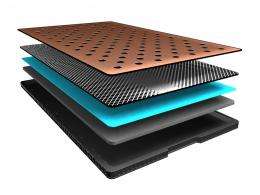
Battery layers. Image: ReVolt
(PhysOrg.com) -- A new breed of rechargeable zinc-air batteries is soon to be available, and may replace lithium-ion batteries in cell phones, laptops and other consumer items. Lithium-ion batteries store only a third of the energy and cost around twice as much as the new batteries.
The Swiss company ReVolt, from Staefa, plans to release the new batteries next year, initially as small batteries for use in hearing aids, and later for cell phones. Eventually much larger batteries are planned for electric vehicles.
The new battery was developed in Trondheim in Norway by the SINTEF Group, the largest independent research institution in Scandinavia, and ReVolt was formed to market the device.
Zinc-air batteries need oxygen from the air to generate the current. They are safer than lithium-ion batteries because they do not contain volatile materials, and therefore do not catch fire. Non-rechargeable zinc-air batteries have been available for some time, but rechargeable versions have proved more difficult to develop.
The battery consists of an "air" electrode, an electrolyte, and a zinc electrode, all set in a casing that lets in air. When the battery is discharging the air electrode (with the help of catalysts) produces hydroxyl ions in the aqueous electrolyte. At the zinc electrode the hydroxyl ions oxidize the zinc, a process that releases electrons to form an electric current. During recharging the process is reversed, with oxygen being released at the air electrode.
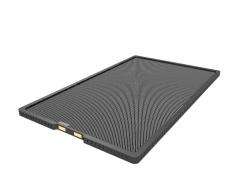
Battery. Image: ReVolt
In previous rechargeable zinc-air batteries the air electrolyte became deactivated and the reduction and oxidation reactions slowed or stopped after a few discharge/recharge cycles. The battery function could also be degraded if the water-based electrolyte dried out or was absorbed too deeply into the pores, and if the zinc deposited in the recharge cycles built up unevenly, which could cause short circuits.The new battery uses gelling and binding agents to control the zinc electrode shape, and controls the humidity inside the battery. The new catalysts used have been tested and found to improve both the reduction and production of oxygen during discharge/recharge cycles.
Prototypes of the new battery have been tested for more than a hundred cycles, and are expected to last at least twice as long. CEO of ReVolt, James McDougall, said the company aims to increase the life to between 300 and 500 cycles, which would make them useful for cell phones and electric bicycles.
ReVolt has also been developing zinc-air batteries for use in electric vehicles. These batteries resemble fuel cells, with a zinc slurry forming a liquid zinc electrode, and a series of tubes forming the air electrode. Electricity is generated by pumping the slurry through the tubes, where it is oxidized and releases electrons. The resultant zinc oxide is stored in another compartment and flows back through the tubes when the battery is recharging. This releases oxygen, and the zinc oxide reverts to zinc.
Since the slurry can be in greater volume than the air electrode, the energy density is increased and more electricity is produced. McDougall expects the batteries to last much longer too, for up to 10,000 discharge/recharge cycles. The battery could also be repaired, by replacing failed parts such as the air electrode.
The zinc-air battery for hearing aids will be available next year. The battery for electric vehicles is still some years away from mass marketing.
More information: http://www.revoltt … hnology.com/
© 2009 PhysOrg.com
-
Zinc-Air Batteries Will Extend Mission Times Of NASA Micro Aerial Vehicles
Jun 27, 2005 |
not rated yet |
0
-
ZPower claims its silver-zinc batteries last 40% longer than lithium-ion
Oct 08, 2008 |
not rated yet |
0
-
New Battery Technology in Development to Potentially Double Laptop Run Times
Jun 11, 2004 |
not rated yet |
0
-
An environment-friendly rechargeable battery
Jun 09, 2005 |
not rated yet |
0
-
Researchers predict 'nanobattery' performance
Apr 02, 2007 |
not rated yet |
0
-
Engineers build first sub-10-nm carbon nanotube transistor
Feb 01, 2012 |
5 / 5 (21) |
19
-
Something old, something new: Evolution and the structural divergence of duplicate genes
Jan 31, 2012 |
4.6 / 5 (7) |
1
-
The hidden nanoworld of ice crystals: Revealing the dynamic behavior of quasi-liquid layers
Jan 30, 2012 |
5 / 5 (2) |
1
-
Stock market network reveals investor clustering
Jan 27, 2012 |
4.1 / 5 (21) |
8
-
Of microchemistry and molecules: Electronic microfluidic device synthesizes biocompatible probes
Jan 26, 2012 |
not rated yet |
0
-
Tennis Court Speed Measurement
11 hours ago
-
Fastest way to cool water
19 hours ago
-
Counter-weights
Feb 02, 2012
-
Composite electric glass heating elements
Feb 02, 2012
-
pipe stress analysis
Feb 02, 2012
-
Interested in average household energy consumption in 2011...
Feb 01, 2012
- More from Physics Forums - General Engineering
More news stories
Hackers intercept FBI, Scotland Yard call (Update)
(AP) -- Trading jokes and swapping leads, investigators from the FBI and Scotland Yard spent the conference call strategizing about how to bring down the hacking collective known as Anonymous, responsible ...
13 hours ago |
5 / 5 (7) |
22
Japanese entrepreneurs aim for Silicon Valley
For an emerging generation of Japanese innovators, the dream isn't a job for life at a big company. They have new ambitions, and they're determined to go places. Especially Silicon Valley.
10 hours ago |
5 / 5 (1) |
1
A 'natural' solution for transportation
As the United States transitions away from a primarily petroleum-based transportation industry, a number of different alternative fuel sourcesethanol, biodiesel, electricity and hydrogenhave each ...
Technology / Energy & Green Tech
14 hours ago |
3 / 5 (2) |
13
Hackers deface website of lawyers for US Marine
Members of the hacker group Anonymous defaced the website on Friday of the law firm that defended a US Marine who faced charges in connection with the 2005 killing of 24 Iraqi civilians.
7 hours ago |
5 / 5 (2) |
2
TV executives crave viewers who watch 2 screens
Forget the small screen and the big screen. The hottest new thing in television is the "second screen" - the one on the tablet computer or cell phone that an increasing number of viewers keep an eye on while they're watching ...
7 hours ago |
1 / 5 (2) |
0
Amazon fungi found that eat polyurethane, even without oxygen
(PhysOrg.com) -- Until now polyurethane has been considered non-biodegradable, but a group of students from Yale University in the US has found fungi that will not only eat and digest it, they will do so even in the absence ...
Scientists chart high-precision map of Milky Way's magnetic fields
(PhysOrg.com) -- Scientists at the Naval Research Laboratory (NRL) are part of an international team that has pooled their radio observations into a database, producing the highest precision map to date of ...
Whole exome sequencing identifies cause of metabolic disease
Sequencing a patient's entire genome to discover the source of his or her disease is not routine yet. But geneticists are getting close.
Hearing metaphors activates brain regions involved in sensory experience
When a friend tells you she had a rough day, do you feel sandpaper under your fingers? The brain may be replaying sensory experiences to help understand common metaphors, new research suggests.
Renowned physicist invents microscope that can peer at living brain cells
(PhysOrg.com) -- Ever since scientists began studying the brain, theyve wanted to get a better look at what was going on. Researchers have poked and prodded and looked at dead cells under electron microscopes, ...
New kind of high-temperature photonic crystal could someday power everything from smartphones to spacecraft
A team of MIT researchers has developed a way of making a high-temperature version of a kind of materials called photonic crystals, using metals such as tungsten or tantalum. The new materials which ...
Oct 29, 2009
Rank: 2.9 / 5 (7)
Oct 29, 2009
Rank: 4.6 / 5 (5)
Oct 29, 2009
Rank: 3.5 / 5 (2)
Oct 29, 2009
Rank: 3.5 / 5 (2)
Oct 29, 2009
Rank: not rated yet
Oct 30, 2009
Rank: not rated yet
Oct 30, 2009
Rank: 5 / 5 (1)
1000 miles??? Wow, talk about setting the bar high.
85% of drivers drive less then 40 miles a day. You go do the math.
Oct 30, 2009
Rank: 4.5 / 5 (2)
Actually, I think that's pretty realistic. The Tesla Model-S is supposed to get 300 miles on its lithium-ion batteries. If these batteries have three times the energy density then it shouldn't be a problem to get to 1000. If you could go to a station and swap exhausted goo for charged goo as David 42 suggested you'd be laughing.
Oct 31, 2009
Rank: not rated yet
With these zinc air batteries, you may have the energy, but you don't have the power. Meaning it stores a lot but it will charge VERY slowly and provide VERY low power to drive the car.
For energy storage, there are several factors:
1) Energy density, the hot topic everywhere. How much can it store per unit of weight or volume.
2) Power density, few people realize it is the reason why Lithium air or Zinc air batteries aren't suited to the automotive market. How fast energy can be transfered to and from the battery.
3) Cost $$$ the most important factor really.
4) Cycle and life durability
5) Environmental sustainability, availibility, toxicity, volitility, crash durability, thermal tolerances, etc.
This is one of the most exciting fields in science today.
Oct 31, 2009
Rank: not rated yet
http://www.electr...ex.shtml
Oct 31, 2009
Rank: not rated yet
Nov 01, 2009
Rank: not rated yet
Think again: When your current car reaches 300 miles you simply go to a gas station and are ready to continue your trip in a few minutes.
With current battery technology those 300 miles would be all you get in one day. If your destination is further away: tough luck - get a hotel while your car recharges.
So the 1000 miles is not all that much overblown as a demand for e-cars (Although I'd say 1000km is more realistic for the maximum travel distance anyone would do during one day)
However, I could envision using a modular approach: Have a scaled down trailer with additional batteries which you attach for long distance journeys. When you only do day-to-day, short distance driving unhook it and leave it at your base (at home or the place where you drove to on vacation).
Nov 02, 2009
Rank: not rated yet
They're already in a motor bike/scooter:
http://www.wired....-comman/
No, I don't work for the company, but had saved a notice about the battery from 2007, and this article prompted me to see where they've gone since then.
I don't know how they compare to the zinc-air batteries, but they're much further along in development.
Nov 02, 2009
Rank: not rated yet
Motive applications include vehicles and personal electronics and are the most challenging.
However, stationary applications, such as utility scale battery plants, are much less challenging and also encompass an enormous market potential.
Note that energy density is not a deal-breaker in stationary battery systems, as with motive ones. This is where I believe the first breakthroughs will occur, also because there are not the same market forces hindering a quick adaptation to electric technology, as is the case with vehicles.
Nov 03, 2009
Rank: not rated yet
They are about 10K USD more than comparable internal combustion vehicles, they should soon produce packs to support 300+ mile ranges. They also can recharge overnight on regular household circuits. Biggest drawback would be grid issues in supplying charge power for eight or more charging units at a typical fueling station. They have also demonstrated a 65 passenger bus.