Venomous bite: Harmless digestive enzyme evolved into venom in two species
October 29, 2009 Venomous bite: Harmless digestive enzyme evolved into venom in two species

Enlarge

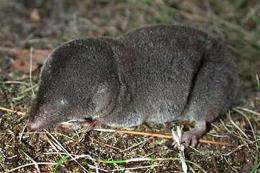
A harmless digestive enzyme can be turned into a toxin in two unrelated species — a shrew (pictured) and a lizard — thereby giving each a venomous bite. Courtesy of the University of Michigan Museum of Zoology

(PhysOrg.com) -- Biologists have shown that independent but similar molecular changes turned a harmless digestive enzyme into a toxin in two unrelated species -- a shrew and a lizard -- giving each a venomous bite.

The work, described this week in the journal by researchers at Harvard University, suggests that protein adaptation may be a highly predictable process, one that could eventually help discover other toxins across a wide array of species.

"Similar changes have occurred independently in a shrew and a lizard, causing both to be toxic," says senior author Hopi E. Hoekstra, John L. Loeb Associate Professor of the Natural Sciences in Harvard's Department of Organismic and . "It's remarkable that the same types of changes have independently promoted the same toxic end product."

Lead author Yael T. Aminetzach, a postdoctoral researcher in the same department, suggests that the work has important implications for our understanding of how novel protein function evolves by studying the relationship between an ancestral and harmless protein and its new toxic activity.

"The venom is essentially an overactivation of the original digestive enzyme, amplifying its effects," she says. "What had been a mild in the salivary glands of both species has become a much more extreme compound that causes paralysis and death in prey that is bitten."

In the first part of the study, Aminetzach and her colleagues compared a toxin found in the salivary glands of the insectivorous North American shrew Blarina brevicauda to its closely related digestive enzyme kallikrein. Enzymes are proteins that catalyze, or increase the rates of, chemical reactions; this rate enhancement occurs at a specific region on an enzyme called the active site.

Aminetzach found that the specific molecular differences between kallikrein and its toxic descendent are highly localized around the enzyme's active site.

" is fostered by three specific changes that increase enzyme activity," Aminetzach says. "The active site is physically opened up, and the loops surrounding it become more flexible. The area around the active site also becomes positively charged, serving to better guide the substrate directly into the active site."

To further demonstrate that these molecular changes to kallikrein are related to the evolution of toxicity, Aminetzach explored the evolution of another kallikrein-like toxin in the Mexican beaded lizard (Helodermata horridum). She found that this toxin, while distinct from the analogous toxin in the shrew, nonetheless exhibits the same catalytic enhancement relative to the original kallikrein enzyme.

Equally important, she found that this functional change in the lizard toxin is accomplished through similar molecular modifications of kallikrein, and through identical mechanisms of structural alteration of the active site, as in the shrew toxin.

This insight -- namely, that toxins could arise by increasing the catalytic activity of enzymes through a conserved and predictable mechanism -- could be used both to identify other kallikrein-derived toxic proteins and as a method to evolve new function in general.

Source: Harvard University (news : web)


print this article email this article download pdf blog this article bookmark this article     Stumble it Digg this share on Facebook retweet share on Reddit add to delicious
Rate this story - not rated yet


October 29, 2009 all stories

Comments: 0

not rated yet
  • Stumble this up

  • Digg this

  • share this

  • hide
  • Related Stories

  • Evolution mystery: Spider venom and bacteria share same toxin
    created Feb 01, 2006 | popularity not rated yet | comments 0
  • Researchers discover a method for clamping down on a cancer-promoting enzyme
    created Apr 18, 2008 | popularity not rated yet | comments 0
  • Snake venoms share similar ingredients
    created Dec 20, 2007 | popularity not rated yet | comments 0
  • Unlocking the function of enzymes
    created Nov 06, 2007 | popularity not rated yet | comments 0
  • A Change for the better: Improving properties of enzymes
    created Sep 24, 2009 | popularity not rated yet | comments 0


  • hide
  • Relevant PhysicsForums posts

  • Human Leukocyte Antigen (HLA) typing
    created 4 hours ago
  • Breeding program
    created Nov 20, 2009
  • How does a concentration gradient provide energy?
    created Nov 20, 2009
  • Eyesight and Neural Damage from Electronics
    created Nov 19, 2009
  • More from Physics Forums - Biology

Other News

The Monarchs' annual migration ritual has yet to be scientifically explained

Tree-eating bugs threaten Monarch butterfly in Mexico

Biology / Ecology

created 5 hours ago | popularity 4 / 5 (1) | comments 0

The mysterious Monarch butterfly, which migrates en masse annually between Canada and Mexico, is now facing a new peril: another insect thriving in Western Mexican forests.


Extinct goat Myotragus balearicus

Extinct goat was cold-blooded

Biology / Plants & Animals

created Nov 18, 2009 | popularity 4.9 / 5 (32) | comments 10

(PhysOrg.com) -- An extinct goat that lived on a barren Mediterranean island survived for millions of years by reducing in size and by becoming cold-blooded, which has never before been discovered in mammals.


Bigger not necessarily better, when it comes to brains

Bigger not necessarily better, when it comes to brains

Biology / Plants & Animals

created Nov 17, 2009 | popularity 4.5 / 5 (17) | comments 11

(PhysOrg.com) -- Tiny insects could be as intelligent as much bigger animals, despite only having a brain the size of a pinhead, say scientists at Queen Mary, University of London.


Right-handed chimpanzees provide clues to the origin of human language

Biology / Plants & Animals

created Nov 16, 2009 | popularity 3 / 5 (1) | comments 7

Most of the linguistic functions in humans are controlled by the left cerebral hemisphere. A study of captive chimpanzees at the Yerkes National Primate Research Center (Atlanta, Georgia), reported in the January 2010 issue ...


The creature was found at a depth of 161 metres

Japanese researchers film rare baby fish 'fossil'

Biology / Plants & Animals

created Nov 17, 2009 | popularity 4.7 / 5 (7) | comments 4

Japanese marine researchers said Tuesday they had found and successfully filmed a young coelacanth -- a rare type of fish known as "a living fossil" -- in deep water off Indonesia.