Ancient ocean chemistry: Effects of biological oxygen production 100 million years before it accumulated in atmosphere
October 29, 2009 A new wrinkle in ancient ocean chemistry

Enlarge

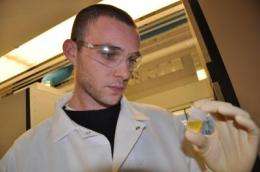
UC Riverside's Chris Reinhard studies a sample of pulverized black shale in solution. Credit: UCR Strategic Communications.

(PhysOrg.com) -- Scientists widely accept that around 2.4 billion years ago, the Earth's atmosphere underwent a dramatic change when oxygen levels rose sharply. Called the "Great Oxidation Event" (GOE), the oxygen spike marks an important milestone in Earth's history, the transformation from an oxygen-poor atmosphere to an oxygen-rich one paving the way for complex life to develop on the planet.

Two questions that remain unresolved in studies of the are when production via got started and when it began to alter the chemistry of Earth's and atmosphere.

Now a research team led by geoscientists at the University of California, Riverside corroborates recent evidence that oxygen production began in Earth's oceans at least 100 million years before the GOE, and goes a step further in demonstrating that even very low concentrations of oxygen can have profound effects on ocean chemistry.

To arrive at their results, the researchers analyzed 2.5 billion-year-old black shales from Western Australia. Essentially representing fossilized pieces of the ancient , the fine layers within the rocks allowed the researchers to page through ocean chemistry's evolving history.

Specifically, the shales revealed that episodes of accumulation in the oxygen-free occurred nearly 100 million years before the GOE and up to 700 million years earlier than such conditions were predicted by past models for the early ocean. Scientists have long believed that the early ocean, for more than half of Earth's 4.6 billion-year history, was characterized instead by high amounts of dissolved iron under conditions of essentially no oxygen.

"The conventional wisdom has been that appreciable atmospheric oxygen is needed for sulfidic conditions to develop in the ocean," said Chris Reinhard, a Ph.D. graduate student in the Department of Earth Sciences and one of the research team members. "We found, however, that sulfidic conditions in the ocean are possible even when there is very little oxygen around, below about 1/100,000th of the oxygen in the modern atmosphere."

Reinhard explained that at even very low oxygen levels in the atmosphere, the mineral pyrite can weather on the continents, resulting in the delivery of sulfate to the ocean by rivers. Sulfate is the key ingredient in hydrogen sulfide formation in the ocean.

Timothy Lyons, a professor of biogeochemistry, whose laboratory led the research, explained that the hydrogen sulfide in the ocean is a fingerprint of photosynthetic production of oxygen 2.5 billion years ago.

"A pre-GOE emergence for oxygenic photosynthesis is a matter of intense debate, and its resolution lies at the heart of understanding the evolution of diverse forms of life," he said. "We have found an important piece of that puzzle."

Study results appear in the Oct. 30 issue of Science.

"Our data point to oxygen-producing photosynthesis long before concentrations of oxygen in the atmosphere were even a tiny fraction of what they are today, suggesting that oxygen-consuming chemical reactions were offsetting much of the production," said Reinhard, the lead author of the research paper.
A new wrinkle in ancient ocean chemistry
Enlarge

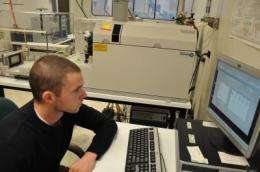
UC Riverside's Chris Reinhard analyzes metal content in 2.5 billion-year-old black shale using a mass spectrometer seen to his left. Credit: UCR Strategic Communications.

The researchers argue that the presence of small amounts of oxygen may have stimulated the early evolution of eukaryotes - organisms whose cells bear nuclei - millions of years prior to the GOE.

"This initial oxygen production set the stage for the development of animals almost two billion years later," Lyons said. "The evolution of eukaryotes had to take place first."

The findings also have implications for the search for life on extrasolar planets.

"Our findings add to growing evidence suggesting that biological production of oxygen is a necessary but not sufficient condition for the evolution of complex life," Reinhard said. "A planetary atmosphere with abundant oxygen would provide a very promising biosignature. But one of the lessons here is that just because spectroscopic measurements don't detect oxygen in the atmosphere of another planet doesn't necessarily mean that no biological oxygen production is taking place."

To analyze the shales, Reinhard first pulverized them into a fine powder in Lyons's laboratory. Next, the powder was treated with a series of chemicals to extract different minerals. The extracts were then run on a mass-spectrometer at UC Riverside.

"One exciting thing about our discovery of sulfidic conditions occurring before the GOE is that it might shed light on ocean chemistry during other periods in the geologic record, such as a poorly understood 400 million-year interval between the GOE and around 1.8 billion years ago, a point in time when the deep oceans stopped showing signs of high iron concentrations," Reinhard said. "Now perhaps we have an explanation. If sulfidic conditions could occur with very small amounts of oxygen around, then they might have been even more common and widespread after the GOE."

Said Lyons, "This is important because oxygen-poor and sulfidic conditions almost certainly impacted the availability of nutrients essential to life, such as nitrogen and trace metals. The evolution of the ocean and atmosphere were in a cause-and-effect balance with the evolution of life."

Source: University of California - Riverside (news : web)


Rate this story - 4.8 /5 (13 votes)

Rank Filter

Move the slider to adjust rank threshold, so that you can hide some of the comments.


Display comments: newest first

  • Mandan - Oct 29, 2009
    • Rank: 4.2 / 5 (5)
    This was the point at which the mitochondrion entered into symbiotic cooperation with the nucleated cell, filtering out the deadly toxin oxygen for the nucleated cell and producing huge quantities of energy for the subsequent evolution into more and more complex, multi-cellular organisms. Lynn Margulis has pioneered this research, and her book 'Microcosmos' is an outstanding explanation of the basic processes of evolution, especially for those who believe evolution has been disproven.
  • Ethelred - Oct 30, 2009
    • Rank: 4.8 / 5 (4)
    Such preposterous claims

    Since when it is it preposterous to go on the evidence?
    Please focus on real science--that is, the study of the present,

    The present was formed by the past. We cannot understand the present without understanding the past.

    Perhaps you just don't want to know the truth as it appears that it must conflict with your religious beliefs.
    Evolution has already been debunked by thousands of scientists as patently false and mathematically impossible.

    Since when does a few dozen cranks count as thousands? Evolution is real. The entire world confirms this. The ONLY reason to think that evolution isn't real is religious.

    Now would you care to post some evidence that the world is young? Radiative dating will quite nicely as the physics are exceedingly well understood.

    Ethelred
  • peteone1 - Oct 30, 2009
    • Rank: 1 / 5 (5)
    ((Since when it is it preposterous to go on the evidence?))
    Never.

    ((The present was formed by the past. We cannot understand the present without understanding the past.))
    Is the slogan of Uniformitarian philosophy concerning geology popularized by Hutton in the 19th century. Although we take it at face value to be honest no one was present in the past to make an empirical observation of the past. All we have to go on is the fossil record and some good approximations based on our current understanding of nature.

    ((you just don't want to know the truth as it appears that it must conflict with your religious beliefs))
    That's not so since I am a Christian & have no prob with evolution.

    ((Since when does a few dozen cranks count as thousands? ))
    Not so fast, ~ 50% of Americans believe that we were created like we are now about 10,000 yrs ago as a literal reading of Genesis teaches.

    ((The ONLY reason to think that evolution isn't real is religious))
    Not really...atheism is a religion.
  • Ethelred - Oct 30, 2009
    • Rank: 5 / 5 (3)
    Is the slogan of Uniformitarian philosophy concerning geology popularized by Hutton in the 19th century.

    I will take your word about that. I simply pointed out the obvious and Uniformitarianism is wrong in any case.
    Although we take it at face value to be honest no one was present in the past to make an empirical observation of the past.

    Which does not stop us from learning from the past.
    That's not so since I am a Christian & have no prob with evolution.

    Do you actually think that all Christians have the same exact beliefs? He doesn't agree with you on this.

    Besides he could be Islamic. I deliberately refrained from specifics.
    Not so fast, ~ 50% of Americans believe that we were created like we are now about 10,000 yrs ago as a literal reading of Genesis teaches.

    They aren't scientists. Do read what he and I said again.
    Not really...atheism is a religion.

    Wrong. Its a religious belief but not a religion.

    Which is why I am Agnostic.

    Ethelred

October 29, 2009 all stories

Comments: 4

4.8 /5 (13 votes)

  • hide
  • Related Stories


  • hide
  • Relevant PhysicsForums posts

  • Carbon Dioxide emissions question
    created Feb 08, 2010
  • Photosynthesis vs. carbonization
    created Feb 07, 2010
  • Sheep's footprints
    created Feb 05, 2010
  • How did Victorians estimate the ages of fossils?
    created Feb 03, 2010
  • How can we defeat pollution as individuals?
    created Jan 29, 2010
  • Formation of lava fields on Lanzarote
    created Jan 27, 2010
  • More from Physics Forums - Earth

Other News

Space shuttle Endeavour pulls in at space station (AP)

Space shuttle Endeavour pulls in at space station

Space & Earth / Space Exploration

created 1hour ago | popularity not rated yet | comments 0

(AP) -- Shuttle Endeavour arrived to a warm welcome at the International Space Station early Wednesday, delivering a new room and observation deck that will come close to completing construction 200 miles ...


Rho Ophiuchus cloud

Professor: We have a 'moral obligation' to seed universe with life

Space & Earth / Astronomy

created 23 hours ago | popularity 3.1 / 5 (27) | comments 54 | with audio podcast report

(PhysOrg.com) -- Eventually, the day will come when life on Earth ends. Whether that’s tomorrow or five billion years from now, whether by nuclear war, climate change, or the Sun burning up its fuel, the last ...


Climate 'Tipping Points' May Arrive Without Warning, Says Top Forecaster

Space & Earth / Environment

created 12 hours ago | popularity 3 / 5 (8) | comments 8 | with audio podcast

(PhysOrg.com) -- A new University of California, Davis, study by a top ecological forecaster says it is harder than experts thought to predict when sudden shifts in Earth's natural systems will occur -- a worrisome finding ...


38 percent of world's surface in danger of desertification

38 percent of world's surface in danger of desertification

Space & Earth / Environment

created 8 hours ago | popularity 2.3 / 5 (3) | comments 5

A team of Spanish researchers has measured the degradation of the planet's soil using the Life Cycle Assessment (LCA), a scientific methodology that analyses the environmental impact of human activities, and ...


A new 3-D map of the interstellar gas within 300 parsecs from the sun

A new 3D map of the interstellar gas within 300 parsecs from the Sun

Space & Earth / Astronomy

created 14 hours ago | popularity 5 / 5 (5) | comments 0 | with audio podcast

(PhysOrg.com) -- Astronomy & Astrophysics is publishing new 3D maps of the interstellar gas in the local area around our Sun. A French-American team of astronomers presents new absorption measurements toward ...