Underground mission to Mars

October 29, 2009 Underground mission to Mars

Enlarge

The Netherlands is home to around 120,000 kilometres of underground gas pipelines. Researcher Edwin Dertien of Dutch University of Twente is working on a robot which can inspect the gas pipelines independently. His long, thin robot will snake its way through the pipe network. “It’s like a mission to Mars, but then underground.”

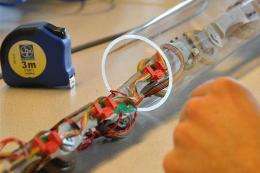
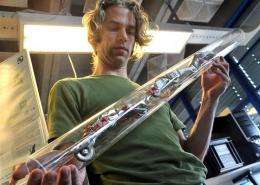
The Pirate (Pipe Inspection Robot for Autonomous Tunnel Exploration) resembles a miniature train. It is over half a metre in length and has eight wheels. At present it runs on power from a lead that trails behind it, but the design has already incorporated space for a battery so that it will soon be able to zoom around independently. UT researcher Edwin Dertien has been hard at work on the robot since 2006, in collaboration with engineering firm Demcon, network company Alliander and quality control experts Kiwa Gastec.
Underground mission to Mars
Enlarge


Preventive measures

Edwin explains what led him to develop the Pirate. "Around 8000 gas leaks are discovered in the Netherlands each year. Some are discovered when people smell gas and some are traced using "sniffing systems" in the form of sensors that can detect gas. The problem with these methods is that you discover the weak points in the pipeline too late, i.e. once a leak has already sprung. The aim of the Pirate is to seek out weak points in the pipeline as a preventive measure."

Mars mission

Building a robot that can travel through gas pipelines may seem relatively simple, but as Edwin explains, the degree of complexity is high. "Travelling straight ahead is not too tricky but the robot encounters all kinds of obstacles in the pipelines, ranging from bends and constrictions to valves and diagonal pipes." An additional factor is that communicating with a robot on the move underground is all but impossible. Edwin compares the project to a Mars mission. "Under those conditions a robot has to negotiate uncharted territory and respond to stimuli that are picked up by its sensors. The robot therefore has to be so smart that it can continue to operate and complete its mission even when faced with disturbances."
Underground mission to Mars
Enlarge


T junctions

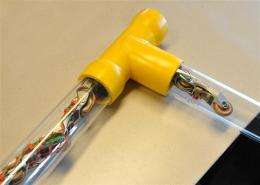
The Pirate has been designed for pipes with a diameter of between 5 and 12 centimetres. The robot attaches itself to the wall of the pipe by folding its front and rear segments to form an inverted V shape. This clinging technique also enables the robot to travel along diagonal pipes. To make sure that the robot can negotiate bends, the Pirate has a central axle which allows the front and back sections to rotate independently of each other. Edwin is currently refining the robot's steering system with final-year student Harwin Reemeijer. "The trickiest challenge is getting through a right-angled turn, as you would encounter at a T junction. When the front of the robot goes into the turn, it is forced to let go of the wall, which means it loses part of its momentum."
Underground mission to Mars
Enlarge


Eyes and ears

Once the robot is fully functional in terms of steering and motion, it will be fitted with sensors which will act as its proverbial eyes and ears. Edwin will fit the robot with a camera and a laser which work in unison so that the robot not only "sees" where it is going and where obstacles lie, but can also measure whether the pipe is round enough and free of dents, which can be caused by tree roots for example. An ultrasonic microphone will function as the robot's ears and listen out for gas escaping from the pipes. Edwin expects that his will be ready to embark on its maiden trip through the Netherlands' gas pipeline network in three to four years' time.

Provided by University of Twente (news : web)


print this article email this article download pdf blog this article bookmark this article     Stumble it Digg this share on Facebook retweet share on Reddit add to delicious
Rate this story - 5 /5 (2 votes)

Rank Filter

Move the slider to adjust rank threshold, so that you can hide some of the comments.


Display comments: newest first

  • Birger - Oct 30, 2009
    • Rank: not rated yet
    Maybe somethig useful for bona fide Mars missions -mainly, for exploring the *lava tube caves* that are expected to exist under much of the surface of the Moon and Mars, providing shelter from radiation for future astronauts on extended missions.

October 29, 2009 all stories

Comments: 1

5 /5 (2 votes)
  • Stumble this up

  • Digg this

  • share this

  • hide
  • Related Stories

  • The robot that climbs in the pipe
    created Jun 23, 2008 | popularity not rated yet | comments 0
  • Study finds gas pipelines could serve as wireless links
    created Dec 12, 2005 | popularity not rated yet | comments 0
  • Scientists study robot-human interactions
    created Aug 30, 2006 | popularity not rated yet | comments 0
  • Fla. boaters urged to look out for missing robot
    created Sep 05, 2009 | popularity not rated yet | comments 0
  • Canadian schools to send robot to Mars
    created Aug 23, 2007 | popularity not rated yet | comments 0


  • hide
  • Relevant PhysicsForums posts

  • Base Isolation Systems in Skyscrapers?
    created 14 hours ago
  • Need to interview a Computer Hardware Engineer for school project
    created 16 hours ago
  • transient heat transfer
    created 22 hours ago
  • Trying to adapt a fuel gage circuit
    created Nov 22, 2009
  • Pushing the piston.
    created Nov 22, 2009
  • Do Camcorders/ Video camera have Sensors in them?
    created Nov 22, 2009
  • More from Physics Forums - General Engineering

Other News

NREL Uncovers Clean Energy Leaders State by State

NREL Uncovers Clean Energy Leaders State by State

Technology / Energy

created 4 hours ago | popularity 1 / 5 (1) | comments 1

(PhysOrg.com) -- That California and Texas still lead the United States in generating renewable energy probably is no surprise. But, NREL's 2009 State of the States report shows that several smaller states ...


Opera logo

Stable Opera 10.10 browser with Unite now available

Technology / Software

created 5 hours ago | popularity 4.7 / 5 (3) | comments 1

(PhysOrg.com) -- The web browser Opera 10.10 has been released as a stable version, and it has a number of new features to enhance the browsing experience, including "Unite", which is a group of applications ...


Intelligence inside metal components

Intelligence inside metal components

Technology / Engineering

created 2 hours ago | popularity 4.5 / 5 (2) | comments 0

Up to now, extreme production temperatures made it impossible to equip metallic components with RFID chips during the operating process. At Euromold in Frankfurt (Dec. 2-5), Germany, Fraunhofer researchers ...


Key scientist says politics behind stolen e-mails

Technology / Other

created 5 hours ago | popularity 1 / 5 (1) | comments 4

(AP) -- A leading climate change scientist said hackers breaking into a university's computer server and then posting documents online show the nasty politics of global warming.


Just in time for Black Friday: students turn iPhone into barcode scanner

Just in time for Black Friday: students turn iPhone into barcode scanner

Technology / Software

created 16 hours ago | popularity 4.7 / 5 (3) | comments 0

(PhysOrg.com) -- Comparing prices over the Internet has become a common practice for consumers. Now, just in time for Black Friday, a group of Missouri University of Science and Technology students is putting ...