Ariane 5 rocket places two satellites into orbit (w/ Video)
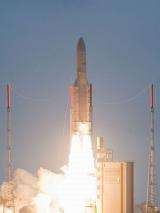
October 30, 2009 Another dual launch for Ariane 5

Enlarge

Credits: ESA / CNES / Arianespace / Optique vidéo du CSG - S. Martin.

(PhysOrg.com) -- Last night, an Ariane 5 ECA launcher lifted off from Europe’s Spaceport in French Guiana on a journey to place two telecommunications satellites, NSS-12 and Thor 6, into geostationary transfer orbits. Flight V192 was the sixth Ariane 5 launch of 2009 and the fourth dual-payload mission.

Liftoff of the 48th mission took place at the start of the launch window: 21:00 CET (20:00 UTC; 17:00 French Guiana). The target injection orbit had a perigee altitude of 250 km, an apogee altitude at injection of 35 786 km and an inclination of 6º. The satellites were accurately injected into their transfer orbits about 27 and 31 minutes after liftoff, respectively.

NSS-12 will be located at 57°E and provide direct-to-home coverage using four regional Ku-band spot beams covering the Middle East and Europe, Central and South Asia and, for the first time, East Africa. High-capacity, high-power C-band hemispheric beams will serve Europe, Africa (including Mauritius) and the Middle East, as well as an area stretching across Asia to Australia. A powerful C-band global beam will reach from the United Kingdom to the Far East.

You need Flash installed to watch this ideo

Ariane 5 flight V191 lifts off from Rurope's Spaceport in French Guiana, carrying the telecommunications satellites Amazonas 2 and ComSatBw-1, into geostationary transfer orbits. Lift-off of the 47th Ariane 5 mission took place at 23:59 CEST (21:59 UTC; 18:59 French Guiana). The target injection orbit had a perigee altitude of 250 km, an apogee altitude at injection of 35 786 km and an inclination of 3º. The satellites were accurately injected into their transfer orbits about 27 and 33 minutes after lift-off, respectively. Credits: Arianespace, 2009

Thor 6 will be located at 1°W and deliver high-power, direct-to-home television services using 36 Ku-band transponders, 16 of which will serve the Nordic countries. The other 20 transponders will provide capacity for the growing broadcasting demands across Central and Eastern Europe.

The payload mass for this launch was 9462 kg; the satellite masses totalled 8671 kg, with payload adapters and dispensers making up the additional 791 kg.

and Europe’s Spaceport are planning seven Ariane launches during 2009, maintaining the heavy-lift vehicle’s flight rate. The ability to sustain high launch rates has already been demonstrated: during the 12-month period from August 2007 to August 2008, there were nine launches (V177 - V185).

Initial construction of the Ariane 5 GS launcher for the seventh flight has been completed and the vehicle stands ready in the Launcher Integration Building (Bâtiment d’Intégration Lanceur; BIL) to be transferred to the Final Assembly Building (Bâtiment d’Assemblage Final; BAF) now it has been vacated by the rollout of V192.

Flight timeline

The Ariane 5’s cryogenic, liquid-propellant main engine was ignited first. Seven seconds later, the solid-propellant boosters were also fired, and the vehicle lifted off a fraction of a second later.

The solid boosters were jettisoned 2 min 21 sec after main engine ignition, and the fairing protecting the payload during the climb through Earth’s atmosphere was discarded at 3 min 9 sec. The launcher’s main engine was shut down at 8 min 52 sec; six seconds later, the main cryogenic stage separated from the upper stage and its payload.

Four seconds after main stage separation, the engine of the cryogenic upper stage was ignited to continue the journey. The engine was shut down at 24 min 45 sec into the flight, at which point the vehicle was travelling at 9400 m/s (33 840 km/h) at an altitude of 600 km. The conditions for geostationary transfer orbit injection had been achieved.

At 26 min 36 sec after main engine ignition, NSS-12 separated from the upper stage, followed by Thor 6 at 31 min 14 sec. Ariane 5’s flight operations were completed 49 min 28 sec after main engine ignition.

Provided by European Space Agency (news : web)


Rate this story - 5 /5 (2 votes)


October 30, 2009 all stories

Comments: 0

5 /5 (2 votes)

  • hide
  • Related Stories

  • Ariane 5 - Fifth launch of 2008
    created Aug 15, 2008 | popularity not rated yet | comments 0
  • Ariane 5 -- fourth launch this year
    created Oct 08, 2007 | popularity not rated yet | comments 0
  • Ariane rocket puts telecom satellites into orbit
    created Dec 21, 2008 | popularity not rated yet | comments 0
  • Ariane 5 - First launch of 2009
    created Feb 13, 2009 | popularity not rated yet | comments 0
  • European rocket hoists biggest-ever telecoms satellite (w/ Video)
    created Jul 02, 2009 | popularity not rated yet | comments 0


  • hide
  • Relevant PhysicsForums posts

  • Spreading Life in the Universe
    created 3 hours ago
  • Force of Gravity in terms of Density
    created Feb 08, 2010
  • what is the relation between gravity and light?
    created Feb 08, 2010
  • Does the Thermoelectric effect apply in sun?
    created Feb 07, 2010
  • More from Physics Forums - General Astronomy

Other News

A new 3-D map of the interstellar gas within 300 parsecs from the sun

A new 3D map of the interstellar gas within 300 parsecs from the Sun

Space & Earth / Astronomy

created 4 hours ago | popularity 5 / 5 (3) | comments 0 | with audio podcast

(PhysOrg.com) -- Astronomy & Astrophysics is publishing new 3D maps of the interstellar gas in the local area around our Sun. A French-American team of astronomers presents new absorption measurements toward ...


Climate 'Tipping Points' May Arrive Without Warning, Says Top Forecaster

Space & Earth / Environment

created 2 hours ago | popularity not rated yet | comments 1 | with audio podcast

(PhysOrg.com) -- A new University of California, Davis, study by a top ecological forecaster says it is harder than experts thought to predict when sudden shifts in Earth's natural systems will occur -- a worrisome finding ...


Rho Ophiuchus cloud

Professor: We have a 'moral obligation' to seed universe with life

Space & Earth / Astronomy

created 13 hours ago | popularity 3.6 / 5 (20) | comments 40 | with audio podcast report

(PhysOrg.com) -- Eventually, the day will come when life on Earth ends. Whether that’s tomorrow or five billion years from now, whether by nuclear war, climate change, or the Sun burning up its fuel, the last ...


URI researcher calls for global effort to monitor marine pollutants

Space & Earth / Environment

created 3 hours ago | popularity 5 / 5 (1) | comments 1

A University of Rhode Island researcher who studies chemical pollutants in the marine environment has called on colleagues around the world to establish a global monitoring network to verify that the chemicals banned by the ...


New international satellite observations help assess future earthquake risk in Haiti

New international satellite observations help assess future earthquake risk in Haiti

Space & Earth / Earth Sciences

created 5 hours ago | popularity not rated yet | comments 0

Virginia Key, Florida--Scientists at the University of Miami have analyzed images based on Synthetic Aperture Radar (SAR) observations taken before and just after Haiti's earthquake, on January 12. The images ...