October 30, 2009 feature
Porphyrin Dimers Increase Efficiency of Dye-Sensitized Solar Cells
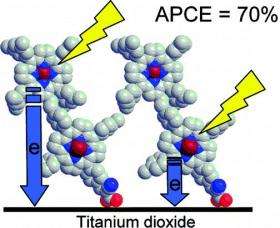
(PhysOrg.com) -- Porphyrins are most commonly thought of as the pigment in red blood cells, but now scientists have found that porphyrins can also be used to increase the efficiency of an inexpensive type of solar cell. In a recent study, researchers have found that a variety of porphyrin arrays can improve the solar-to-electrical energy conversion efficiency of dye-sensitized solar cells (DSSCs), and could potentially be used to construct larger 3-D light harvesting arrays.
The researchers, Attila J. Mozer and colleagues from the University of Wollongong in Australia, Shinshu University in Japan, the University of Otago in New Zealand, and the National Institute of Advanced Industrial Science and Technology in Japan, have published their study in a recent issue of the Journal of the American Chemical Society.
Regarded as an inexpensive alternative to silicon solar cells, dye-sensitized solar cells work by imitating the way plants convert sunlight into energy. Rather than using silicon to absorb light, DSSCs absorb light using dye molecules, which are chemically bound to a porous film of titanium dioxide. When a dye molecule absorbs a photon from sunlight, it ejects an electron into the titanium dioxide, and then the dye molecule is recharged by an electrolyte.
“The emulation of photosynthesis, the efficient and sustainable utilization of solar energy using renewable materials, represents one of the great scientific challenges or ‘Holy Grails’ of the 21st century,” Mozer and coauthor David Officer, also of the University of Wollongong, told PhysOrg.com. As the scientists explained, at the heart of this light-harvesting process are chlorophyll antennae. “Synthetic porphyrin molecules such as tetraphenylporphyrin A have similar optical properties to those of chlorophyll B but are much more easily manipulated in the laboratory,” the scientists said.
In the current study, the scientists designed two new kinds of porphyrin dimers composed of two monoporphyrin dyes linked in different ways, and incorporated them into DSSCs. In experiments, the researchers found that the dimers, when excited by a photon, could quickly and efficiently inject an electron into the titanium dioxide. Their measurements showed that both monoporphyrins within the dimers contributed to the electron injection.
Overall, the scientists found that the DSSCs with porphyrin dimers offered significant advantages in several areas: the modified thin film solar cells offered a 20% increase in the light harvesting efficiency, and a 10% increase in the incident photon-to-current conversion efficiency. Further, by incorporating the porphyrin dimers into the DSSCs, the researchers could achieve an absorbed photon-to-current conversion efficiency of 70-80%.
“The best efficiency for a ruthenium dye-sensitized solar cell is around 12%, and 7% for a porphyrin-sensitized solar cell, both using thick (15-20 micron) titanium dioxide photoanodes,” the scientists said. “The dimers help to increase the efficiency of thin (about 2.5 micron is demonstrated in the paper) dye-sensitized solar cells due to the increased light harvesting. The improvement demonstrated in our article is from 2.9% for the N719 standard ruthenium dye to 3.8% for the P10 linear dimer, an overall 30% increase. The challenge is of course to increase thin film efficiency as close to the 12% of thick film devices using larger arrays.”
The scientists found that both kinds of porphyrin dimers performed well in these experiments, suggesting that both dimers could be used as building blocks to construct larger 3-D light harvesting arrays with efficient solar energy conversion.
“Light harvesting in the dye-sensitized solar cell relies on the photoactivity of a single dye layer, effectively 2-D rather than 3-D light harvesting,” the researchers said. “A significant research effort has been invested in creating multichromophoric dye arrays in order to go beyond this conventional approach. However, introduction of these arrays into photovoltaic devices has not provided major improvement to date.”
As the scientists explain, there are number of challenges facing DSSCs. These challenges include improving the charge transport and increasing cell efficiency by using more red absorbing dyes or mixtures of dyes that absorb light at different wavelengths across the solar spectrum.
More information: Attila J. Mozer, et al. “Zn-Zn Porphyrin Dimer-Sensitized Solar Cells: Toward 3-D Light Harvesting.” J. Am. Chem. Soc. DOI: 10.1021/ja9057713
Copyright 2009 PhysOrg.com.
All rights reserved. This material may not be published, broadcast, rewritten or redistributed in whole or part without the express written permission of PhysOrg.com.


