Heavy metals accumulate more in some mushrooms than in others
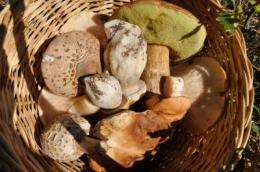
A research team from the University of Castilla-La Mancha (UCLM) has analysed the presence of heavy metals in 12 species of mushroom collected from non-contaminated natural areas, and has found that the levels vary depending on the type of mushroom. The results of the study, which appears this month in the journal Biometals, show that the largest quantities of lead and neodymium are found in chanterelles.
"The aim was to find out if there is a connection between the concentrations of specific heavy metals detected in the mushrooms, based on three factors: the type of substrate, the study area and the species of mushroom. The third was the determining factor", explains Juan Antonio Campos, principal author of the study and researcher at the Department of Crop Production and Agricultural Technology at UCLM.
The researchers have analysed the presence of lead (Pb), neodymium (Nd), thorium (Th) and uranium (U) in a hundred samples of 12 different species of common mushroom, both edible and non-edible, collected from non-contaminated zones in the Ciudad Real province. They were collected from wooded areas comprising Holm oak, Kermes oak, Pyrenean oak, Pine and Cistus.
The results of the study, published this month in the journal Biometals, reveal that there are 'considerable' quantities of the four metals in all the species examined, as well as significant differences in the capacity for accumulation of these elements depending on the species.
The analysis of these heavy metals - which can be toxic to humans - was carried out using X-ray fluorescence spectometry, a technique that enables a sample's composition to be detected and quantified using X-rays.
The highest levels of neodymium (7.1 micrograms/gram) and lead (4.86 µg/g) were found in the chanterelle (Cantharellus cibarius), a mushroom widely used in European cuisine. This mushroom grows in the shadow of Holm oaks, Cork oaks and oaks, and is ectomycorrhizal (it clings to the external roots of plants to exchange nutrients), thereby it has direct contact with the mineral particles of the soil.
For their part, thorium and uranium accumulated mostly in Hypholoma fasciculare, with concentrations of 3.63 and 4.13 µg/g, respectively, "despite being a species that lives on fallen tree trunks and is isolated from the mineral substances of the soil".
The scientists found no significant differences in the metal levels when comparing mushrooms collected from different substrates, habitats and localisations. The only exception was with thorium, which accumulates more in mushrooms which grow on wood (such as Hypholoma fasciculare or Gymnopilus spectabilis) than in those which have contact with the organic material of the soil (Tricoloma ustaloides and Pisolithus arrhizus).
New lines of research
To confirm that the type of substrate can take on a more important role than reflected in the study, the researchers have embarked on a new project in which they will analyse the presence of 19 chemical elements (toxic and non-toxic) in 15 species of edible mushroom.
"The real issue is that those mushrooms that form ectomycorrhizae are specially adapted to absorb chemical elements from the mineral particles of the soil, and give them to the plant. This is their contribution to symbiosis, and, the more effective they are in providing nutritional elements to the plant, the closer their connection to it, and the more sugars from photosynthesis they can access, which is what they are ultimately looking for", explains Juan Antonio Campos.
This type of mushroom carries out an indiscriminate acid attack on the mineral particles of the soil and absorbs elements in quantities relative to the mineralogical composition of the soil. "In some contaminated soils, or those with particular mineralogical characteristics, the mushrooms collected can reach such high concentrations of toxic elements that their consumption would be unadvisable", reveals the researcher.
More information: Juan A. Campos, Noel A. Tejera y Carlos J. Sánchez. "Substrate role in the accumulation of heavy metals in sporocarps of wild fungi". Biometals 22 (5): 835-841, Oct 2009.
Source: FECYT - Spanish Foundation for Science and Technology


