Team Discovers New Dinosaur Species From Montana
October 30, 2009
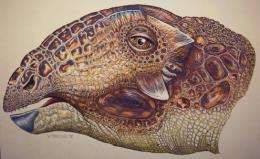
Tatankacephalus cooneyorum. (illustration by William Parsons)
A husband and wife team of American paleontologists has discovered a new species of dinosaur that lived 112 million years ago during the early Cretaceous of central Montana.
The new dinosaur, a species of ankylosaur, is documented in the October issue of the Canadian Journal of Earth Sciences. Ankylosaurs are the biological version of an army tank. They are protected by a plate-like armour with two sets of sharp spikes on each side of the head, and a skull so thick that even 'raptors' such as Deinonychus could leave barely more than a scratch.
Bill and Kris Parsons, Research associates of the Buffalo Museum of Science, found much of the skull of the newly described Tatankacephalus cooneyorum resting on the surface of a hillside in 1997. Because the skull was 90% complete, it was possible to justify this fossil as a new species.
"This is the first member of Ankylosauridae to be found within the Early Cretaceous Cloverly Geologic Formation," said Bill Parsons, who characterized the fossil as a transitional evolutionary form between the earlier Jurassic ankylosaurs and the better known Late Cretaceous ankylosaurs.
The skull is heavily protected by two sets of lateral horns, two thick domes at the back, and smaller thickenings around the nasal region. "Heavy ornamentation and horn-like plates would have covered most of the dorsal surface of this dinosaur" said Bill Parsons.
"For years, Bill and Kris have been collecting fossils from a critical time in Earth's history, and their hard work has paid off," said Lawrence Witmer, professor of paleontology at Ohio University who was not involved with this study. "This is a really important find and gives us a clearer view of the evolution of armored dinosaurs. But this is just the first; I'm sure, of what will be a series of important discoveries from this team."
Parsons also illustrated the dermal armour of this new species based on the theory by Museum of the Rockies paleontologist John R. Horner that there was an outer keratinous sheathing on it as found in modern turtle shells and bird beaks. In his new reconstruction, Parsons suggests that Tatankacephalus exhibited complex and colorful patterns rather than the dull appearance suggested in earlier ankylosaur portraits. "According to Horner's theory, many other dinosaurs also had this kind of sheathing and also may have been diversely colored" said Parsons.
As to its name, the broad, short horns on the back of its skull resemble the horns found on a modern buffalo skull and Tatankacephalus loosely translates as 'Buffalo head.' Parsons also noted, "of course any further allusions to the city of Buffalo are completely intentional as well".
Bill Parsons works as a teacher at the Gow School in South Wales, NY, and as scientific illustrator for the Buffalo Museum of Science. He is also freelance dinosaur illustrator whose images have appeared on the covers of Science, Nature, Time and Newsweek. The publication of Tatankacephalus may be the first time that an established dinosaur illustrator has discovered, prepared, researched, and published on a new dinosaur taxon.
Source: Buffalo Museum of Science
-
Smallest Triceratops skull described
Mar 06, 2006 |
not rated yet |
0
-
New dinosaur species found in Montana
Sep 24, 2007 |
not rated yet |
0
-
Researchers claim a third of dinosaurs might never have existed
Oct 13, 2009 |
not rated yet |
0
-
Dinosaur named after Hogwarts School
May 22, 2006 |
not rated yet |
0
-
Museum unveils world's largest T-rex skull
Apr 07, 2006 |
not rated yet |
0
-
Engineers build first sub-10-nm carbon nanotube transistor
Feb 01, 2012 |
4.9 / 5 (30) |
30
-
Something old, something new: Evolution and the structural divergence of duplicate genes
Jan 31, 2012 |
4.6 / 5 (7) |
1
-
The hidden nanoworld of ice crystals: Revealing the dynamic behavior of quasi-liquid layers
Jan 30, 2012 |
5 / 5 (3) |
1
-
Stock market network reveals investor clustering
Jan 27, 2012 |
3.9 / 5 (23) |
8
-
Of microchemistry and molecules: Electronic microfluidic device synthesizes biocompatible probes
Jan 26, 2012 |
5 / 5 (1) |
0
-
Any books/articles for evolutionary stable strategy models in humans?
2 hours ago
-
Science behind the bore feeling?
9 hours ago
-
Homo Sapien vs. Chimpanzee - Divergence Timeline
13 hours ago
-
a single mRNA strand is attached to sevaral ribosomes?
Feb 08, 2012
-
Oestrogen and FSH
Feb 07, 2012
-
Linear Blood Vessel Network Examples in Animals or Plants
Feb 07, 2012
- More from Physics Forums - Biology
More news stories
US workers are 'giving away the store,' costing firms billions
Nearly 70 percent of the nation's service employees give away free goods and services from hamburgers to cable TV costing companies billions of dollars a year, according to a groundbreaking study.
Other Sciences / Economics & Business
9 minutes ago |
not rated yet |
0
'Flipped classroom' teaching model gains an online community
Researchers at Harvard University have launched the Peer Instruction (PI) Network, a new global social network for users of interactive teaching methods.
Other Sciences / Social Sciences
1 hour ago |
not rated yet |
0
Storm warning: Financial tsunami heading this way
In today's global village, national coffers are more interconnected than ever before. And as the current economic crisis has proven, a downturn in one country can travel in a wave across the globe, like a financial tsunami. ...
Other Sciences / Economics & Business
1 hour ago |
not rated yet |
1
Maryland Commission recommends 'common sense' immigration policy
Immigrants to Maryland contribute significantly to the state's economy, and were vital to its workforce expansion in both technical and less-skilled occupations from 2000 to 2010, concludes a new report by a Maryland commission. ...
Other Sciences / Social Sciences
1 hour ago |
not rated yet |
0
Some formerly cohabiting couples with children keep romantic relationship
(PhysOrg.com) -- When low-income cohabiting couples with children decide to no longer live together, that doesnt necessarily mean the end of their romantic relationship.
Other Sciences / Social Sciences
5 hours ago |
not rated yet |
0
FDA-approved drug rapidly clears amyloid from the brain, reverses Alzheimer's symptoms in mice
Neuroscientists at Case Western Reserve University School of Medicine have made a dramatic breakthrough in their efforts to find a cure for Alzheimer's disease. The researchers' findings, published in the journal Science, show t ...
Ocean microbe communities changing, but long-term environmental impact is unclear
As oceans warm due to climate change, water layers will mix less and affect the microbes and plankton that pump carbon out of the atmosphere but researchers say it's still unclear whether these processes ...
Researchers create 3-D laser maps that show how earthquake changes landscape
Geologists have a new tool to study how earthquakes change the landscape down to a few inches, and it's giving them insight into how earthquake faults behave. In the Feb. 10 issue of the journal Science, a team ...
Cell death unleashes full force of human antiviral system
A scientific team led by researchers at the University of Geneva (UNIGE) and the Charite Berlin Medical University has made a completely unprecedented discovery showing how much our immune system is provoked into action when ...
To perform with less effort, practice beyond perfection
Whether you are an athlete, a musician or a stroke patient learning to walk again, practice can make perfect, but more practice may make you more efficient, according to a surprising new University of Colorado Boulder study.
Scientists identify most lethal known species of prion protein
Scientists from the Florida campus of The Scripps Research Institute have identified a single prion protein that causes neuronal death similar to that seen in "mad cow" disease, but is at least 10 times more ...