Hard Winter Wheat Varieties Released
October 30, 2009 By Stephanie Yao Hard Winter Wheat Varieties Released

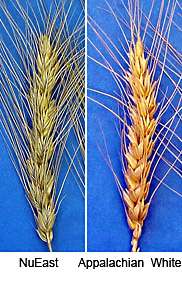
ARS has released the first hard winter wheat varieties bred and developed for production in the eastern United States. Photos courtesy of David Marshall, ARS.

(PhysOrg.com) -- The first hard winter wheat varieties bred and developed for production in the eastern United States have been released by the Agricultural Research Service (ARS).

NuEast, a hard red winter wheat, and Appalachian White, a hard white winter wheat, were bred by ARS plant pathologist and geneticist David Marshall, research leader of the Plant Science Research Unit in Raleigh, N.C.

Soft winter wheats, which are used to make pastries, cookies and biscuits, are typically grown in the eastern United States. Hard wheats, on the other hand, are best suited for making bread. Hard wheat has not traditionally been a successfully grown crop in the eastern states because the area's humidity increases the incidence of disease in the field. This in turn affects yield and the quality of the grain.

But NuEast addresses these problems. In field tests, NuEast had significantly higher grain yield than the check varieties over four years of testing. It also showed moderate reaction to powdery mildew but was more resistant than some check varieties. NuEast's resistance to leaf rust is good, and it is moderately resistant to stem rust, including Ug99 races.

There are very few hard white wheats grown and produced in the . The main challenge with growing hard white wheat under humid conditions in the eastern states is the pre-harvest sprouting typically associated with white wheats, according to Marshall.

Throughout six locations and over three years of testing, Appalachian White had significantly higher yield than the only other variety that could be considered acceptable when grown under in the eastern states. Appalachian White also showed a higher level of resistance to powdery mildew, stripe rust, leaf rust and Hessian fly.

According to Marshall, the key to developing a hard wheat for eastern U.S. production is the ability to produce consistently good grain quality, resulting in good milling and baking characteristics when grown in a humid environment.

Millers and bakers that are part of the North Carolina Organic Bread Flour Project, an initiative supported with funding from the North Carolina Tobacco Trust Fund and Santa Fe Tobacco, have been testing the wheats since their release. So far, the feedback has been positive.

Provided by USDA Agricultural Research Service


print this article email this article download pdf blog this article bookmark this article     Stumble it Digg this share on Facebook retweet share on Reddit add to delicious
Rate this story - not rated yet


October 30, 2009 all stories

Comments: 0

not rated yet
  • Stumble this up

  • Digg this

  • share this

  • hide
  • Related Stories

  • Researchers developing better wheat
    created Feb 16, 2006 | popularity not rated yet | comments 0
  • Elusive rust resistance genes located
    created Dec 06, 2006 | popularity not rated yet | comments 0
  • Scientists fight stem rust UG99 before it becomes a threat
    created Nov 18, 2008 | popularity not rated yet | comments 0
  • Ancient genes used to produce salt-tolerant wheat
    created Feb 01, 2007 | popularity not rated yet | comments 0
  • Dangerous wheat disease jumps Red Sea
    created Jan 16, 2007 | popularity not rated yet | comments 0


  • hide
  • Relevant PhysicsForums posts

  • Questions about diffusion
    created 3 hours ago
  • Human Leukocyte Antigen (HLA) typing
    created 9 hours ago
  • Breeding program
    created Nov 20, 2009
  • How does a concentration gradient provide energy?
    created Nov 20, 2009
  • More from Physics Forums - Biology

Other News

The Monarchs' annual migration ritual has yet to be scientifically explained

Tree-eating bugs threaten Monarch butterfly in Mexico

Biology / Ecology

created 11 hours ago | popularity 4 / 5 (1) | comments 0

The mysterious Monarch butterfly, which migrates en masse annually between Canada and Mexico, is now facing a new peril: another insect thriving in Western Mexican forests.


Bigger not necessarily better, when it comes to brains

Bigger not necessarily better, when it comes to brains

Biology / Plants & Animals

created Nov 17, 2009 | popularity 4.5 / 5 (17) | comments 11

(PhysOrg.com) -- Tiny insects could be as intelligent as much bigger animals, despite only having a brain the size of a pinhead, say scientists at Queen Mary, University of London.


Extinct goat Myotragus balearicus

Extinct goat was cold-blooded

Biology / Plants & Animals

created Nov 18, 2009 | popularity 4.9 / 5 (33) | comments 10

(PhysOrg.com) -- An extinct goat that lived on a barren Mediterranean island survived for millions of years by reducing in size and by becoming cold-blooded, which has never before been discovered in mammals.


Right-handed chimpanzees provide clues to the origin of human language

Biology / Plants & Animals

created Nov 16, 2009 | popularity 3 / 5 (1) | comments 7

Most of the linguistic functions in humans are controlled by the left cerebral hemisphere. A study of captive chimpanzees at the Yerkes National Primate Research Center (Atlanta, Georgia), reported in the January 2010 issue ...


The creature was found at a depth of 161 metres

Japanese researchers film rare baby fish 'fossil'

Biology / Plants & Animals

created Nov 17, 2009 | popularity 4.7 / 5 (7) | comments 4

Japanese marine researchers said Tuesday they had found and successfully filmed a young coelacanth -- a rare type of fish known as "a living fossil" -- in deep water off Indonesia.