Dark Matter in a Galaxy
October 30, 2009
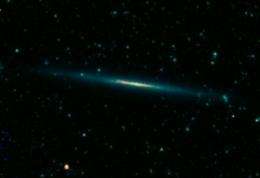
An false-color infrared image of the faint, edge-on galaxy UGC 7321 as seen with the Spitzer Space Telescope IRAC camera. Astronomers modeling the galaxy have concluded that dark matter plays an important role in determining the dynamics of the inner as well as the outer regions of this galaxy. Credit: NASA, and Lynn Matthews/Kenneth Wood
(PhysOrg.com) -- Stars, the most familiar objects in the night sky, make up only a tiny percentage of the total amount of matter in the universe -- about 2%.
Another approximately 8% of the matter is in objects that have never been directly seen because, for example, they might be too cool to radiate much visible light; scientists estimate this percentage indirectly, from the relative abundances of hydrogen and helium gas and other sensitive monitors of the existence of other kinds of atoms.
The vast majority of matter however, nearly 90% of the total, is in some unknown form. Its presence is inferred from the motions of galaxies: their rotations, their motions as members of clusters of galaxies, and their behaviors in the expanding universe. This dominant and mysterious type of matter has been dubbed "dark matter." We do not know what dark matter is, only that it is unlike the particles that comprise normal atoms. Clues to its nature, however, may be found in where it is located and how it is distributed. Astronomers therefore probe galaxies looking for these elusive hints.
The galaxy UGC 7321 is a spiral galaxy, seen edgewise, with a highly flattened disk of stars lacking the central bulge commonly seen in many spirals. Many studies have modeled dark matter based on the way its gravity influences the rotation of the galaxy's disk at radii far from the center, but recently astronomers have tried examining how dark matter might be influencing the behavior of matter perpendicular to a galaxy's disk. SAO astronomer Lynn Matthews, along with two colleagues, used UGC 7321 to study this perpendicular influence for the first time in a faint, thin galaxy.
The astronomers modeled the stars and gas of the galaxy with a halo of dark matter whose gravity constrains both the radial and the perpendicular shape of the system.
They conclude that a consistent picture emerges with a dark matter halo whose average density is equivalent to about 500 earth-masses per cubic light-year, and whose presence is influential even within the inner spiral regions of the galaxy (a few thousand light-years), in contrast to the case in more luminous, massive galaxies where stars and gas overwhelmingly dominate the dynamics of the inner regions.
The new results imply that dark matter permeates a galaxy, and is not constrained to exist in the cold outer regions of intergalactic space. Although this does not seem to be a surprising conclusion, with matter that is a mystery every bit of information is valuable.
Provided by Harvard-Smithsonian Center for Astrophysics (news : web)
-
Dark Energy and Dark Matter – The Results of Flawed Physics?
Sep 11, 2006 |
not rated yet |
0
-
Astronomers Discover Most Dark Matter-Dominated Galaxy in Universe
Sep 18, 2008 |
not rated yet |
0
-
How to Bake a Galaxy
Jun 16, 2006 |
not rated yet |
0
-
A dark matter disk in our Galaxy
Sep 16, 2008 |
not rated yet |
0
-
Seeing the invisible – first dark galaxy discovered?
Feb 23, 2005 |
not rated yet |
0
-
Engineers build first sub-10-nm carbon nanotube transistor
Feb 01, 2012 |
4.9 / 5 (31) |
30
-
Something old, something new: Evolution and the structural divergence of duplicate genes
Jan 31, 2012 |
4.6 / 5 (7) |
1
-
The hidden nanoworld of ice crystals: Revealing the dynamic behavior of quasi-liquid layers
Jan 30, 2012 |
5 / 5 (3) |
1
-
Stock market network reveals investor clustering
Jan 27, 2012 |
3.9 / 5 (23) |
8
-
Of microchemistry and molecules: Electronic microfluidic device synthesizes biocompatible probes
Jan 26, 2012 |
5 / 5 (1) |
0
-
Titan's lack of impact craters
Feb 09, 2012
-
Real pictures of black hole eating a star?
Feb 08, 2012
-
Hypothetical way to travel faster than light, but not technically exceed lightspeed
Feb 06, 2012
-
How do scientists monitor the Sun's activity?
Feb 05, 2012
-
Search patterns in observational studies
Feb 05, 2012
-
Derivation of Pogson's law
Feb 03, 2012
- More from Physics Forums - General Astronomy
More news stories
Humans may have helped the decline of African rainforests 3000 years ago
(PhysOrg.com) -- Large areas of rainforests in Central Africa mysteriously disappeared over three thousand years ago, to be replaced by savannas. The prevailing theory has been that the cause was a change ...
Could Venus be shifting gear?
(PhysOrg.com) -- ESAs Venus Express spacecraft has discovered that our cloud-covered neighbour spins a little slower than previously measured. Peering through the dense atmosphere in the infrared, the ...
Space & Earth / Space Exploration
6 hours ago |
5 / 5 (5) |
7
|
Mars Science Laboratory computer issue resolved
(PhysOrg.com) -- Engineers have found the root cause of a computer reset that occurred two months ago on NASA's Mars Science Laboratory and have determined how to correct it.
Space & Earth / Space Exploration
7 hours ago |
5 / 5 (5) |
3
|
Clam fields found at deep, low-temperature Mariana vents
(PhysOrg.com) -- Scientists have marveled at the unusual life forms thriving at high temperature hydrothermal vents of the deep ocean.
Space & Earth / Earth Sciences
6 hours ago |
not rated yet |
0
|
Two new moons for Jupiter
Advances in technology have lead to the discovery of new planets outside of our Solar System, and now even new moons in our own backyard.
Space & Earth / Space Exploration
6 hours ago |
not rated yet |
3
Human cognitive performance suffers following natural disasters, researchers find
Not surprisingly, victims of a natural disaster can experience stress and anxiety, but a new study indicates that it might also cause them to make more errors - some serious - in their daily lives. In their upcoming Human Fa ...
The power of estrogen -- male snakes attract other males
A new study has shown that boosting the estrogen levels of male garter snakes causes them to secrete the same pheromones that females use to attract suitors, and turned the males into just about the sexiest ...
New error-correcting codes guarantee the fastest possible rate of data transmission
Error-correcting codes are one of the triumphs of the digital age. Theyre a way of encoding information so that it can be transmitted across a communication channel such as an optical fiber o ...
Putting the squeeze on planets outside our solar system
(PhysOrg.com) -- Using high-powered lasers, scientists at Lawrence Livermore National Laboratory and collaborators discovered that molten magnesium silicate undergoes a phase change in the liquid state, abruptly ...
Both maternal and paternal age linked to autism
Older maternal and paternal age are jointly associated with having a child with autism, according to a recently published study led by researchers at The University of Texas Health Science Center at Houston (UTHealth).
Curry spice component may help slow prostate tumor growth
Curcumin, an active component of the Indian curry spice turmeric, may help slow down tumor growth in castration-resistant prostate cancer patients on androgen deprivation therapy (ADT), a study from researchers ...
Oct 30, 2009
Rank: 3 / 5 (2)
Oct 30, 2009
Rank: 1 / 5 (1)
Oct 30, 2009
Rank: 4.2 / 5 (5)
Oct 30, 2009
Rank: 3 / 5 (4)
I contacted the author of the papers on antigravity beams projected via the lens thirring effect affecting the radial velocity of galactic matter as opposed to dark matter theories, Frank Felber; He told me somebody in the audience of a lecture he gave had the same idea in 2006. I thought that I had thought of it first.
Oct 31, 2009
Rank: 2 / 5 (3)
The too high star speed presented by flat galaxy rotation curves, are an effect of the density waves that are responsible for the spiral pattern. Density waves go faster in the exterior regions of a galaxy.
What we now about gravity is how a mass behave in an gravitation field. With density waves we speak about changes of a gravitation field that goes faster around the galaxy then the stars of this galaxy. At 15 kpc is the speed of the density waves +/- 9 times faster as the stars. This makes that the change of the gravitational field cause by the density wave is +/- 9 times higher then what standard theory’s says about the density waves. I didn’t have a mathematical framework for this part of my cosmology. Wouter Vanhoutte
Oct 31, 2009
Rank: 1 / 5 (2)
elliptical galaxy e.g. NGC4881 "Three Dimension" ordinary Newton's equation
GM(
Oct 31, 2009
Rank: 1 / 5 (2)
elliptical galaxy e.g. NGC4881 "Three Dimension" ordinary Newton's equation
GM(smaller than r)m/r^2 = mv^2/r
gravitationally unstable
barred spiral galaxy e.g.NGC1300 "One Dimension" new New1ton's equation
G''M(smaller than r)m = mv^2/r
spiral galaxy e.g. NGC4414 "Two Dimension" new New2ton's equation
G'M(smaller thanr)m/r = mv^2/r
gravitationally stable
There are also phase-shifts among those three phases.
Iori Fujita
http://www.geocit...y01.html
Oct 31, 2009
Rank: 1 / 5 (1)
Nov 01, 2009
Rank: 1 / 5 (1)
Remember you read it first coined here:ORBITAL UNIVERSE
Nov 01, 2009
Rank: 5 / 5 (3)
I have read extensively on the subject and while I don't pretend to understand all of the science involved, I do understand that there are multiple converging lines of evidence upon which dark matter theories exist. There are also competing gravitation theories which basically modify Einsteins gravity equations at very large scales. The difficulty with the gravity theories is that they don't work in all circumstances.
At any rate, I can positively and without fear of contradiction say that truth is unresponsive to personal wishes. Just because you don't like a theory doesn't mean that its not the truth. And visa versa.
Nov 01, 2009
Rank: 2.8 / 5 (4)
[1] Unfortunately, most articles about DM forget to mention that the existence of DM is not proven. You don't need to be a professional scientist to see this flaw.
[2] There is no idea how the constituents of DM fit into the standard theory of particle physics. Everytime some experiment or observation is done to pin down a certain elementary particle as constituent of DM, as a result this elementary particle must be excluded from the set of candidate constituents.
[3] There are alternative cosmologies without DM.
[4] There is an "invisible hand" in DM: http://www.physor...210.html
[5] The unphysical idea of a "beginning of time and space" is religious/metaphysical thinking.
Nov 01, 2009
Rank: not rated yet
In most cases framedragging causes minute effects that can only be observed through detailed observations. The 'too fast' spinning of the galaxies is not such a minute effect, it's a very big effect.
Nov 01, 2009
Rank: not rated yet
Do these "alternative cosmologies" delve into the issue of accounting for the missing source of 90% of the gravity in the universe?
Nov 01, 2009
Rank: not rated yet
If you look above your comment you see one guy introducing the 'Orbital Universe' and another guy talking about us not being able to see the matter in other places unless we travel to those distant galaxies. Unfortunately this forum is flooded with comments from people who seems to have no education in physics, astronomy or cosmology but yet they know that dark matter doesn't exist (or they know that the sun is actually a neutron star).
I don't find it hard to believe in dark matter at all, the history of science is full of big discoveries and some are yet to be made. The evidence for some huge invisible mass acting upon the galaxies is very strong and this cannot be explained by modifying Einsteins field equations on a large scale. The problem is that dark matter is observed in galaxies that are 'very small' on a cosmological scale.
Nov 02, 2009
Rank: 1 / 5 (1)
One alternative theory is the Ekpyrosis of Steinhardt and Turok. It does account for the missing mass in a very elegant way: The observable universe lies in a brane with 3 space dimensions and 6 curled-up dimensions. There is another 9-dimensional brane at a certain distance along a tenth dimension. According to the equations of M theory all familiar particles and forces are confined to our brane. Except gravity. A lump of matter in the other brane generates a gravitational force pulling matter in our brane toward the point directly opposite the lump.
Nov 02, 2009
Rank: not rated yet
Would that indicate that galaxies on our brane can only form where there is a corresponding mass on the other brane? Can you imagine an experiment that might allow us to investigate that idea?
Nov 02, 2009
Rank: not rated yet
So, here is food for thought (brane). Gravity appears to be of equal distribution as it permeates all matter & overcomes the other forces of the "brane string theory". Gravity being so equally distributive throughout the observable universe is of significant portent & unexplainable with current cosmological models. We can locate the nuclear forces that operate within the "brane string", but cannot locate the source of 90% of gravity.
Nov 03, 2009
Rank: 4 / 5 (1)
The alternative cosmologies must have testable, unique explanatory power. It will be great when we have something more satisfying than "dark x;" we do not yet. And, all cosmologies end up with metaphysical propositions. To deny this is usually to change the meaning of the word "metaphysical."
Nov 06, 2009
Rank: 1 / 5 (1)
No, two different models may not have unique explanatory power. That's what Occam's Razor is for.
Satisfaction lies in the eye of the beholder. The beauty of string based models like the ekpyrotic/cyclic model is very satisfying. It answers many questions the standard model leaves open.
A cosmological model which can describe the universe without implying an initial point for the validity of the laws of physics has IMHO less metaphysical burden to bear.