Superstring theory useful for experimental physics
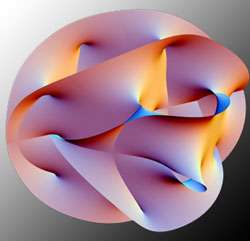
Superstring theory aims to explain the laws of physics from extremely small strings in various states. Theoretical superstring theory is therefore normally not considered to be particularly relevant for practical particle physics experiments.
However two researchers at the Niels Bohr International Academy (Denmark) have, together with a colleague from the French research institute Saclay, shown how superstring theory can be used to infer relations between processes, which can also be studied at the Large Hadron Collider (LHC), the experiment at CERN. The results are published in Physical Review Letters.
In superstring theory, particles are replaced by string states. The string should be understood as a wave, whereas the particles are different vibrational states. Superstring theory consists of cascades of particle states, all with increasing energies - energies that are so incomprehensibly high that no experiment would be able to reach them. Therefore there are no realistic possibilities of observing them in particle accelerators.
The group of particles with the lowest possible energy are exactly those particles, which can be created by the Large Hadron Collider (LHC), the experiment at CERN in Geneva. If relations between all of the states of superstrings can be deduced, then relations between processes that can be observed at the LHC will have been derived simultaneously.
Particle physicists Emil Bjerrum-Bohr and Poul Henrik Damgaard from the Niels Bohr International Academy and Pierre Vanhove from Saclay in France have, based on these observations, demonstrated how a set of surprising relations between LHC processes can be proven with the help of string theory.
Normally it would require more conventional methods from particle physics to derive such relations. The astonishing observation is that the new relations between processes at the LHC can be derived in a quick and elegant way from superstring theory, while no one yet has been able to do so directly from particle physics.
After the repairs in the tunnel of the LHC accelerator at CERN, the experiment is currently warming up again - or rather, cooling down (the experiment requires superconducting currents and therefore large quantities of liquid helium). Poul Henrik Damgaard and Emil Bjerrum-Bohr will be responsible for developing the theoretical portion of the new centre DISCOVERY at the Niels Bohr Institute, which has been established by the Danish National Research Foundation. The new results for the LHC-processes, which the two researchers have derived from superstring theory, will play a central role in future work.
More information: link.aps.org/abstract/PRL/v103/e161602
Provided by Niels Bohr Institute


