Bye bye 'Hogwarts dinosaur'? New analyses of dinosaur growth may wipe out one-third of species
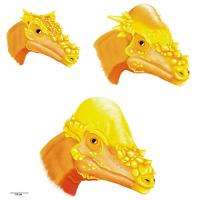
(PhysOrg.com) -- Paleontologists from the University of California, Berkeley, and the Museum of the Rockies have wiped out two species of dome-headed dinosaur, one of them named three years ago - with great fanfare - after Hogwarts, the school attended by Harry Potter.
Their demise comes after a three-horned dinosaur, Torosaurus, was assigned to the dustbin of history last month at the Society of Vertebrate Paleontology meeting in the United Kingdom, the loss in recent years of quite a few duck-billed hadrosaurs and the probable disappearance of Nanotyrannus, a supposedly miniature Tyrannosaurus rex.
These dinosaurs were not separate species, as some paleontologists claim, but different growth stages of previously named dinosaurs, according to a new study. The confusion is traced to their bizarre head ornaments, ranging from shields and domes to horns and spikes, which changed dramatically with age and sexual maturity, making the heads of youngsters look very different from those of adults.
"Juveniles and adults of these dinosaurs look very, very different from adults, and literally may resemble a different species," said dinosaur expert Mark B. Goodwin, assistant director of UC Berkeley's Museum of Paleontology. "But some scientists are confusing morphological differences at different growth stages with characteristics that are taxonomically important. The result is an inflated number of dinosaurs in the late Cretaceous."
Goodwin and John "Jack" Horner of the Museum of the Rockies at Montana State University in Bozeman, are the authors of a new paper analyzing North American dome-headed dinosaurs that appeared this week in the public access online journal PLoS One.
Unlike the original dinosaur die-off at the end of the Cretaceous period 65 million years ago, this loss of species is the result of a sustained effort by paleontologists to collect a full range of dinosaur fossils - not just the big ones. Their work has provided dinosaur specimens of various ages, allowing computed tomography (CT) scans and tissue study of the growth stages of dinosaurs.
In fact, Horner suggests that one-third of all named dinosaur species may never have existed, but are merely different stages in the growth of other known dinosaurs.
"What we are seeing in the Hell Creek Formation in Montana suggests that we may be overextended by a third," Horner said, a "wild guess" that may hold true for the various horned dinosaurs recently discovered in Asia from the Cretaceous. "A lot of the dinosaurs that have been named recently fall into that category."
The new paper, published online Oct. 27, contains a thorough analysis of three of the four named dome-headed dinosaurs from North America, including Pachycephalosaurus wyomingensis, the first "thick-headed" dinosaur discovered. After that dinosaur's description in 1943, many speculated that male pachycephalosaurs used their bowling ball-like domes to head-butt one another like big-horn sheep, though Goodwin and Horner disproved that notion in 2004 after a thorough study of the tissue structure of the dome.
Many paleontologists now realize that the elaborate head ornaments of dinosaurs, from the huge bony shield and three horns of Triceratops to the coxcomb-like head gear of some hadrosaurs, were not for combat, but served the same purpose as feathers in birds: to distinguish between species and indicate sexual maturity.
"Dinosaurs, like birds and many mammals, retain neoteny, that is, they retain their juvenile characteristics for a long period of growth," Horner said, "which is a strong indicator that they were very social animals, grouping in flocks or herds with long periods of parental care."
These head ornaments, which probably had horny coverings of keratin that may have been brightly-colored as they are in many birds, started growing when these dinosaurs reached about half their adult size, and were remodeled as these dinosaurs matured, continuing to change shape even into adulthood and old age, according to the researchers.
In the new paper, Horner and Goodwin compared the bone structures of Pachycephalosaurus with that of a domeheaded dinosaur, Stygimoloch spinifer, discovered in Montana by UC Berkeley paleontologists in 1973, and a dragon-like skull discovered in South Dakota and named in 2006 as a new species, Dracorex hogwartsia.
With the help of CT scans and microscopic analysis of slices through the bones of Pachycephalosaurus and Stygimoloch, the team concluded that Stygimoloch, with its high, narrow dome, growing tissue and unfused skull bones, was probably a pachycephalosaur subadult, in a stage just before sexual maturity.
Dracorex is one of a kind, and thus unavailable for dissection, but morphological analysis indicates it is a juvenile that hasn't yet formed a dome, although the top of its skull shows thickening suggestive of an emerging dome.
"Dracorex's flat skull, nodules on the front end and small spikes on back, and thickened but undomed frontoparietal bone all confirm that, ontogenetically, it is a juvenile Pachycephalosaurus," Goodwin said.
Comparison of these skulls to other fossils in the hands of private collectors confirm the conclusions, they said. In all, they looked at 21 dome-headed dinosaur skulls and cranial elements from North America.
The key to this analysis, Horner said, was years of field work in Montana by his team and Goodwin's in search of fossils of all sizes.
"We have gone out in the Hell Creek Formation for 11 years doing nothing but collecting absolutely everything we could find, which is the kind of collecting that is required," he said. "If you think about Triceratops, people had collected for 100 years and still hadn't found any juveniles. And we went out and spent 11 years collecting everything, and we found all kinds of them."
"Early paleontologists recognized the distinction between adults and juveniles, but people have lost track of looking at ontogeny - how the individual develops - when they discover a new fossil," Goodwin said. "Dinosaurs are not mammals, and they don't grow like mammals."
In fact, the so-called metaplastic bone on the heads of horned dinosaurs grows and dissolves, or resorbs, throughout life like no other bone, Horner said, and is reminiscent of the growth and loss of horns today in elk and deer. In earlier studies, Horner and Goodwin found dramatic remodeling of metaplastic bone in Triceratops, which led to their subsequent focus on dome-headed dinosaurs.
"Metaplastic bones get long and shorten, as in Triceratops, where the horn orientation is backwards in juveniles and forward in adults," Horner said. Even in older specimens, such as the fossil previously named Torosaurus, bone in the face shield resorbs to create holes along the margin. John Scannella, Horner's student at Montana State, presented a paper reclassifying Torosaurus as an old Triceratops at the Society for Vertebrate Paleontology meeting in Bristol, U.K., on Sept. 25.
"In order for that huge amount of bone to move, there has to be a lot of deposition and resorption," Horner said.
Horner and Goodwin continue to search for dinosaur fossils in the Hell Creek Formation, which is rich in Triceratops, dome-headed dinosaurs, hadrosaurs and tyrannosaurs. Analysis of growth stages in these taxa will have implications for other horned dinosaurs that are being uncovered in Asia and elsewhere.
"There are other horned dinosaurs I think may be over split," that is, split into too many new species rather than being lumped together as one species, Goodwin said.
Source: University of California - Berkeley (news : web)


